
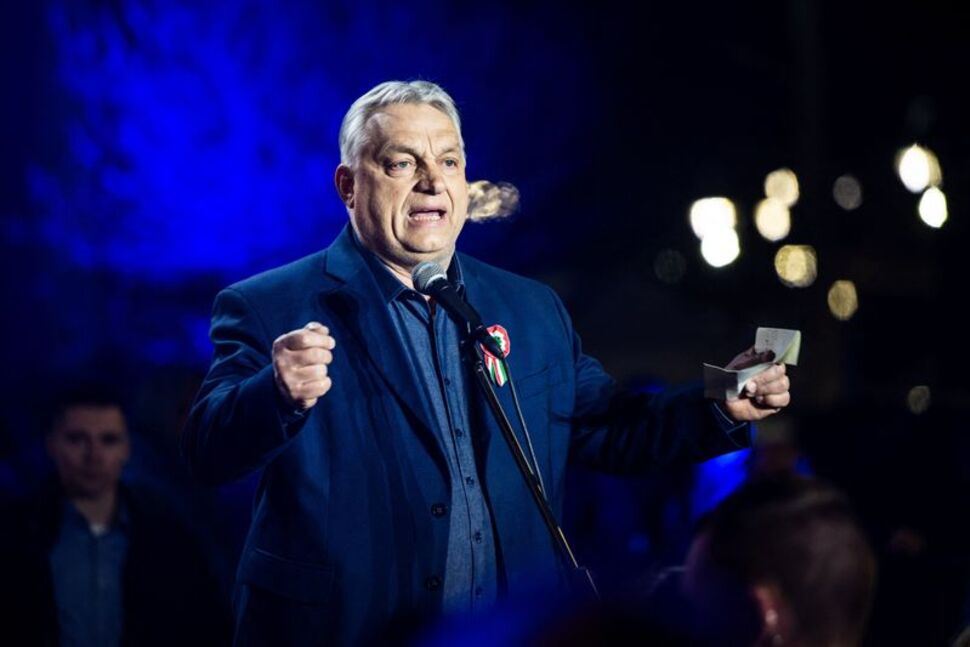
European Union leaders gathered in Brussels on Thursday for a summit dominated by a confrontation with Hungarian Prime Minister Viktor Orban, who has blocked a 90-billion-euro ($103 billion) emergency loan to Ukraine three months after personally endorsing it — a reversal that has left Kyiv facing a potential financial crisis within weeks and forced a reckoning over the limits of EU decision-making when a single member chooses to defect.
Orban traveled to Brussels making clear he had not shifted his position. “We are going to Brussels, where we will have to fight a fierce battle because the Europeans want to give the Ukrainians a 90-billion-euro loan, which we will not agree to until we get what we are owed,” he said in a video address to Hungarians broadcast on state television on the eve of the summit.
His condition is unambiguous and has not changed since he invoked his veto in mid-February: Russian oil must resume flowing through the Druzhba pipeline, which crosses Ukrainian territory, before Hungary will allow the loan to proceed. “No oil deliveries? No money. It’s that simple,” he posted on X on Tuesday.
The loan was agreed unanimously by all 27 EU member states at a December summit in Brussels and was designed to cover two-thirds of Ukraine’s combined military and economic financing needs for 2026 and 2027. Orban had secured a full opt-out from bearing any share of the joint borrowing costs, along with Slovakia and the Czech Republic — a concession intended to bring all three dissenting states on board without forcing them to contribute financially. The assumption was that removing Budapest from the cost structure would neutralize its objection. Instead, Orban vetoed the loan’s implementation in mid-February in what diplomats described as an unprecedented reversal — the first time he has openly broken a deal concluded at the European Council’s highest level.
“It’s absolutely unacceptable that a deal agreed by leaders in December is taken hostage with unrelated conditions, and that sets a dangerous precedent,” a senior EU diplomat told reporters ahead of the summit, describing the veto as “a turning point” in Orban’s behavior within the bloc.
The pipeline at the center of the standoff, the Druzhba system, stopped carrying Russian crude to Slovakia and Hungary on January 27 after what Ukraine has described as a Russian drone strike on the section of the line running through Ukrainian territory. Orban has consistently rejected that explanation. He has accused Zelenskyy of deliberately blocking oil supplies for political reasons and said he does not believe the Ukrainian president’s assurances that the pipeline can be repaired. “If Zelenskyy wants to get his money from Brussels, he needs to open the Druzhba pipeline,” he said this week.
A diplomatic opening materialized Tuesday when Zelenskyy agreed to allow an external European Commission inspection team into Ukraine to assess the damaged section and help coordinate a repair process with EU technical and financial backing. Von der Leyen and European Council President Antonio Costa announced Brussels would provide financial, technical, and expert assistance for the repair work. Zelenskyy stated it would take between one and six weeks to restore flows, and that Ukraine was also prepared to seek alternative routes for delivering non-Russian oil to Central European customers. Budapest’s response was immediate and dismissive.
Read Also: Ukraine Retakes 400km² As Russia Bombs Sloviansk, Talks Stall
Hungarian officials declared the proposals from Brussels and Kyiv “completely untenable,” reiterating their position that the pipeline was already physically and technically operational and that Ukraine was blocking supplies for purely political reasons.
Hungarian Foreign Minister Peter Szijjarto went further at an EU foreign ministers meeting, stating that as long as the oil blockade continued, Hungary would oppose not only the Ukraine loan but also the EU’s 20th package of sanctions against Russia. The threat to withhold consent on Russia sanctions represents an escalation of Budapest’s leverage, given that EU sanctions require unanimity to pass and are typically renewed every six months.
Ukraine’s financial situation lends urgency to the standoff that EU leaders are not willing to minimize. Kyiv received $5.3 billion from international partners in the first two months of 2026, and a recent $1.5-billion IMF disbursement and front-loaded Japanese financing will extend the country’s budget liquidity through the end of spring. But a senior Ukrainian official, speaking to the Kyiv Independent on condition of anonymity, said there was no “reliable alternative option” beyond that window unless the European funds begin flowing. Officials from Brussels and Kyiv have been meeting twice a week to plan for the arrival of the first tranche in April.
A consortium of Nordic and Baltic countries has been discussed as a potential source of bridge financing. However, EU officials have expressed concern that actively planning alternatives to the loan would amount to accepting and normalizing Hungary’s blockade as a legitimate instrument of policy — a precedent other member states with grievances might be tempted to replicate.
The political backdrop in Budapest is impossible to separate from Orban’s calculations. He is trailing in polls ahead of Hungary’s parliamentary election on April 12, and his campaign has centered on portraying both Zelenskyy and the EU establishment as colluding against Hungary’s interests. His framing of the loan dispute as a case of Brussels and Kyiv weaponizing energy policy against ordinary Hungarians has resonated with a segment of the electorate, even as other EU leaders have characterized it as a deliberate attempt to hold Ukraine’s survival hostage to domestic electoral considerations.
Read Also: Zelensky Warns US Russia Oil Waiver Funds War Against Ukraine
Cypriot President Nikos Christodoulides, speaking at a Brussels think tank event on Wednesday, expressed what several leaders present at the summit have said privately.
“In December, we took a political decision — a political decision at the level of the European Council. Now is the time to deliver,” he said. “I don’t want to think of a scenario where the European Union decides something at the level of 27 leaders, and this political decision is not implemented.”
The summit’s agenda is further compressed by the broader geopolitical emergency surrounding it. EU leaders are also expected to discuss the ongoing U.S.-Israeli war against Iran, the energy price shock it has generated across European economies, and competing positions within the bloc over the future of the EU Emissions Trading System. The Iran conflict has added an additional layer of pressure on Kyiv’s finances by absorbing Western diplomatic bandwidth and complicating the international financial environment in which Ukraine is seeking support.
No agreement between Orban and the remaining 26 members had been reached as of Thursday morning, and diplomats arriving at the summit acknowledged that a breakthrough before Hungary’s April 12 election was unlikely. Zelenskyy was scheduled to address the summit via video conference.
EU officials have declined to specify what formal steps, if any, the bloc would consider if Orban maintains his veto beyond the spring window, when Ukraine’s budget reserves are projected to run out.