
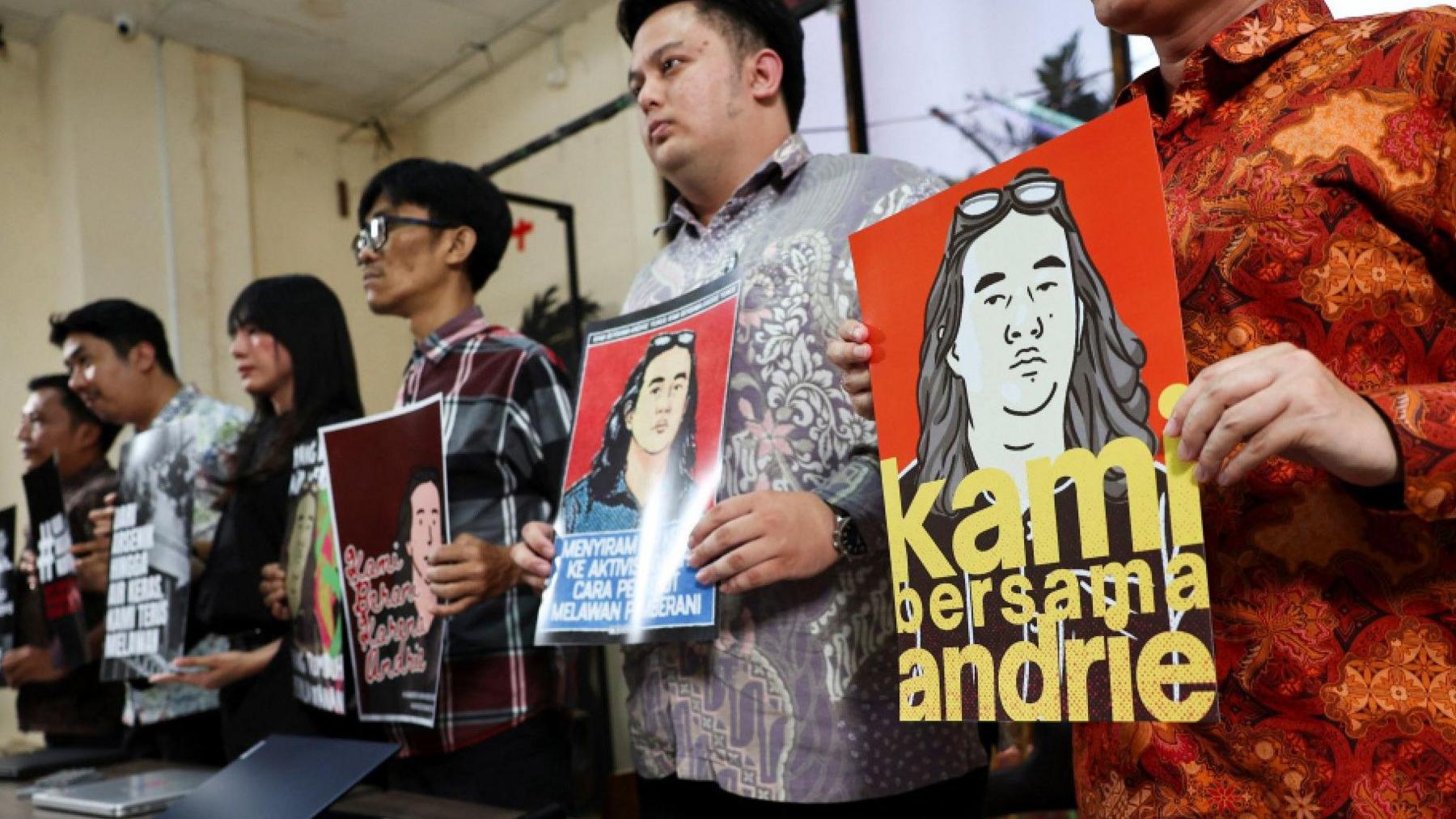
Indonesian military authorities have detained four soldiers from the country’s military intelligence agency in connection with an acid attack on a prominent human rights defender who had publicly opposed the military’s expanding role in civilian governance — an arrest that has triggered immediate accusations from civil society groups that the military is attempting to control and contain an investigation that implicates its own institutional culture.
The attack occurred at approximately 11:37 p.m. on March 12 as Andrie Yunus, Deputy External Affairs Coordinator at KontraS — the Commission for Missing Persons and Victims of Violence — was riding his motorcycle home along Jalan Salemba I–Talang in Central Jakarta.
Two unidentified men on a separate motorcycle pulled alongside him and threw a corrosive liquid at him, causing severe burns to his face, neck, chest, back, and both arms, as well as vision impairment to his right eye. Medical reports confirmed burns covering 24 percent of his body. None of his belongings were taken during the attack, which KontraS said indicated robbery was not the motive.
The four detained soldiers are members of BAIS — the Indonesian Armed Forces Strategic Intelligence Agency — and have been held at the Military Police Command in Jakarta since early Wednesday morning, March 18.
Military police commander Yusri Nuryanto confirmed the detentions and said the motive for the attack remained under investigation. The announcement, however, quickly generated controversy rather than confidence.
The Jakarta Metropolitan Regional Police had identified two attackers with the initials BHC and MAK and displayed their photographs at a separate press conference at the South Jakarta Regional Police Headquarters on the same day — findings that civil society groups said the military’s parallel announcement appeared designed to complicate and overshadow.
Hendardi, chairperson of the SETARA Institute’s National Council, accused the Indonesian Military, known by its acronym TNI, of having “sabotaged and interrupted” the national police’s law enforcement process through the narrative conveyed in the TNI’s press conference. The TNI Military Police subsequently confirmed that the case involving the four detained soldiers would be handled in military court under the 2025 TNI Law rather than in civilian courts — a jurisdictional arrangement that rights groups have said raises serious questions about accountability and transparency.
Alghifari Aqsa, a lawyer representing Yunus, raised further concerns about the investigation’s independence.
“We want authorities to find the masterminds and the people who fund this operation,” he said, urging the government to form an independent fact-finding team to reveal what he called “the big operation” behind the attack.
The broader context surrounding the attack has reinforced civil society’s alarm. Yunus had recorded a podcast titled “Remilitarism and Judicial Review in Indonesia” at the offices of the Indonesian Legal Aid Foundation in Central Jakarta on the evening of March 12, concluding at approximately 11:00 p.m. The attack came 37 minutes later, directly on his route home. KontraS stated that the perpetrators appeared to have selected the precise time and location of the attack immediately after his public engagement on military expansion — a pattern the organization said indicated the assault was premeditated.
Read Also: Indonesia Landfill Collapse Kills Four, Five Still Missing
Between March 9 and 12, Yunus received threatening phone calls from eight unknown numbers, a pattern his colleagues at KontraS described as systematic efforts to spread fear among rights defenders in the days before the assault. Since March 2025, KontraS’s Jakarta office had been surveilled by unidentified individuals on multiple occasions, and army vehicles had been observed stopping outside the premises and photographing the building.
Yunus had been among the most vocal critics of a revision to Indonesia’s military law, passed in March 2025, that significantly expanded the TNI’s authority to place active military officers in civilian government positions — a change human rights organizations said weakened constitutional checks on military power and reversed gains made since the fall of Suharto’s authoritarian New Order regime in 1998.
On March 20, 2025, the Indonesian parliament unanimously adopted the amendments in a session with virtually no public consultation. Yunus had led a group of activists in storming a closed-door legislative meeting to protest the bill before it was passed.
Earlier on March 12, hours before the acid attack, Yunus had attended a meeting to review a fact-finding commission report on the mass arrests of students and activists during the August 2025 protests — the most turbulent period of President Prabowo Subianto’s tenure. Police arrested 6,719 people nationwide during those protests, which erupted over low wages and lawmakers’ perks.
International and domestic responses were immediate and forceful. United Nations High Commissioner for Human Rights Volker Türk said he was “deeply concerned” by the attack and called on those responsible to be held to account. Indonesia’s National Commission on Human Rights, Komnas HAM, described the attack as a violation of the constitutional right to security and called for a formal investigation, witness and victim protection for Yunus, and support for his medical rehabilitation. Amnesty International, Climate Rights International, and Front Line Defenders each issued statements condemning the assault and demanding independent investigations that extend to identifying whoever ordered the attack, not only those who carried it out.
President Prabowo Subianto, a retired Army general who served as defense minister before being elected president, has not addressed the calls for an independent investigation publicly.
Read Also: Indonesia To Repatriate 3,600 Citizens From Cambodia
A presidential spokesperson said Tuesday that Prabowo had ordered an “objective, open and expeditious investigation” without providing further details. Human rights organizations have noted that the attack on Yunus coincides with a broader pattern of restrictions on civil society under Prabowo’s administration, including an academic manuscript released in January 2026 by the Ministry of Law justifying the development of a bill aimed at combating disinformation and foreign propaganda — legislation that advocates say would be used to suppress dissent.
Police have collected 86 pieces of CCTV footage from around the attack site and have indicated that the number of individuals involved in the operation may exceed four.
A joint police-military investigative team has been formed, though the separate jurisdictional tracks — military court for the soldiers, civilian court for the named civilian suspects — remain a point of contention among civil society organizations demanding unified accountability. No senior official or commanding officer has been named as a suspect, and no individual has been publicly charged as of Thursday.