
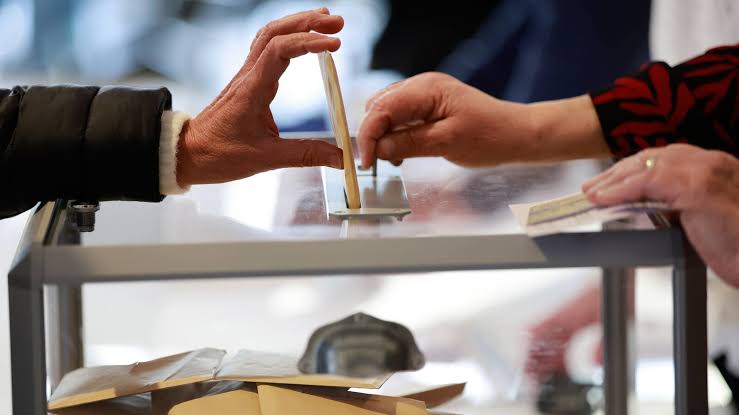
French voters returned to the polls Sunday for the second round of municipal elections across more than 1,500 cities and towns, with the race to control Marseille, the country’s second-largest city, emerging as the pivotal contest of an election cycle that will be read across Europe as a gauge of the National Rally’s capacity to break into major urban centers, less than 13 months before France’s next presidential election.
In both Paris and Marseille the race is neck and neck, with the far right potentially poised to take Marseille, which would be the largest city ever won by the National Rally at municipal level. Polls closed at 8 p.m. in France’s largest cities and preliminary results were expected shortly after that hour, with final projections anticipated through the evening.
The Marseille contest, which first-round results in March 15 showed could be decided by a fraction of the vote, pits incumbent Socialist mayor Benoît Payan against National Rally candidate Franck Allisio in a race whose dynamics shifted decisively between rounds.
Payan narrowly led the first round with 36.7 percent against Allisio’s 35 percent, with LFI candidate Sébastien Delogu on 11.94 percent and conservative Martine Vassal on 12.41 percent both qualifying for the second round. The week between rounds then produced the decision that most significantly shaped Sunday’s outcome: Delogu withdrew from the second round citing concern that a split left-wing vote would hand the city to the RN, effectively consolidating left-leaning support behind Payan in a race where every percentage point carried decisive weight.
Whether that consolidation proved sufficient to hold off Allisio — who had campaigned on a message of urban decline and a demand for change after years of Socialist management — was the question French politics was waiting for the evening to answer.
A Marseille victory for the National Rally would represent a qualitative escalation in the party’s territorial presence. The first round confirmed that several RN mayors were re-elected outright and that the party was leading in smaller southern cities including Nîmes and Toulon, where it has established itself as the dominant force over the past decade.
Taking France’s second city — a Mediterranean port of more than 900,000 people, historically complex, economically strained, and politically competitive — would mark a different order of achievement entirely, and party leader Jordan Bardella and Marine Le Pen had each invested personal campaign time in the city during the final weeks.
Read Also: Europe Rejects Trump’s Hormuz Naval Coalition, Warns On NATO
The RN’s first-round performance nationally showed the party had roughly doubled its footprint at municipal level compared with 2020: more than 500 far-right candidate lists won at least 10 percent of the vote in the first round, compared with around 250 in 2020, and the RN and its allies finished first in at least 75 communes, compared with just 11 six years ago.
The party’s growth, however, remained concentrated in towns with fewer than 10,000 residents, revealing a structural ceiling that Marseille, if captured Sunday, would crack for the first time.
In Paris, where the left has governed continuously since 2001, the second round produced a three-way competition of a different character. Socialist candidate Emmanuel Grégoire led the first round with approximately 38 percent of the vote — more than 12 points ahead of conservative Rachida Dati on 25.5 percent. That lead, however, was complicated by the fragmentation of the left: Grégoire refused to merge his list with that of LFI candidate Sophia Chikirou, meaning both ran separately in the second round, while a smaller conservative list withdrew and endorsed Dati in a deliberate effort to consolidate right-of-center voters against the left.
The Paris election also introduced a structural novelty. A 2025 electoral reform changed the voting system in Paris, Lyon, and Marseille, requiring voters for the first time to cast two separate ballots — one for the arrondissement council and one for the Council of Paris. The Council of Paris, once seated, elects the mayor in a subsequent vote among its members, meaning Sunday’s popular vote determines the council’s composition and political balance rather than selecting the mayor directly.
Read Also: France Presses Lebanon Peace Plan As Israel Rejects Demand
The broader picture emerging from the first round extended beyond the RN’s performance. France Unbowed made significant advances in urban constituencies with large working-class and young voter populations, finishing strongly in cities including Roubaix, Saint-Denis, and several arrondissements of Lyon and Toulouse — a performance that party coordinator Manuel Bompard said placed LFI in “hundreds” of second-round contests and confirmed the movement’s growing capacity in municipal rather than only national elections.
The Socialist Party recorded strong performances in major urban centers, while the conservatives held their own in other parts of the country, including an outright first-round victory for former Prime Minister Édouard Philippe in Le Havre.
President Emmanuel Macron’s centrist Horizons-Renaissance bloc continued to struggle to find independent footing in a municipal landscape where local identities, factional histories, and bloc politics leave limited space for a political center increasingly defined in national terms by the president’s declining approval ratings.
The election is being watched as an indicator of the alliance patterns and party strengths that will define the landscape heading into the April 2027 presidential election — though analysts have cautioned that municipal contests, driven heavily by local issues and individual candidacies, are imperfect predictors of national voting intention.
Turnout in the first round was estimated at around 56 percent — higher than the 2020 elections, which took place during the early weeks of the COVID-19 pandemic, but below the levels recorded in 2014.
Interior Ministry figures showed midday turnout in the second round at 20.3 percent, approximately one percentage point above the equivalent figure from the first round — a marginal increase that analysts said was consistent with heightened engagement in the cities where races were closest.
Results from across France’s 35,000 communes were expected to trickle in through the evening, with the major city outcomes likely confirmed before midnight.