
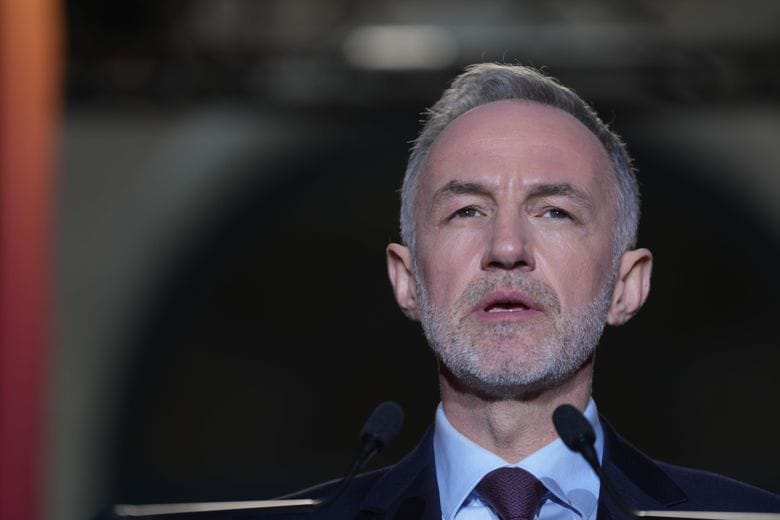
France’s Socialist Party claimed the most symbolic prize in French municipal politics on Sunday as Emmanuel Grégoire won the Paris mayoralty, while the far-right National Rally fell short of breakthrough victories in Marseille and Toulon despite posting what its own leader called the strongest local election result in the party’s history.
Grégoire, a 48-year-old former deputy to outgoing mayor Anne Hidalgo, led a broad left coalition uniting Socialists, Greens and Communists to an estimated 51 to 53 percent of the vote in the capital, according to exit polls, defeating Conservative challenger Rachida Dati, who conceded.
The son of a teacher and civil servant had campaigned on a promise to make Paris a “city of refuge” and a “bastion against the right and the far right” — language that framed the local contest as a national referendum on the direction of French politics.
Sunday’s run-off votes across more than 1,500 communes produced a map that offered both camps reasons to claim momentum heading toward the 2027 presidential election, with the traditional left and right consolidating their urban strongholds while the National Rally expanded its footprint in smaller towns and secured a landmark win in Nice, France’s fifth-largest city.
In Marseille, incumbent Socialist Mayor Benoît Payan was on course for re-election with 56.3 percent of the vote, according to an Elabe poll for BFM TV, a result that owed something to tactical maneuvering. A hard-left France Unbowed candidate withdrew before the second round to consolidate the anti-RN vote — a calculated sacrifice that appeared to have done its work. The RN’s bid to take France’s second-largest city, long one of the party’s most coveted targets, fell flat.
Toulon told a similar story. Centre-right candidate Josée Massi led with 53.5 percent in an Elabe poll, and RN candidate Laure Lavalette conceded defeat in a southern Mediterranean city the party had hoped to add to its column. Two of the three big southern cities the National Rally had identified as winnable held against it.
Read also: France Holds Runoffs As Far Right Eyes Marseille
Nice did not. Exit polls indicated that Éric Ciotti, a former mainstream conservative who has aligned himself with the RN, won in the Riviera city — a result that the party’s leadership cited as evidence of genuine expansion into territory where it had previously lacked the credibility to win.
RN chief Jordan Bardella rejected any suggestion that the night represented a ceiling on the party’s ambitions, framing losses in Marseille and Toulon as secondary to a broader pattern of gains.
“The National Rally and its candidates have achieved tonight, in this municipal election, the biggest breakthrough in its entire history,” Bardella said, pointing to victories in local constituencies where the party had previously held no presence. The argument — that the headline losses obscure structural progress — will define how the RN pitches itself to voters in the months ahead.
The first round had already delivered the party a re-election in Perpignan, the southern city the RN has held since 2020 and which has served as its laboratory for governing at the local level. Sunday extended the pattern of wins in smaller towns and communes, even as the three major southern cities it needed to demonstrate governing capacity at scale largely held against it.
The night produced a notable subplot in Le Havre, where former Prime Minister Édouard Philippe was re-elected mayor by a margin that exceeded expectations. Philippe, a centre-right politician who served under centrist President Emmanuel Macron, used his victory speech to deliver a message that was unmistakably national in register.
Read more: UK Minister Says No Assessment Iran Could Strike London
His result showed, he said, that “there were reasons to be hopeful” in French values and that the extremes can be beaten — the language of a man testing whether a local platform can carry a presidential candidacy into 2027.
Philippe has been among the most closely watched figures in French politics as the next presidential cycle begins to take shape.
A stronger-than-expected performance in a working-class northern port city, in an election where turnout was higher than the COVID-era 2020 vote, gives him a genuine argument to make.
Turnout across mainland France reached just above 48 percent by early evening, surpassing the 2020 municipal vote held during the pandemic but running four points below the 2014 figure — a pattern that suggests persistent but not catastrophic civic disengagement.
Socialist Party leader Olivier Faure drew the broadest conclusion from Paris and Marseille, positioning his party as the one force capable of holding the line against the far right. “Only the left can prevent France from this regression,” he said — a framing that subsumes the Greens, Communists and tactical withdrawals into a single narrative of left-wing necessity.
Whether Sunday’s results settle anything about 2027 is doubtful. Municipal elections reward local incumbency, neighbourhood networks and the accumulated goodwill of years in office. Presidential elections are fought on different terrain, on national anxieties and the particular chemistry of individual candidacies. What Sunday showed is that French cities, at least, are not yet ready to be won by the National Rally at scale. What that means when the country votes for its next president remains, for now, an open question.