
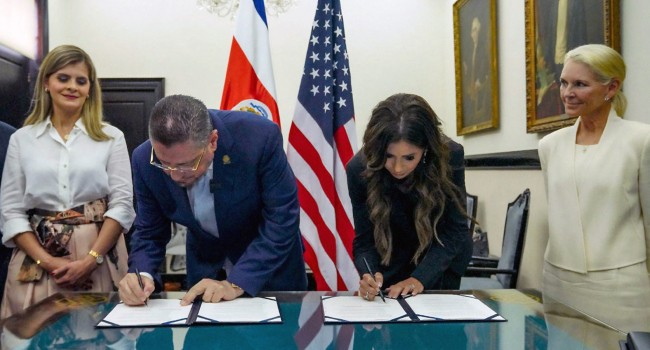
Washington and San José formalised a deportation deal on Monday that will allow the United States to send up to 25 people at a time to Costa Rica — migrants who are not necessarily Costa Rican, deposited on Central American soil as part of the machinery of President Donald Trump’s immigration crackdown, which has been grinding through lives and legal challenges since January 2025.
Kristi Noem put her name to the agreement alongside Costa Rican President Rodrigo Chaves and his successor Laura Fernandez, who takes office on May 8. The optics were deliberate — two administrations, one outgoing and one incoming, both signing. A show of continuity. A signal that this arrangement would not dissolve the moment the presidential sash changed shoulders.
Chaves was careful with his words, the way politicians learn to be when they are doing something their constituents might have feelings about. “It’s a voluntary agreement,” he said, adding that “under this protocol we can reject anyone, not accept specific nationalities, while collaborating within the human rights framework of our country.” The kind of statement designed to face in two directions simultaneously — reassuring Washington that the deal holds, reassuring Costa Ricans that the country has not simply become America’s waiting room.
These are the calculations small nations make. The arithmetic of proximity to power.
Noem herself is in the middle of a transition. Trump announced earlier this month that she would leave her role as DHS secretary to become special envoy to the “Shield of the Americas” — a coalition of 17 Latin American nations assembled around the shared project of countering cartels, or at least being seen to. The woman who spent more than a year as one of the most visible faces of the administration’s immigration machinery is being redeployed, her hard edges and her willingness to stand in front of cameras at border facilities now useful in a different configuration.
Her replacement at DHS, Oklahoma senator Markwayne Mullin, was confirmed by the Senate on Monday — the same day the Costa Rica agreement was signed. The timing had a certain administrative tidiness to it. One door closes, another opens, the deportation flights continue.
Read also: EU Leaders Press Orban To Drop $103 Billion Ukraine Loan Veto
The “third country” deportation policy — sending migrants to countries they did not come from, places that owe them nothing and where they know no one — has been the most contested element of the broader crackdown. Courts have pushed back. International human rights organisations have documented what they describe as violations embedded in the policy’s logic and implementation. El Salvador and Panama have already agreed to receive deportees under similar arrangements. Costa Rica joins that list, smaller and quieter and more diplomatically cautious than its neighbours, but on the list nonetheless.
There is something to sit with in the phrase “third country deportation.” It is the language of logistics, of processing, of movement managed at scale. But each person moved is not a unit in a processing system. They are somebody’s person — somebody’s parent, somebody’s child, the one who was supposed to make it. The one the family prayed over before the journey, whose name was spoken carefully in the night, whose success or failure would ripple backwards through everything everyone had sacrificed to get them to the door of the chance.
Washington does not write about them that way. Washington writes memoranda and bilateral protocols and signed agreements with friendly governments who need the relationship more than they need to say no.
Costa Rica has positioned itself, over decades, as the decent one in a difficult neighbourhood — no standing army, high literacy rates, the kind of stable democratic governance that earns it a different quality of international attention than its neighbours manage. Chaves knows this. His insistence on the voluntary nature of the agreement, on the right to refuse specific cases, on the human rights framework — these are the verbal fences a man builds around a decision he has already made, to protect the story he tells himself about what kind of country he leads.
The agreement covers up to 25 people per transfer. Not hundreds. Not the mass movements that clog the news cycles when the big operations happen. Twenty-five. A number small enough to be manageable, large enough to be meaningful, and precise enough to suggest that someone in a conference room somewhere negotiated it down from something larger.
Read more: Spain Withdraws Ambassador To Israel, Rift Deepens
Noem will move on to her new role. Mullin will settle into his. The coalition will hold meetings, issue statements, coordinate operations against cartels that have been coordinated against before and remained, adjust their routes, reconstitute in different configurations.
And somewhere, twenty-five people will land somewhere they did not plan to land, in a country that signed a voluntary agreement to receive them, carrying the weight of a journey that did not end where they needed it to.
The handshakes were warm. The cameras got their shots. The paperwork is in order.