
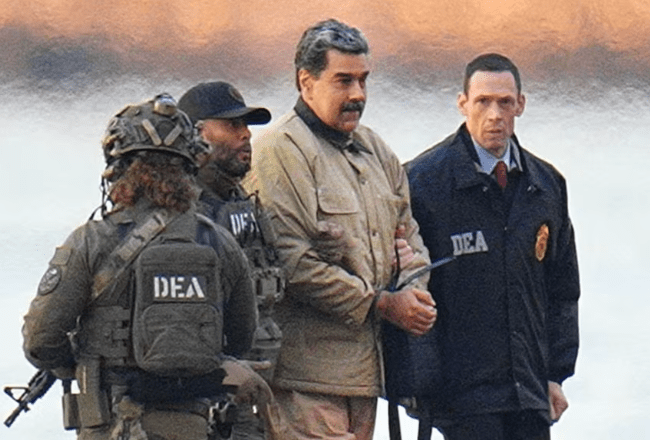
A federal judge in Manhattan declined Thursday to dismiss narco-terrorism charges against ousted Venezuelan President Nicolas Maduro but indicated that the Trump administration may have arbitrarily blocked Venezuela from paying his legal fees, setting up a decision that could determine whether the case can continue in its current form.
U.S. District Judge Alvin Hellerstein was unambiguous on the central question before him: “I’m not going to dismiss the case,” he told the court during the high-stakes hearing. He then introduced a significant caveat. While acknowledging that the government had the legal right to block the funds, Hellerstein suggested that the Treasury Department license permitting Venezuela to pay had been “arbitrarily withheld.” He told the court that Maduro’s lawyer could renew the dismissal request if he ultimately finds that the administration blocked the payments without adequate justification. “At this point, it’d be such a serious step based on hypotheticals, that I don’t think we should get into it now,” the judge said.
Maduro, 63, and his wife Cilia Flores, 69, appeared at the Daniel Patrick Moynihan federal courthouse in lower Manhattan wearing beige prison clothing, seated at the defense table with headphones for translation, occasionally passing notes to their attorneys. Neither has requested bail, and both remain in custody at the Metropolitan Detention Center in Brooklyn. Outside, police formed barriers between rival groups of demonstrators, one side holding a sign reading “Maduro rot in prison” and the other bearing placards demanding his release. In Caracas, several hundred people gathered in a public square, including ruling party supporters and state employees, to express solidarity with the detained couple.
The dispute at the center of Thursday’s proceedings was set in motion by a reversal from the Treasury Department’s Office of Foreign Assets Control. OFAC approved an arrangement on January 9 that would have permitted Venezuela to fund Maduro’s legal defense, then rescinded that authorization without explanation less than three hours later. Maduro’s attorney, Barry Pollack, who previously represented WikiLeaks founder Julian Assange, argued that the flip-flop violated Maduro’s Sixth Amendment right to counsel of his choosing. He and Flores’s lawyer filed a joint motion seeking outright dismissal of the indictments on constitutional grounds.
Read Also: Over 1,500 Venezuelan Political Prisoners Apply For Amnesty
Prosecutor Kyle Wirshba told the court that the initial OFAC authorization was an administrative error and that existing sanctions regulations expressly prohibit the use of funds controlled by a sanctioned government to cover the legal fees of a separately sanctioned individual. He accused Maduro and Flores of having “plundered the wealth of Venezuela” and said they retained access to personal funds in Venezuela that could, in principle, cover their legal costs. Pollack contested that characterization directly, filing a sworn declaration from Maduro stating he was “entitled to have the government of Venezuela pay for my legal defense” and asserting that neither defendant could afford private counsel from personal resources.
Hellerstein said he hoped to issue a ruling on the legal fees question promptly. “Thank you very much for excellent arguments,” he told the court at the hearing’s conclusion. “I hope to get this out as soon as I can.” If he finds that OFAC acted arbitrarily, Pollack would be permitted to bring the dismissal motion before him again. Should the judge instead uphold the administration’s position and OFAC declines to reverse course, Pollack has said he will withdraw from the case entirely, leaving Maduro and Flores eligible only for court-appointed public defenders.
The hearing opened against an additional complication introduced by the White House. Earlier Thursday morning, President Donald Trump told reporters at a Cabinet meeting that additional charges would be brought against Maduro, without specifying what they would cover or when they would be filed. The announcement added a new dimension of uncertainty to a case already freighted with unprecedented legal questions about the capture of a sitting foreign head of state on his own soil.
Maduro faces four counts in total: conspiracy to commit narco-terrorism, conspiracy to import cocaine, possession of machine guns and destructive devices, and a related weapons conspiracy charge. The narco-terrorism statute criminalizes drug trafficking conducted to finance activities the United States designates as terrorism. Legal experts have noted the statute has rarely been used at trial and that courts have historically been reluctant to override executive branch determinations on sanctions and national security grounds. “Because he is not recognized as the leader of Venezuela and the whole sanctions regime is meant to cut him off, it’s unlikely that the court is going to feel that he’s entitled to any of the money to help fund his criminal defense,” said attorney Ekaterina Levin, who follows sanctions law.
Read Also: Trump: US Gets 80m Barrels Venezuela Oil, Seizes 3rd Tanker
Maduro has maintained throughout that the charges are fabricated and designed to justify what he called U.S. ambitions to control Venezuela’s oil sector. His dismissal of the allegations was entered into the court record through a sworn written declaration. In Caracas, his ruling party issued a statement calling for the defense of his “legitimate rights” and condemning the January 3 operation.
No trial date has been set. Hellerstein’s forthcoming written ruling on the legal fees question is the next scheduled step in the case.