
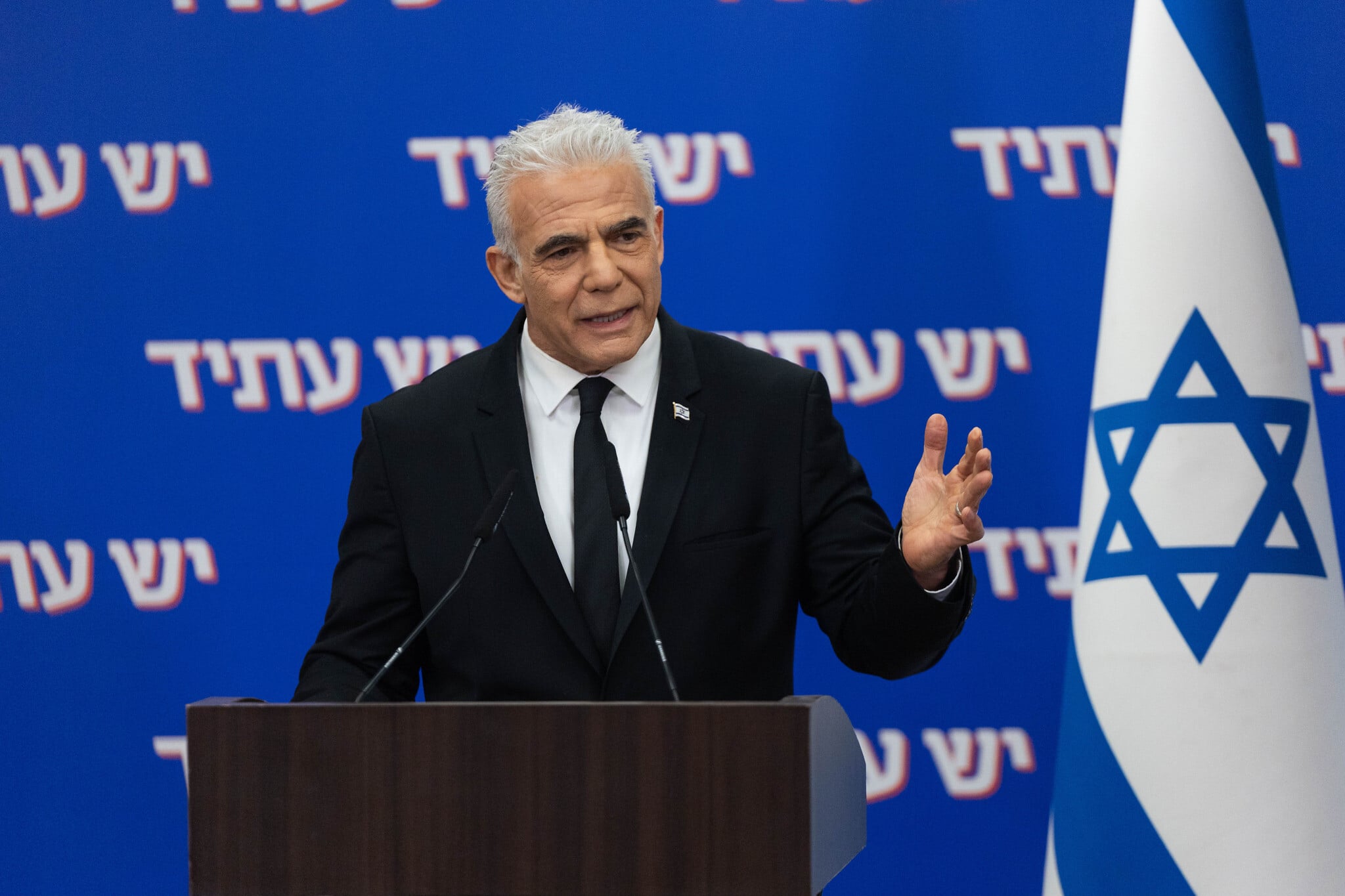
Israel’s opposition leader Yair Lapid declared Thursday that the country’s military is heading toward a catastrophic breakdown, publicly endorsing a confidential warning from the army’s own chief of staff that the Israel Defense Forces were on the verge of collapse under the strain of simultaneous wars on four fronts, and demanding the government immediately draft ultra-Orthodox men who have evaded compulsory service.
IDF Chief of Staff Lieutenant General Eyal Zamir told the security cabinet Wednesday night that he was “raising 10 red flags,” warning that the army could soon “collapse in on itself” under mounting operational demands and a deepening manpower shortage.
“The IDF now needs a conscription law, a reserve duty law, and a law to extend mandatory service,” he reportedly told ministers. “Before long, the IDF will not be ready for its routine missions and the reserve system will not hold.”
Lapid, speaking at a press conference, said the leaked account confirmed his most serious concerns about the government’s management of the conflict.
“The chief of staff laid out before the cabinet a whole series of threats, most of which cannot be detailed on camera, but the bottom line is this: the government is sending the army into a multi-front war without a strategy, without sufficient resources, and with too few soldiers,” he said. He added that the army was struggling with reservists completing sixth and seventh rotations. “These reservists are worn out and exhausted and can no longer meet our security challenges,” Lapid said. “The army does not have enough soldiers for its missions.”
Read Also: Netanyahu Proclaims Dominance As Iran Gets Pummeled
Lapid said this was the most severe military warning he had heard in 13 years of participation in Israeli security cabinets and sensitive security forums. He told reporters that Prime Minister Benjamin Netanyahu would not be able to claim ignorance: “This time, the government will not be able to say, ‘I didn’t know.’ This is the chief of staff they appointed.”
Military spokesman Brigadier General Effie Defrin acknowledged the manpower shortfall in a televised briefing the same day. “More combat soldiers are needed” across multiple fronts, he said, naming Lebanon, the occupied West Bank, Gaza, and Syria as areas of demand. The Lebanese front has become the most acute pressure point. Israel declared this week that its forces would establish a defensive buffer zone extending up to the Litani River, approximately 30 kilometers from the border, and has deployed additional divisions to southern Lebanon to pursue that objective. Defense Minister Israel Katz said the IDF would maintain control of the zone until the threat from Hezbollah was fully removed, and that hundreds of thousands of Lebanese civilians who had fled northward would not be permitted to return south of the Litani until security for northern Israeli communities was ensured.
Hezbollah has resisted the advance. The group fired more than 100 rockets at Israel on Thursday, setting off sirens across the Haifa area. Sergeant Aviaad Volansky was killed in southern Lebanon, with four other soldiers wounded in the same engagement. A civilian was killed by an antitank missile fired from Lebanon that struck the northern Israeli city of Nahariya. The cumulative toll in Lebanon from Israeli operations has reached 1,116 dead, according to Lebanese health authorities, with Israeli strikes targeting Hezbollah’s fuel distribution network, weapons infrastructure, and command positions across the south and Beirut suburbs.
Lebanese Prime Minister Nawaf Salam has formally warned the United Nations of what he described as the risk of annexation of Lebanese territory south of the Litani River, a concern echoed by France’s foreign minister, who called on Israel to refrain from such ground operations, warning they would have “major humanitarian consequences.” Finance Minister Bezalel Smotrich suggested earlier this week that Israel should move its border northward to the Litani itself, a position that drew criticism from within Israel as well as internationally.
Read Also: Israel Opens Ground Push In Southern Lebanon
Lapid’s critique extended beyond battlefield management to the politically sensitive question of Haredi conscription. He called on the government to halt all funding for ultra-Orthodox draft evaders, deploy military police to pursue deserters, and compel the Haredi community’s enlistment without further delay. Military service is compulsory in Israel, but men who devote themselves to full-time religious study have been de facto exempt since the country’s founding, when the community was small. As the ultra-Orthodox population has grown into the hundreds of thousands, that exemption has become a major source of resentment among serving soldiers and their families during wartime.
Lapid also called on the government to strip authority from far-right National Security Minister Itamar Ben Gvir, saying the minister openly supports Jewish violence in the West Bank and that the government must address settler attacks with the same enforcement capability applied to other threats. Zamir reportedly raised the West Bank as an additional drain on military resources, telling the cabinet he was being forced to deploy more forces there as a result of escalating settler attacks on Palestinians.
Israeli forces continue to operate in Gaza, where more than 700 Palestinians have been killed since the October 2025 ceasefire took effect, according to Palestinian health authorities. No Israeli government response to Lapid’s statement or to the leaked Zamir remarks had been issued as of Friday morning.