
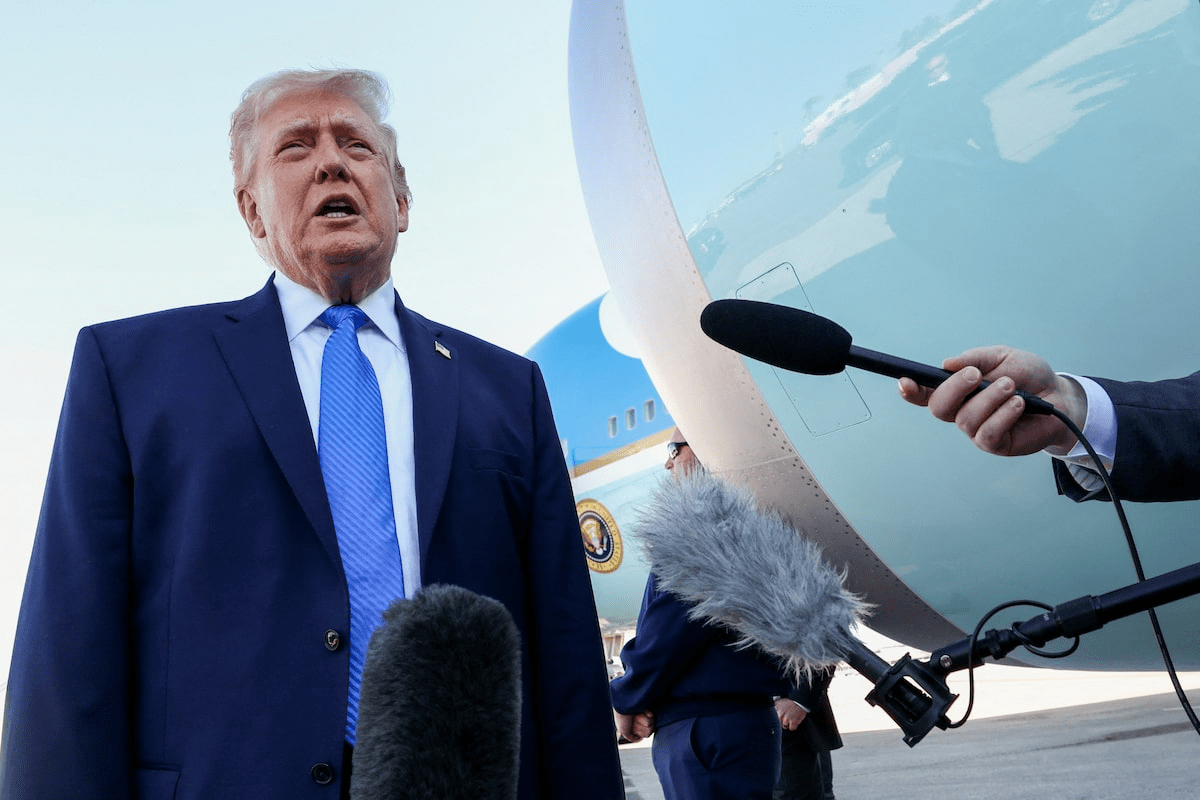
Donald Trump has given Iran ten more days to live with its power grid intact. The deadline he set Sunday — open the Strait of Hormuz within 48 hours or watch your energy infrastructure burn — has now been extended twice. The latest postponement, announced Thursday on Truth Social, pushes the threat to April 6 at 8 p.m. Eastern Time. Trump framed the pause as a concession to Iranian requests and cited progress in negotiations he described as going “very well” despite what he called false media reports to the contrary.
Iran says there are no negotiations.
This is the central contradiction sitting at the heart of the war’s 28th day: two governments describing the same reality in terms so incompatible that one of them must be lying, and possibly both are managing their domestic audiences in ways that happen to produce opposite public statements. Trump told his cabinet Thursday that Iran was “begging” for a deal. Tehran has threatened to escalate attacks across the region if its energy grid is struck. The White House says a 15-point ceasefire plan is being discussed. Iranian officials say they have rejected it and are not at the table.
“Of course, they’re negotiating,” Trump said Thursday. “They’ve been obliterated. Who wouldn’t negotiate?”
The question contains its own answer and its own problem. A country that has absorbed the scale of destruction Iran has absorbed in four weeks has every rational incentive to seek terms. It also has every political incentive to deny doing so, because the leadership that survives this war — whatever is left of it, however it is configured — cannot be seen capitulating to the country that launched the strikes. These two pressures do not resolve each other. They produce exactly the kind of contradictory public signals that have made the war’s diplomatic track almost impossible to read from the outside.
Read also: Judge Refuses To Dismiss Nicholas Maduro Narco-Terrorism Case
What is clear is the toll. An estimated 1,937 people have been killed in Iran. Thirteen American service members have died. Dozens more deaths have been reported across a Middle East that has been absorbing the conflict’s spillover — missile strikes on Gulf states, attacks on US bases in Iraq and Syria, Hezbollah rockets into northern Israel, Iranian interdiction of commercial shipping through the strait. The White House has maintained that victory is close. The war has not consulted that assessment.
The power grid threat has drawn its own category of concern, separate from the battlefield calculus. Legal experts characterised the initial US-Israeli attack on Iran as unprovoked aggression. The additional step of deliberately targeting civilian electricity infrastructure occupies even more contested legal ground. The Geneva Conventions prohibit attacks on civilian infrastructure when the foreseeable harm to civilians is disproportionate to any military advantage gained. The International Criminal Court has issued arrest warrants over Russian strikes on Ukrainian power systems — strikes Putin justified using precisely the “dual-use” logic that some analysts say Washington would deploy to defend similar action in Iran. Amnesty International called Trump’s power grid threat “a threat to commit war crimes” before the first extension was announced.
Trump has not withdrawn the threat. He has moved the date.
The Strait of Hormuz remains the lever through which Iran is applying maximum economic pressure on a world that did not choose this war but is paying for it in energy costs.
More than a fifth of global oil passes through its 34 miles. Traffic has ground largely to a halt under the threat of Iranian strikes on tankers. Oil is above $110 a barrel.
Read more: Iran Permits Tanker Passage Through Hormuz As “Goodwill” Present
The emergency reserve releases coordinated by the International Energy Agency — the largest in the agency’s history — have cushioned some of the blow without resolving the underlying blockage. France and Britain are quietly assembling a coalition for a post-war demining and escort mission that nobody can launch until the shooting stops and Iran agrees to let the ships through. Neither condition currently exists.
Trump said Thursday that the right deal from Tehran would result in the strait reopening. He did not specify what the right deal looks like, though reports of a 15-point American ceasefire plan suggest the contours exist somewhere in the back channels that both sides are publicly denying they are using. Reports have also surfaced suggesting the White House is weighing ground operations in Iran — a step that analysts across the political spectrum describe as an escalation with consequences that would dwarf everything the past four weeks have produced.
Ten days. April 6. The deadline is the message, whether or not the strikes ever happen.