
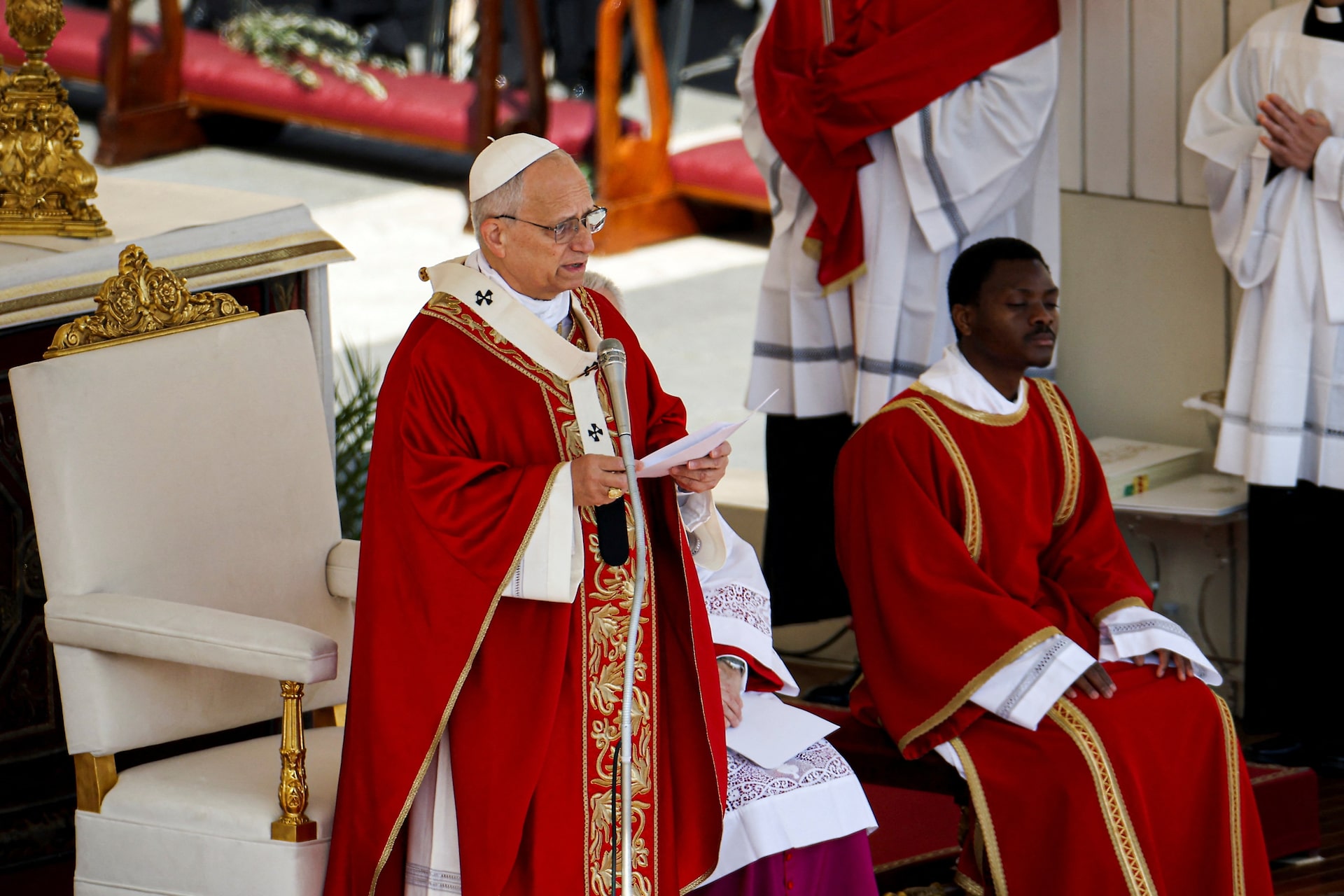
Pope Leo XIV delivered his sharpest public condemnation yet of the Iran war on Sunday, telling tens of thousands of people gathered in St. Peter’s Square for Palm Sunday Mass that God does not hear the prayers of those who wage war and rejects leaders whose hands are, as he put it, “full of blood,” in remarks widely interpreted as a direct challenge to the Christian framing being used by U.S. officials to justify the month-old conflict.
With the U.S.-Israeli war on Iran entering its second month and Russia’s campaign in Ukraine continuing, Leo dedicated his Palm Sunday homily to insisting that God is the “King of Peace” who rejects violence and comforts the oppressed.
“This is our God: Jesus, King of Peace, who rejects war, whom no one can use to justify war,” the pope told the crowd beneath brilliant sunshine. “(Jesus) does not listen to the prayers of those who wage war, but rejects them, saying: ‘Even though you make many prayers, I will not listen: your hands are full of blood,'” he added, citing the Book of Isaiah.
Leo named no individual leaders. He did not identify the United States or Israel by name. But the context and timing left the target of his remarks unmistakable to those present and to a global audience watching the address. The Iran war began on February 28 with joint U.S.-Israeli strikes on Iranian territory. Since then, senior American officials have repeatedly deployed religious language to frame the conflict. Defense Secretary Pete Hegseth, who has been conducting Christian prayer services at the Pentagon, prayed at one such session for what he described as “overwhelming violence of action against those who deserve no mercy.” Russia’s Orthodox Church has similarly justified Moscow’s invasion of Ukraine as a holy war against a West it characterizes as morally corrupt. The pope’s homily confronted each of those framings without engaging with them individually.
Read Also: Pope Leo XIV Calls For Ban On Aerial Bombardments
In the homily, Leo drew on the Gospel account of Jesus in the Garden of Gethsemane, moments before his arrest, rebuking a disciple who struck the ear of one of those who came to seize him. “He did not arm himself, or defend himself, or fight any war,” the pope said. “He revealed the gentle face of God, who always rejects violence. Rather than saving himself, he allowed himself to be nailed to the cross.”
At the close of the Mass, Leo addressed those he described as responsible for the conflict directly.
“On behalf of the Christians of the Middle East and all women and men of good will, I appeal to those responsible for this conflict. Cease fire so that avenues for dialogue may be reopened. Violence can never lead to the justice, stability, and peace that the people are waiting for.” He said he was close to the families of those killed in strikes that had hit schools, hospitals, and residential areas, and expressed particular concern for Christian communities in Lebanon, where Israeli operations have intensified.
Sunday’s address represented a notable escalation in tone from a pontiff who had, in the early weeks of the war, kept his public comments carefully measured. Since the conflict began, Leo had limited himself to appeals for diplomacy and dialogue, in what observers described as a deliberate effort to avoid positioning himself as a political counterweight to Trump. He had not named the United States or Israel publicly, in keeping with the Vatican’s tradition of diplomatic neutrality. But several of his senior cardinals moved ahead of him. Cardinal Robert McElroy, the Archbishop of Washington, said the war was morally unjustifiable.
Cardinal Blase Cupich of Chicago criticized the White House for embedding video game imagery into its social media coverage of the conflict. Vatican Secretary of State Cardinal Pietro Parolin rejected Washington’s characterization of the strikes as a preventive war, while saying the Holy See was maintaining dialogue with all parties.
When the war began on March 1, Leo had declared the world was “faced with the possibility of a tragedy of enormous proportions,” appealing to all parties to assume the moral responsibility of halting what he called a “spiral of violence before it becomes an irreparable abyss.” The language on Sunday went considerably further, invoking divine judgment against those who lead their nations into war.
Palm Sunday marks the beginning of Holy Week, the most sacred period in the Catholic liturgical calendar, commemorating Jesus’s entry into Jerusalem before his crucifixion and resurrection.
Read Also: Pope Leo Issues Strongest Ceasefire Demand, Targets War’s Authors
Leo is due to preside over the Holy Thursday foot-washing ceremony at the Basilica of St. John Lateran, the Good Friday Passion procession at the Colosseum, the Easter Vigil on Saturday night, and the Easter Sunday Mass in St. Peter’s Square, where he will deliver his traditional blessing to the city and to the world. Whether he will address the Iran war again at Easter Sunday’s address, which carries particular institutional weight, was not indicated by the Vatican as of Sunday evening.