
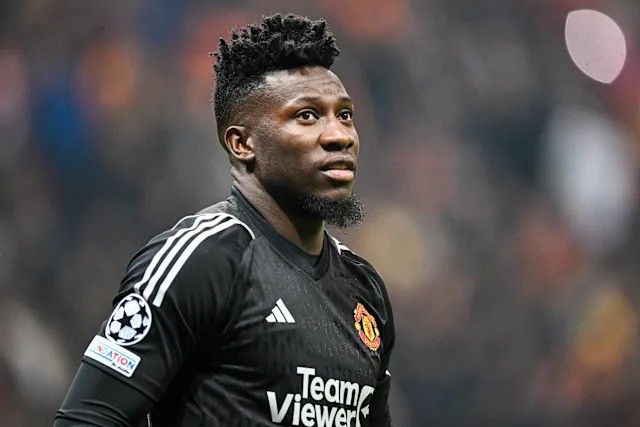
Manchester United may be approaching a familiar contractual dilemma as uncertainty grows around the future of André Onana, with internal concerns emerging over both his wage structure and market appeal ahead of the summer window.
The situation is complicated by performance-linked salary conditions embedded in Onana’s contract. Should Manchester United secure qualification for the UEFA Champions League, the goalkeeper’s wages are set to increase—effectively reversing the reduced salary arrangement currently in place. While such clauses are standard at elite clubs, in this case they introduce an additional layer of financial pressure at a time when United are actively assessing squad optimization.
Read Also: Haftar Obtains Combat Drones In Defiance Of UN Arms Ban
Onana is expected to return to Old Trafford at the end of the season, with no purchase clause attached to his current arrangement. That contractual reality removes any straightforward pathway to a permanent transfer, placing the burden back on United to determine his next role within the squad or facilitate another move.
However, generating concrete interest in the Cameroonian international is proving more complex than anticipated. Despite his pedigree and experience at the highest level, concerns persist among potential suitors regarding consistency and overall fit within differing tactical systems. These reservations have, according to reports, tempered what might otherwise have been a more competitive market for a goalkeeper of his profile.
Internally, this has prompted discussions about the possibility of subsidizing a portion of Onana’s wages to enable an exit. Such arrangements, while not uncommon among top European clubs managing high-earning players, are typically viewed as a last resort—reflecting a gap between a player’s contractual earnings and current market demand.
For United, the issue underscores a broader structural challenge tied to legacy contracts and evolving squad strategy. The club’s recent recruitment approach has increasingly emphasized financial sustainability and tactical alignment, yet situations like Onana’s highlight the lingering impact of earlier decisions made under different sporting and financial assumptions.
Read Also: India Converts LPG Import Crunch Into Piped Gas Push
From a sporting perspective, the uncertainty surrounding Onana’s future also raises questions about goalkeeping continuity. Stability in that position is often foundational to defensive organization, and prolonged ambiguity can complicate planning for the upcoming campaign.
The coming months will therefore be critical. United must balance financial pragmatism with squad coherence, determining whether to reintegrate André Onana into their long-term plans or pursue an exit strategy that may require financial compromise. Either outcome will reflect not only on the player’s trajectory but also on the club’s broader capacity to manage high-value assets in an increasingly competitive and scrutinized transfer market.