
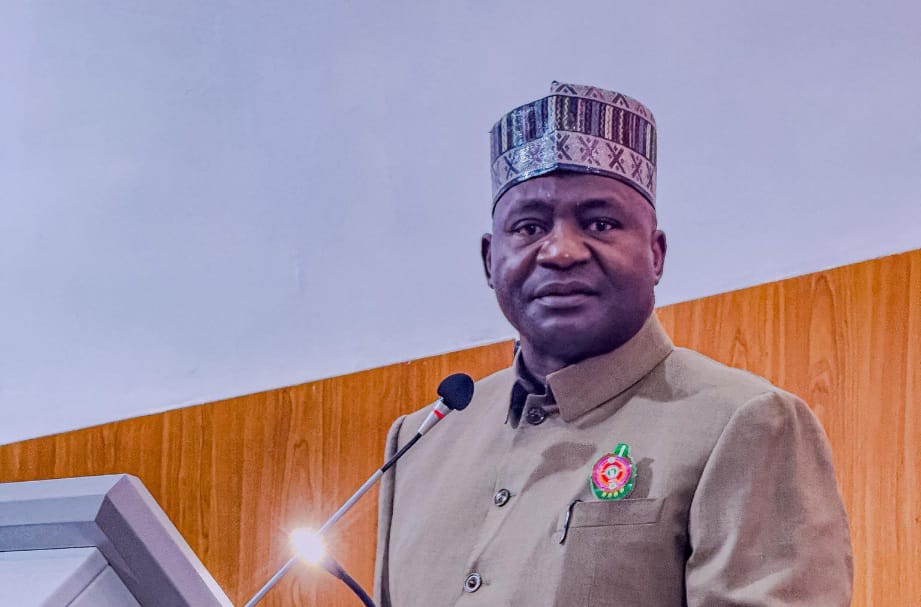
Nigeria’s defence chief has warned that surges in violence often coincide with the country’s political cycle, suggesting that election seasons can amplify insecurity as competing interests seek to shape public perception.
In an interview aired Tuesday, Christopher Musa said recent patterns indicate that attacks tend to rise when political activity intensifies, pointing to what he described as deliberate attempts to destabilise the environment and cast doubt on the government’s ability to maintain order.
He did not name specific actors. But the implication was clear, insecurity is not only a product of armed groups operating in isolation, but also of a broader ecosystem in which political motives, internal collaborators, and external backing intersect.
Musa framed Nigeria’s security challenges as part of a complex conflict against adversaries driven by ideology rather than conventional military logic. Fighters motivated by extremist beliefs, he said, are harder to deter because they view death as a reward rather than a risk.
That mindset, according to him, shifts the nature of the battlefield.
Conventional deterrence loses effectiveness when those carrying out attacks believe their actions carry spiritual or ideological justification. It also complicates intelligence gathering and response strategies, as such groups are less predictable and more willing to take high-risk actions.
The defence chief pointed to insider collaboration as one of the most damaging elements of the current security landscape.
Read also: Kwankwaso, Alleged Terror Financing & Implications For APC
Information leaks from within communities have repeatedly exposed troop positions and operational details, he said, allowing attackers to plan with precision. In some cases, individuals perceived as civilians have provided armed groups with real-time intelligence about the size and readiness of military units.
The consequences can be immediate.
Small detachments, he said, have found themselves facing overwhelming numbers after such information is passed on, with attackers mobilising in significantly larger groups based on inside knowledge. This imbalance has contributed to casualties and operational setbacks.
Musa described these networks as critical to sustaining attacks. Beyond intelligence, local collaborators may also assist with logistics, helping to move supplies, coordinate movements, or conceal weapons. That support structure, he suggested, gives armed groups an operational advantage that goes beyond firepower.
Another major concern is the continued use of improvised explosive devices, which he said account for a significant share of military casualties.
Read more: Twin Explosions In Maiduguri Leave 23 Nigerians Dead
Unlike direct engagements, these devices can be planted in advance and triggered without warning, making them difficult to detect and counter. Musa referred to incidents where personnel were killed not in firefights but through explosions buried along movement routes.
One such case involved a senior officer whose death was linked to an explosive device rather than an ambush, underscoring the evolving tactics of insurgent groups.
The materials used to construct these explosives remain relatively accessible.
Musa noted that fertiliser components, particularly urea, are frequently repurposed for bomb-making. Efforts to restrict their availability in conflict-prone regions have been introduced as a countermeasure, especially in the northeast.
However, those restrictions have created unintended consequences.
Farmers in affected areas have reported difficulties accessing fertiliser needed for agriculture, raising concerns about food production and livelihoods. Authorities, Musa said, have had to weigh these competing priorities carefully, balancing security risks against economic needs.
“It is about striking a balance,” he indicated, acknowledging the tension between limiting dangerous materials and sustaining farming activity.
The broader conflict, he added, cannot be understood purely within Nigeria’s borders.
External support, whether financial, logistical, or ideological, continues to play a role in sustaining armed groups, he said. That dimension complicates efforts to contain violence, as it extends the network of influence beyond domestic actors.
At the same time, internal dynamics remain central.
Musa’s comments suggest that insecurity is not solely imposed from outside but is also reinforced by local participation, whether through active collaboration or passive complicity. That dual pressure, external backing and internal facilitation, creates a layered challenge for security forces.
Against this backdrop, the link between political activity and rising violence becomes more significant.
Election periods often heighten tensions, increase movement, and create opportunities for disruption. Musa argued that some individuals or groups may exploit these conditions deliberately, seeking to undermine confidence in governance or to influence political outcomes indirectly.
He cited instances where multiple explosions occurred within a short timeframe, suggesting coordination rather than coincidence.
Such patterns, he implied, point to calculated efforts to send a message.
The objective, in his view, may be to portray the state as vulnerable or incapable, particularly at moments when public scrutiny is already high. That perception, if sustained, could shape political narratives and public opinion.
Asked directly who might be behind such actions, Musa offered a broad response, pointing to actors both within and outside the country who do not act in Nigeria’s interest.
He did not elaborate further.
Nigeria has faced years of overlapping security crises, from insurgency in the northeast to banditry and kidnappings in other regions. These challenges have placed sustained pressure on the military and other security agencies, while also affecting civilian populations through displacement, loss of livelihoods, and disruptions to daily life.
Musa’s remarks reflect an effort to explain not only the persistence of these threats but also their timing.
By linking spikes in violence to political cycles, he introduced a dimension that goes beyond battlefield tactics, suggesting that insecurity can also be shaped by strategic calculations tied to governance and power.
For policymakers, that raises difficult questions.
Addressing the threat may require more than military operations, extending into political accountability, community engagement, and tighter control over both internal and external support networks.