
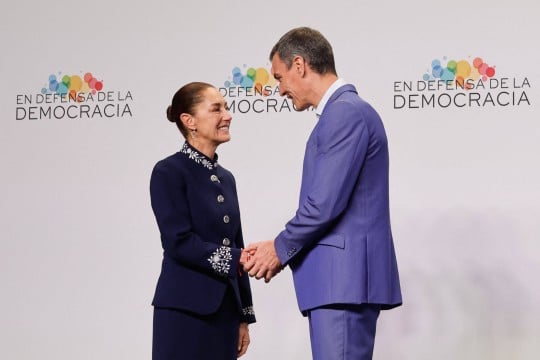
Mexico and Spain took a significant step toward normalising a relationship that had soured into near-silence for years, as President Claudia Sheinbaum met Prime Minister Pedro Sanchez in Barcelona on Saturday in the first visit by a Mexican head of state to Spain since the Morena party came to power in 2018.
The meeting on the sidelines of the fourth “In Defense of Democracy” summit — a gathering of progressive leaders mobilising against the global rise of the far right — carried weight beyond the event itself. Eight years had passed since a Mexican president set foot in Spain officially, and the diplomatic chill that descended after Sheinbaum’s predecessor Andrés Manuel López Obrador demanded a formal apology for colonial-era abuses in 2019 had frozen what was once one of Latin America’s most important bilateral relationships.
Sheinbaum was careful not to declare the historical question resolved. She told reporters leaving the summit that Mexico’s position on the importance of acknowledging colonial abuses remained unchanged and that she had made that clear to Sanchez during their meeting. But she also acknowledged movement from the Spanish side. “There has already been a rapprochement from both the Spanish president and the king himself, which we acknowledge,” she said.
Read also: Canada’s US Economic Dependence Now A ‘Weakness,’ PM Says
That royal reference was pointed. Spain’s King Felipe VI last month acknowledged abuses committed during his country’s colonial past — a statement that stopped short of the formal apology López Obrador had demanded but represented a meaningful shift in tone from the monarchy’s previous position. Sheinbaum’s administration responded by inviting Felipe VI to attend the World Cup opening ceremony in June, a gesture of normalisation notable for its contrast with the conspicuous absence of an invitation to her own inauguration last year.
Spain’s economy minister Carlos Cuerpo described Sheinbaum’s Barcelona presence as “a very important and positive sign of a rapprochement,” pointing specifically to the potential for expanded cooperation in energy, infrastructure and financial services. The economic dimension of the relationship had been collateral damage during the diplomatic freeze, with trade and investment ties between two countries that share deep historical, linguistic and commercial bonds operating well below their potential.
Sheinbaum, for her part, declined to characterise the preceding years in terms that would complicate the current warmth. “There is no diplomatic crisis with Spain; there never has been one,” she said — a formulation that acknowledged the sensitivity of the bilateral history while making clear she intended to move forward rather than relitigate grievances.
She extended an invitation for Sanchez to attend the fifth edition of the democracy summit, which Mexico will host next year — a reciprocal gesture that, if accepted, would bring the Spanish prime minister to Mexico City for a visit that would have been politically unthinkable at the peak of the López Obrador era.
Read also: Pahlavi Warns Against Negotiating With Tehran’s Leadership
The colonial history that López Obrador placed at the centre of the bilateral dispute does not disappear with a summit photograph and a World Cup invitation. Spain’s empire between the 16th and 18th centuries stretched across five continents, and its rule of Latin America involved forced labour, land seizure and systematic violence against Indigenous populations whose descendants still navigate the legacies of that era. The question of how that history should be formally acknowledged — and by whom — has not been settled. What has changed is that both governments appear to have decided the question need not be a precondition for everything else.
The Barcelona meeting established that a working relationship is possible without resolution of the underlying historical argument, and that both sides have enough to gain from normalisation to proceed without waiting for a reckoning that may never arrive in the form either side originally envisioned.