
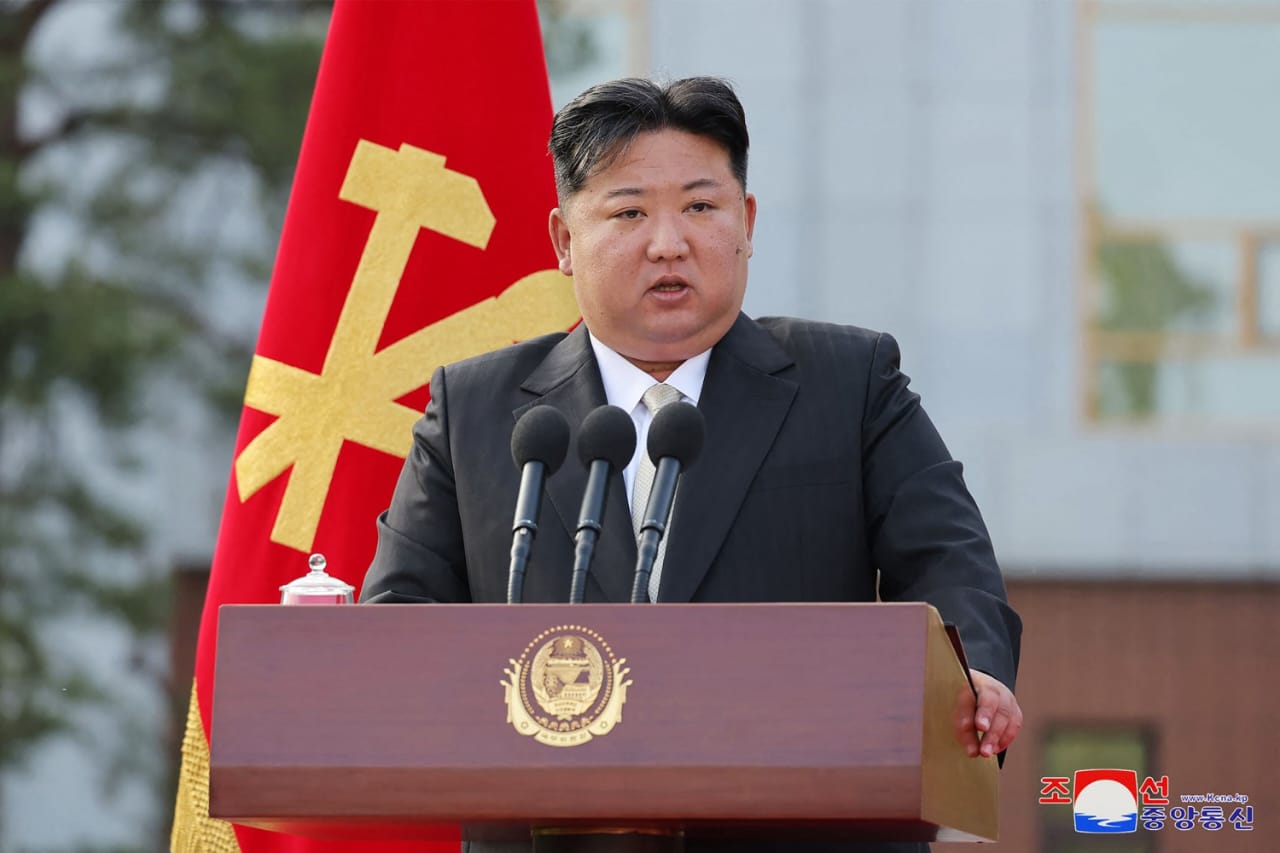
North Korea has rewritten its constitution to formally designate Kim Jong-un as head of state and erase all references to Korean reunification, South Korean unification ministry experts confirmed Tuesday — a document that consolidates Kim’s personal authority to an unprecedented degree while abandoning decades of constitutional language about the shared destiny of the Korean people.
The revised constitution, examined at an expert roundtable held for reporters covering the Ministry of Unification, strips the preamble of every reference to inter-Korean relations that had appeared in previous versions. Language including “northern half,” “national reunification” and “complete victory of socialism” has been deleted entirely.
References to the historic achievements of Kim Il Sung and Kim Jong Il, which had anchored the unification narrative in earlier constitutions, have also been removed — and with them, the ideological justification for reunification as a national mission.
The deletions appear to codify Kim’s declaration at the end of 2023 that inter-Korean relations had become those of “two hostile states” — a formulation that represented the most explicit rejection of the reunification framework in North Korea’s postwar history. Yet the new constitution stops short of enshrining that hostility in its text. South Korea is not described as a hostile state, and the nature of belligerency between the two countries does not appear as a constitutional concept.
Read also: UK Greens Challenge Labor Dominance In London Strongholds
What does appear, for the first time, is a territorial clause. Article 2 of the revised constitution states that North Korea’s territory “includes land bordering the People’s Republic of China and the Russian Federation to the north and the Republic of Korea to the south, as well as the territorial waters and airspace established on that basis.”
The clause acknowledges South Korea’s existence as an adjacent entity without addressing the contested boundary lines between them — a formulation that implies separation without defining its terms.
The consolidation of Kim’s personal authority runs through the document’s structural choices as much as its explicit provisions. The chairman of the State Affairs Commission — Kim’s formal title — now appears first in the order of state institutions, placed ahead of the Supreme People’s Assembly for the first time in North Korean constitutional history. He is explicitly designated as “head of state,” a title the constitution had not previously attached to the commission’s chairmanship. His exclusive authority to command nuclear forces appears in the constitution for the first time, with a new clause providing the basis for delegation of that authority.
Kim’s power over personnel has also been expanded. His authority to appoint and dismiss key officials now explicitly includes the chairman of the Supreme People’s Assembly and the premier of the Cabinet — positions previously outside his formal appointment power. In the same revision, the Supreme People’s Assembly’s theoretical authority to recall the chairman has been abolished, removing what had been a nominal constitutional check on his position, however unlikely it was ever to be exercised in practice.
The ideological framing has shifted as well. The “Kimilsungism-Kimjongilism” line — the theoretical framework named after Kim’s grandfather and father that had been central to the constitutional preamble — has been deleted. In its place, the “people-first principle,” Kim Jong-un’s own governing ideology, is specified. The substitution repositions the constitutional foundation from inherited revolutionary ideology to Kim’s personal political brand.
Read also: Russian Fighters Confirm Withdrawal From Northern Mali
South Korean experts offered a nuanced reading of what the document signals. Lee Jung-chul, a professor at Seoul National University, told the roundtable that while the constitution establishes territory clauses and language emphasizing statehood, the absence of explicit hostile-state declarations or belligerency language was analytically significant. “Although a territory clause was newly established and expressions and provisions emphasizing statehood have emerged, the fact that the nature of hostile relations or a state of belligerency does not appear suggests this draft constitution could be seen as creating one piece of infrastructure for moving toward peaceful coexistence between the two Koreas,” Lee said.
The broader expert consensus was that the document is designed to project the image of a “normal state” — a sovereign entity with defined territory, a designated head of state and a constitutional order that does not define itself primarily through its relationship with or opposition to South Korea.
Whether that normalization framing reflects a genuine strategic reorientation or a presentational adjustment for international audiences is a question the constitution itself does not answer.