
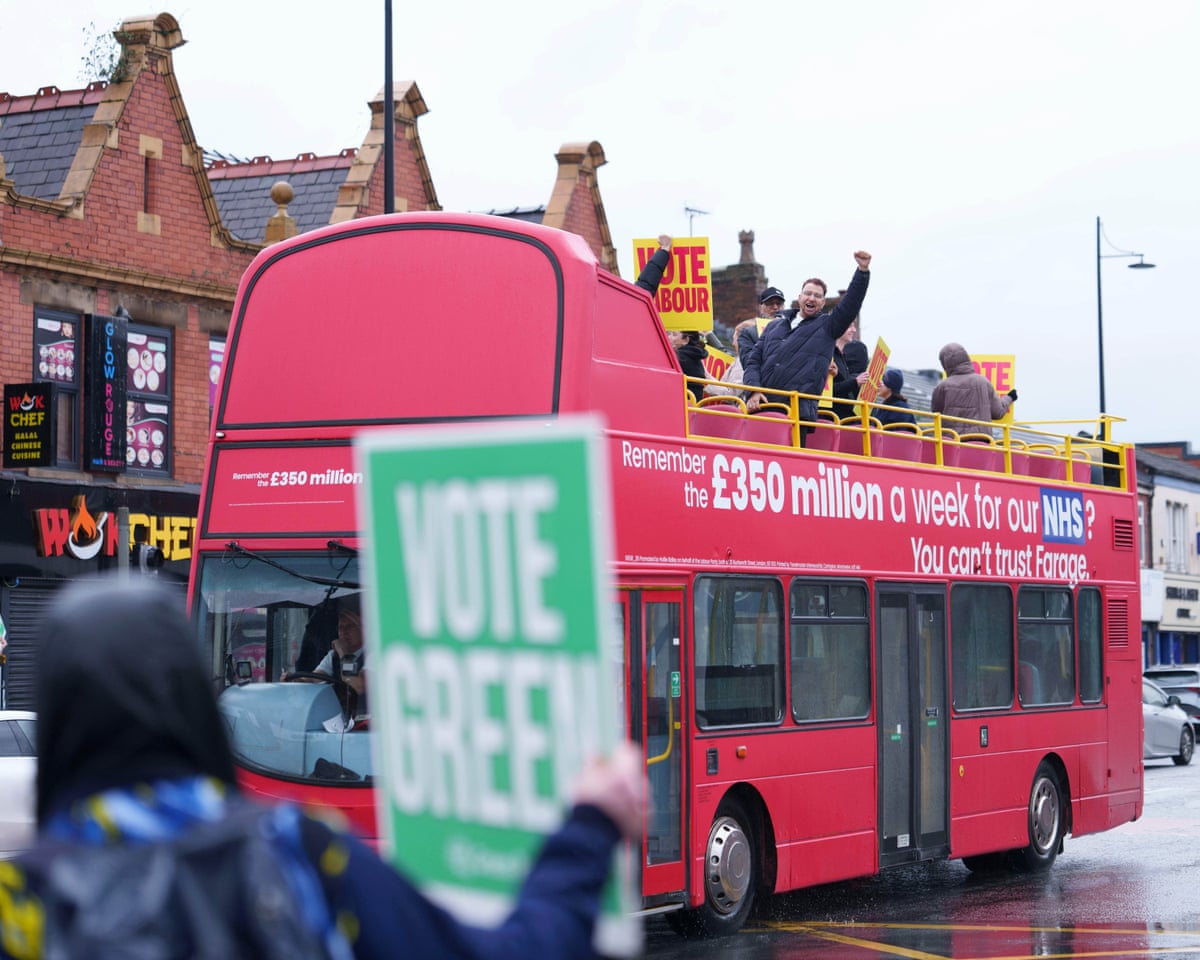
Something is shifting in the Labor heartlands of east London, and Keir Starmer’s party is feeling it in the most uncomfortable way possible — losing ground not to the right but to the left, in the very urban strongholds that were supposed to be the safest ground on the political map.
Nadeshda Jayakody, a 34-year-old human rights lawyer in Hackney, voted Labour in 2024 and will not be doing so again. She is backing the Greens in the May 7 local council elections, and her reasoning cuts directly to the strategic gamble Starmer has made since taking office. “Labour is pandering towards the right, towards Reform, rather than trying to lead from the centre or the left,” she said. “I just think the Greens align better with what I stand for.”
She is not alone. The local elections across Britain on May 7 arrive at a moment of acute political vulnerability for a prime minister whose 2024 landslide now feels like a different era. Opinion polls show Starmer’s personal popularity has collapsed since he entered Downing Street. Scandals, a perception of underdelivery on living standards promises, and a rightward tilt on immigration in response to Nigel Farage’s surging Reform UK have created a two-front erosion: Reform eating into former industrial heartlands in the north, the Greens advancing in the major cities Labour has long taken for granted.
The Greens have accelerated their momentum since Zack Polanski took the party leadership in September and pulled it decisively to the left. Beyond environmentalism, Polanski has championed rent controls, higher taxes on the wealthy and drug legalisation — positions that resonate with urban progressive voters who once considered Labour their natural home. The party is now polling between 15 and 20 percent nationally, sometimes ahead of Labour itself.
In February, it won a parliamentary by-election in a safe Labour seat in Greater Manchester — a result that punctured Starmer’s argument that Labour was the only credible progressive vehicle capable of stopping Reform.
Read also: Two US Service Members Reported Missing In Morocco
In Hackney, where Labour has been the dominant force on the council since the 1970s, Green mayoral candidate Zoë Garbett said the Manchester result had registered directly with doorstep voters. “People in Hackney really were following that and really could see that we are an alternative,” she said. The dissatisfaction she is encountering spans local housing conditions, national economic policy and Labour’s stance on the Gaza war — a range of grievances that suggests no single issue is driving the shift but rather a cumulative sense of being politically homeless inside a party that has moved away from them.
YouGov modeling from last month projected the Greens leading in four London boroughs, including Hackney. A JL Partners model showed them narrowly ahead in Camden — the borough that contains Starmer’s own parliamentary constituency. The symbolism of the prime minister potentially watching the Greens defeat Labour in his own political backyard is not lost on anyone watching the race.
The Greens have not navigated the campaign without difficulty. Several candidates have faced accusations of antisemitism, a charge that Polanski — who is Jewish — has addressed by saying one case is one too many while insisting the issue should not be used to conflate all criticism of Israel with prejudice.
He drew a rebuke from London’s police chief last week after retweeting a post critical of officers who arrested a man following the stabbing of two Jewish people in north London.
Read also: US Drops To Unprecedented Press Freedom Low In RSF Index
Not every Hackney voter is ready to make the switch. Mel Bagshaw, a 69-year-old photographer who has voted Labour throughout his life, said he would do so again, describing Labour as the party that historically protected the most vulnerable and the Greens as “slightly too radical” for his taste. Sophie Bullock, 39, an operations manager, said she was genuinely torn — drawn to what she called the “refreshing” energy of the Greens but wanting the “consistency and stability” that backing Starmer represents.
That ambivalence, multiplied across thousands of urban progressive voters, is precisely what makes May 7 so consequential for Labour. It does not take a majority defection to Green to damage the party severely in borough after borough. A sufficient bleed in the right places — or the wrong ones, from Starmer’s perspective — could reshape the political geography of London and provide the Greens with the platform from which to press their national ambitions harder than at any point in the party’s history.
Garbett put it simply. “I think we’ve seen a real change in politics. And I think this election is going to be a real change for London.”