
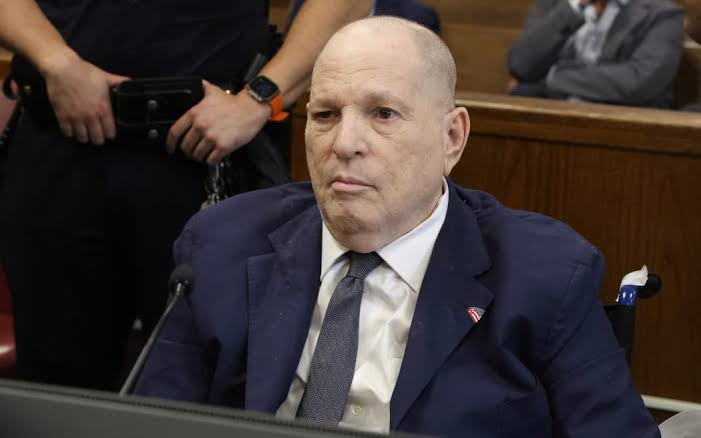
A New York jury failed to reach a unanimous verdict Friday in Harvey Weinstein’s third trial on the charge that he raped aspiring actress Jessica Mann in a Manhattan hotel room in 2013, with Judge Curtis Farber declaring a mistrial after deliberations became heated and jurors sent a note saying they were hopelessly deadlocked.
Nine jurors voted not guilty and three voted guilty, according to defense lawyer Marc Agnifilo, who told reporters outside the courthouse that he would be urging prosecutors to drop the case entirely. “In my view they were lucky to have won over three jurors,” Agnifilo said of the prosecution’s position.
Manhattan District Attorney Alvin Bragg said his office was disappointed but would consider its next steps in consultation with Mann — the woman who has now taken the stand against Weinstein three separate times over the course of nearly a decade, each time reliving in public what she says happened to her in that hotel room. “For nearly a decade, Jessica Mann has fought for justice. Over the course of many weeks during three separate trials, she relived unthinkably painful experiences in front of complete strangers,” Bragg said. Whether prosecutors will pursue a fourth trial was not immediately announced.
Read also: NYPD Arrests Several At Bronx Overnight Car Gathering
Weinstein, 74, has denied the allegation and pleaded not guilty to one count of third-degree rape. His defense has argued throughout that Mann fabricated the rape claim after a consensual relationship with Weinstein failed to advance her acting career — a framing that Mann and prosecutors have consistently rejected.
The mistrial is the latest chapter in a legal history that has cycled through conviction, reversal and retrial with a persistence that reflects both the severity of the allegations and the complexity of the evidentiary questions surrounding them. Weinstein was originally convicted in New York in 2020 of raping Mann and sexually assaulting former production assistant Miriam Haley — a verdict that carried a 23-year prison sentence before New York’s highest court overturned it in 2024, ruling that Weinstein had not received a fair trial. A second New York jury then convicted him in June 2025 of sexually abusing Haley but deadlocked on the Mann rape charge, producing the mistrial that led to the retrial that has now produced another deadlock.
Read also: Major NYC Storm Could Trigger $100B Insurance Loss — KCC
Juror Josh Hadar, 57, told reporters after the verdict that he voted not guilty because of what he described as contradictions in Mann’s testimony. The jury had spent three days deliberating before sending the note that prompted Judge Farber to acknowledge outside the jury’s presence that continued deliberations served no purpose.
Weinstein faces sentencing for the Haley conviction, which carries a potential prison term of up to 25 years. He is also serving a 16-year sentence from a separate 2022 rape conviction in California, which he is appealing. Whatever happens with the Mann charge — a fourth trial, a dropped case, or continued legal limbo — he is not walking free.
The case against Weinstein ignited the MeToo movement when allegations against him became public in 2017, encouraging women across industries to come forward with accounts of sexual abuse by powerful men and reshaping public understanding of how predatory behavior operates inside institutional structures that protect the powerful. The mistrial Friday does not undo that — but for Jessica Mann, the woman at the center of this specific charge, the jury’s inability to agree on what happened to her in 2013 is its own verdict on how the legal system processes her account of that night.