
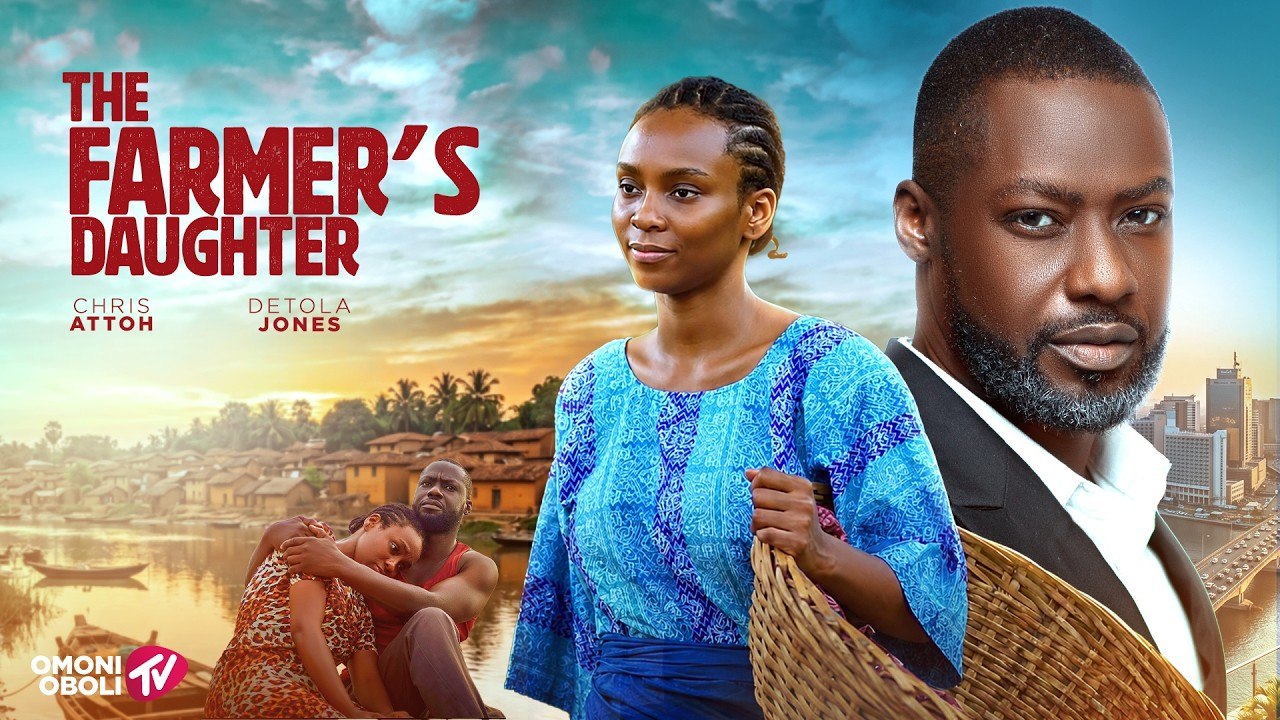
Official Trailer:
For decades, Nollywood has returned repeatedly to one enduring emotional question: what happens when love collides with class? It is a theme deeply woven into African storytelling because it reflects a reality many people understand too well—the tension between where someone comes from and where they hope to belong.
The Farmer’s Daughter revisits this familiar terrain, but it does so with a sincerity that gives the story emotional weight beyond its romantic framework.
At its core, the film is less about romance itself and more about identity, dignity, and the invisible social barriers that define opportunity. The narrative follows a young woman raised within the modest realities of rural life, someone shaped by labor, simplicity, and survival. Her world is built on routine and resilience rather than luxury.
Yet when her path intersects with a man connected to a more polished and economically stable environment, the story begins to evolve into something larger than attraction. It becomes a confrontation between two different worlds—and the emotional consequences of trying to bridge them.
Leading the film is Detola Jones, whose performance gives the narrative much of its emotional authenticity. Jones portrays her character with a quiet naturalism that avoids exaggerated innocence. Instead of reducing the “village girl” archetype to stereotype, she brings emotional intelligence and grounded humanity to the role.
Her expressions often communicate more than the dialogue itself: uncertainty, hope, hesitation, and the silent awareness of being judged before being understood.
What makes her performance particularly effective is the restraint she maintains throughout the film. She does not attempt to overpower scenes emotionally; rather, she allows vulnerability to emerge gradually.
In doing so, the audience is drawn not just to her circumstances, but to her humanity. The result is a character who feels lived-in rather than constructed—a person navigating unfamiliar emotional territory while trying to preserve self-respect.
Read Also: The Other Mother: Love, Lies, And Loyalty
Opposite her, Chris Attoh delivers a composed and emotionally measured performance. His character represents sophistication, access, and urban confidence, yet the film carefully avoids portraying him as emotionally invulnerable.
Beneath the polished exterior lies someone also struggling with expectation—particularly the pressures tied to status, perception, and social acceptance. Attoh brings maturity to the role, understanding that the character’s conflict is not simply romantic but societal. He is forced to choose between comfort within familiar structures and emotional honesty that may challenge them.
The chemistry between both leads develops with patience, allowing the relationship to feel emotionally believable rather than narratively convenient. Their connection is not presented as immediate fantasy. Instead, it grows through observation, misunderstanding, emotional curiosity, and gradual trust. That slower emotional progression gives the story credibility, particularly within a film centered on differences in upbringing and worldview.
Visually, The Farmer’s Daughter leans heavily into contrast. Rural landscapes are captured with warmth and openness, emphasizing community, simplicity, and emotional transparency. In contrast, urban settings appear more polished but emotionally colder, reflecting environments shaped by performance, image, and social hierarchy.
This visual divide becomes symbolic of the larger thematic conflict running throughout the film.
The cinematography does not attempt excessive stylistic experimentation. Instead, it prioritizes emotional clarity. Close framing during quieter scenes allows viewers to engage deeply with character reactions, while wider environmental shots reinforce the physical and emotional distance between both worlds.
The production understands that atmosphere can communicate social reality just as effectively as dialogue.
One of the film’s strongest thematic elements is its exploration of shame and perception. The protagonist is not merely confronting economic disparity; she is confronting the emotional burden society places on people from humble backgrounds.
The film quietly critiques how often worth is measured through presentation, accent, education, or environment rather than character. In this sense, The Farmer’s Daughter becomes more than a romantic drama—it becomes a reflection on social prejudice disguised as sophistication.
The pacing of the narrative mirrors its emotional journey. The film unfolds steadily, resisting the urge to rush conflict or emotional revelation. While some viewers may expect sharper dramatic turns, the measured structure ultimately supports the story’s realism. Relationships shaped by class difference are rarely simple or immediate; they evolve through discomfort, negotiation, and emotional compromise.
Within the broader context of Nollywood cinema, the film aligns with a longstanding tradition of socially conscious romantic storytelling.
However, it also reflects the industry’s growing preference for emotionally grounded narratives that prioritize character psychology over exaggerated melodrama. There is a noticeable effort here to humanize every emotional conflict rather than reduce it to formula.
Importantly, the film understands that social mobility carries emotional consequences. The protagonist’s journey is not simply about escaping poverty; it is about navigating the psychological tension of entering spaces where she constantly feels evaluated. That internal struggle gives the narrative emotional resonance because it speaks to experiences many viewers recognize beyond romance itself.
By the time the film reaches its emotional conclusion, what remains is not merely the question of whether love survives, but whether belonging is truly possible in a society obsessed with status. Can affection genuinely overcome deeply rooted class perception? Or do people eventually retreat toward the comfort of familiar expectations?
The Farmer’s Daughter does not pretend to offer easy answers. Instead, it presents love as something tested by society long before it is tested by emotion.
Read Also: A Random Tuesday And The Chaos Of Timing
Through restrained performances, reflective storytelling, and a sincere engagement with social realities, the film transforms a familiar premise into a thoughtful exploration of identity and acceptance.
In the end, it reminds viewers that sometimes the greatest distance between two people is not geography or language—but the invisible divide created by class, perception, and the fear of not belonging.