
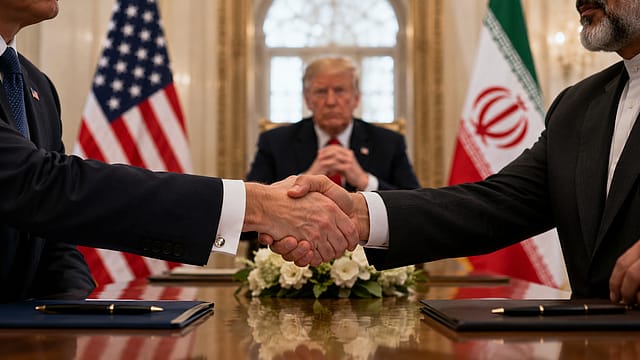
American and Iranian negotiators have drafted a memorandum of understanding to pause their war for another 60 days, but the agreement has stopped at the one desk that matters: President Donald Trump has not approved it, four sources familiar with the talks told the press.
The MOU, as currently written, establishes that Iran’s stockpile of highly enriched uranium will be among the first issues addressed once the extended ceasefire takes effect — a concession to Washington’s core demand that the nuclear question not be deferred indefinitely, according to Axios, which first reported the deal’s existence. The White House offered no comment.
The agreement exists on paper. What it lacks is presidential authorization.
Trump spent the weekend in Washington after abruptly canceling plans and foregoing his son’s wedding, announcing that “circumstances pertaining to government” required him to remain in the capital. The optics fueled immediate speculation that a signing was imminent. Then, on Sunday, a senior administration official walked back the mood, acknowledging agreement only on the broad contours of a deal — not on the specific terms that would move the MOU from draft to done.
The war that prompted these talks is now in its third month. Trump had publicly forecast it would run four to six weeks.
That timeline has not aged well. At various points Trump suggested the fighting could end within days; at others, he indicated it could extend considerably longer. The administration has on multiple occasions declared a deal was imminent, only to have Tehran contest the characterization or simply ignore the framing. The swings in presidential rhetoric have made it difficult for outside observers to gauge how seriously to take any given signal, a skepticism the Iranians have appeared to share. The distance between Washington’s announcements and diplomatic reality has been a recurring feature of the negotiations — one that has trained observers on both sides to discount official optimism until documents are actually signed.
Read also: Russia Accuses US Of Blocking UN Attendance With Visa Refusal
Trump is navigating pressure from two directions simultaneously, and they do not point to the same destination. Iran hawks inside the Republican Party have warned against any agreement that fails to immediately confront Tehran’s nuclear program — a posture that effectively rules out a phased approach or a deal that merely creates a framework for future talks. For that faction, a 60-day ceasefire extension with uranium questions deferred to the agenda rather than resolved upfront is not a deal; it is a delay.
The other pressure is electoral and economic. Gasoline prices have stayed high, and voters have not forgiven it. Republican strategists are watching a House majority that was never wide to begin with grow more precarious with each month the conflict sustains energy market uncertainty.
The Senate, long considered safer territory for the party, is increasingly listed as a concern. A war that ends is, at minimum, one fewer source of economic drag heading into November. A war that continues is a liability the party would rather not be carrying.
Read also: US Launches New Strikes On Iran Missile Sites And Boats
Iran’s highly enriched uranium remains the substantive knot at the center of the negotiations. Tehran has built up stockpiles at enrichment levels that draw sustained attention from nonproliferation experts and international monitors, though Iranian officials have maintained, consistently, that the program is civilian in purpose and that nuclear weapons development is not the goal. Trump has defined preventing Iran from building a bomb as his paramount objective in the war — a formulation that gives him flexibility on means while holding firm on the stated end. What the MOU apparently attempts is to put uranium management at the front of the 60-day agenda, buying time to negotiate what resolution of that question actually looks like in practice.
The MOU itself is a product of that tension. A full resolution to the nuclear question within 60 days is not a realistic expectation — both governments understand that. What the document attempts, instead, is to establish that the enriched uranium stockpile will not be treated as a secondary matter — that it goes first, not last.
The president canceled weekend plans, skipped a family milestone, and stayed in Washington. Three days later, the ceasefire memorandum he was ostensibly there to address is still unsigned.