
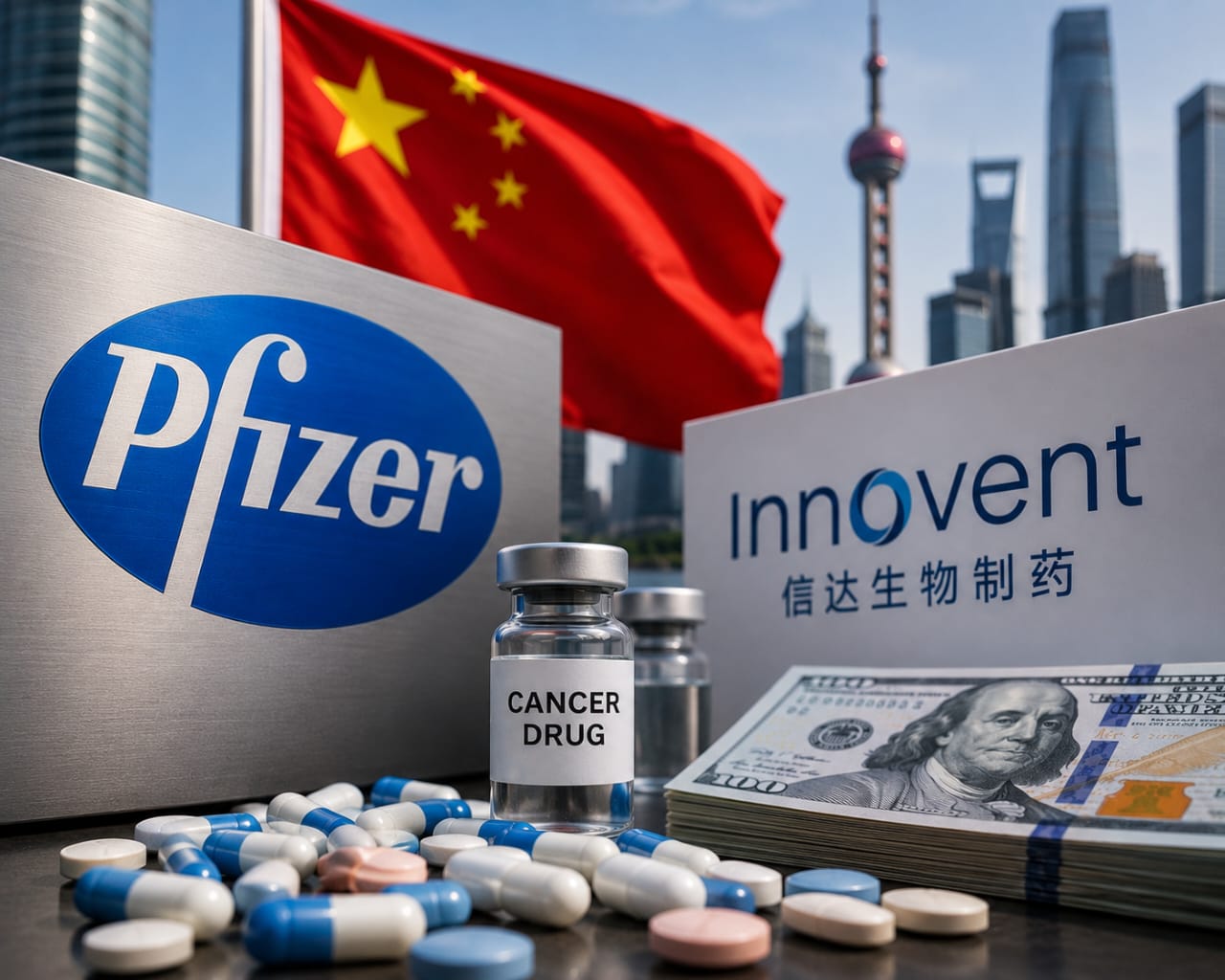
Pfizer has committed up to $10.5 billion to license a dozen early-stage cancer drugs from China’s Innovent Biologics, one of the largest oncology deals to emerge from the accelerating global scramble for Chinese biomedical innovation.
The agreement, disclosed Wednesday in a Hong Kong stock exchange filing, pairs Pfizer’s global development machinery with Innovent’s pipeline of experimental therapies — antibody-drug conjugates carrying novel payloads and multi-specific antibodies, a class of engineered molecules designed to hit cancer from multiple angles simultaneously. Of the 12 programs covered, eight originated inside Innovent’s labs; Pfizer itself proposed the remaining four for collaborative discovery.
Cash flows immediately. Innovent, which operates through its Suzhou-based subsidiary and its U.S. arm Fortvita Biologics, collects $650 million at signing. The remaining $9.85 billion is contingent on the drugs clearing the gauntlet of clinical trials, regulatory reviews, and commercial launch thresholds — payments that may never arrive in full, but that signal how aggressively Pfizer is pricing its confidence in the portfolio.
The structure of the deal is deliberately tiered. For four of the 12 programs, Pfizer and Innovent share development costs, co-promote in the United States and Europe, and split profits, while Innovent retains commercial rights inside Greater China. A second group of four grants Pfizer an exclusive license for markets outside Greater China. The final four hand Pfizer an exclusive global license outright, with Pfizer bearing all development expenses worldwide.
Read also: Tulsi Gabbard Quits As Trump’s Intelligence Chief
The arrangement lets Innovent stay deeply embedded in the programs closest to home while ceding the heaviest lifting — and the greatest upside — to its American partner in markets where Pfizer’s infrastructure is already built.
Under the terms reached, Innovent will carry each program through Phase 1 human trials before handing the baton to Pfizer for global development. That division of labor keeps early-stage risk with the originating company and transfers later-stage capital demands to Pfizer, whose oncology ambitions have grown expensive.
Pfizer has spent the past year building what amounts to a Chinese biotech portfolio. A year ago this month, the company signed a separate licensing deal with Shenyang-based 3SBio, staking several billion dollars on a cancer immunotherapy the company believes could be differentiated from existing treatments on the market.
The Innovent agreement extends that strategy into a broader basket of technologies with a single partner.
The backdrop is a China biotech licensing market that has expanded at a pace few industries match. According to data compiled by Pharmcube, the combined value of such deals struck in the Greater China region grew nearly tenfold between 2021 and last year, reaching an unprecedented $137.7 billion. Analysts covering the sector expected 2026 to push that figure to a new record, though the Pfizer-Innovent transaction alone would represent a meaningful fraction of any annual total.
Read also: Royal-Presidential Summit Aims To Mend US-UK Rift
Global pharmaceutical companies have driven the surge, deploying capital into Chinese biotechs that have built sophisticated pipelines at costs substantially below what comparable U.S. or European programs would require. Antibody-drug conjugates, the technology class at the center of this deal, have become a particular focus. The drugs work by attaching toxic payloads to antibodies engineered to home in on cancer cells, delivering a concentrated strike while sparing healthy tissue. Several Chinese companies have developed ADC platforms that Western drugmakers have been willing to pay generously to access.
For Innovent, a company founded in Suzhou in 2011, the deal is validation at a new scale.
The firm has previously licensed assets to major Western companies, but a partnership of this scope — spanning a dozen programs across multiple technology platforms, with a partner of Pfizer’s size, and an upfront payment in the hundreds of millions — places it among the most prominent Chinese biotech companies in the global licensing economy.
The 12 programs are all early-stage, meaning none has yet generated the clinical proof-of-concept data that would substantially de-risk a commitment of this size.
Pfizer is paying for optionality and for the science itself — a bet that Innovent’s biologists have identified targets and mechanisms worth building on, and that at least some of what is now a portfolio of experiments will become treatments patients actually receive.
That remains years away for most of these programs. What is not in question is how much the pharmaceutical industry’s center of gravity has shifted — and how much Pfizer intends to be there when it lands.