
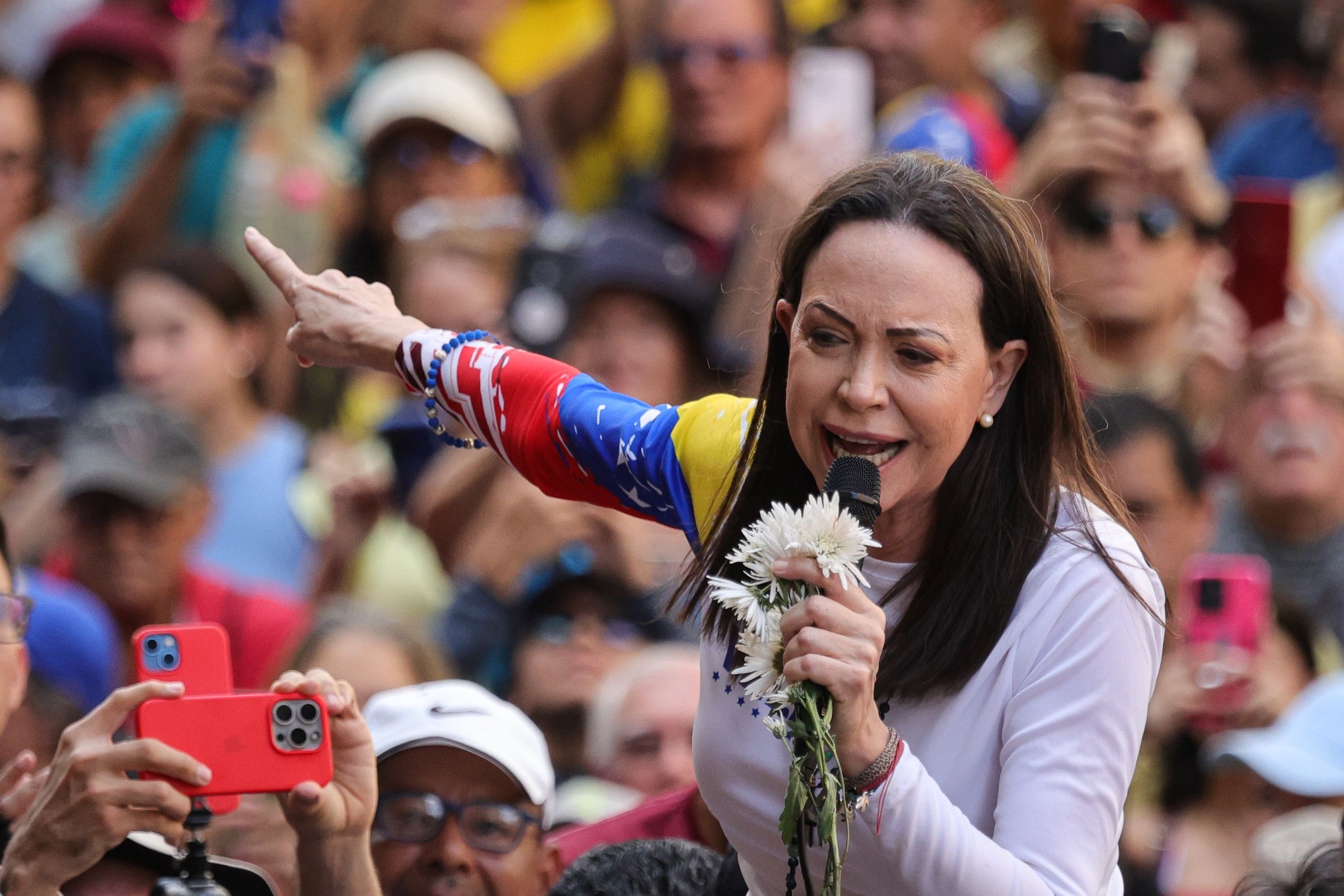
Members of Venezuelan opposition leader Maria Corina Machado’s inner circle worked closely with senior figures in Donald Trump’s administration to argue that President Nicolas Maduro poses a direct threat to United States security, according to more than fifty people familiar with the contacts.
The effort included closed door meetings in Washington and intelligence sharing meant to support a tougher stance against Caracas. It continued even as U.S. immigration policies hardened against Venezuelan citizens.
According to current and former U.S. officials who spoke with Reuters, members of Machado’s team contributed information to federal agencies and worked with sympathetic lawmakers to support the case that Tren de Aragua is directly linked to Maduro and poses a serious threat beyond Latin America.
They held several meetings with officials before and after Trump returned to office in January. Florida Republicans including Marco Rubio, who later replaced Waltz as national security adviser, were key points of contact, sources said.
Rubio has argued for years that military action might be justified in Venezuela. He did not answer detailed questions about the recent contacts. The State Department denied that the opposition has significant influence over the administration’s thinking.
Read Also: Maduro Alleges US Manufacturing Conflict With Venezuela
In the months after the January meeting, the U.S. government formally labelled Tren de Aragua a terrorist group under Maduro’s control. Washington offered a fifty million dollar reward for the Venezuelan leader’s arrest.
The U.S. military has carried out repeated strikes on suspected drug boats near Venezuelan waters. Trump said the eleven people killed in the first strike belonged to Tren de Aragua, though he offered no evidence. At least thirty eight people have died in the operations so far. United Nations human rights experts called the strikes extrajudicial killings.
A declassified report from the U.S. National Intelligence Council in April said some Venezuelan officials might have worked with the gang for financial gain, but it found no proof that Maduro directed its activities inside the United States.
“You cannot have freedom without strength when you are facing a criminal structure,” Machado told U.S. radio network NPR after winning the Nobel Peace Prize on October 10. David Smilde, a Venezuela expert at Tulane University, said she could be celebrated as a saviour if Maduro falls. “If nothing happens, she risks losing support,” he said. If military action leads to chaos, he added, she will be blamed for destruction inside and outside the country. “It is a high risk strategy.”
Maduro has been in office since 2013 and faces accusations of corruption, political repression and economic mismanagement that helped drive millions to flee the country. He denies running a dictatorship and says Venezuela is a full democracy.