
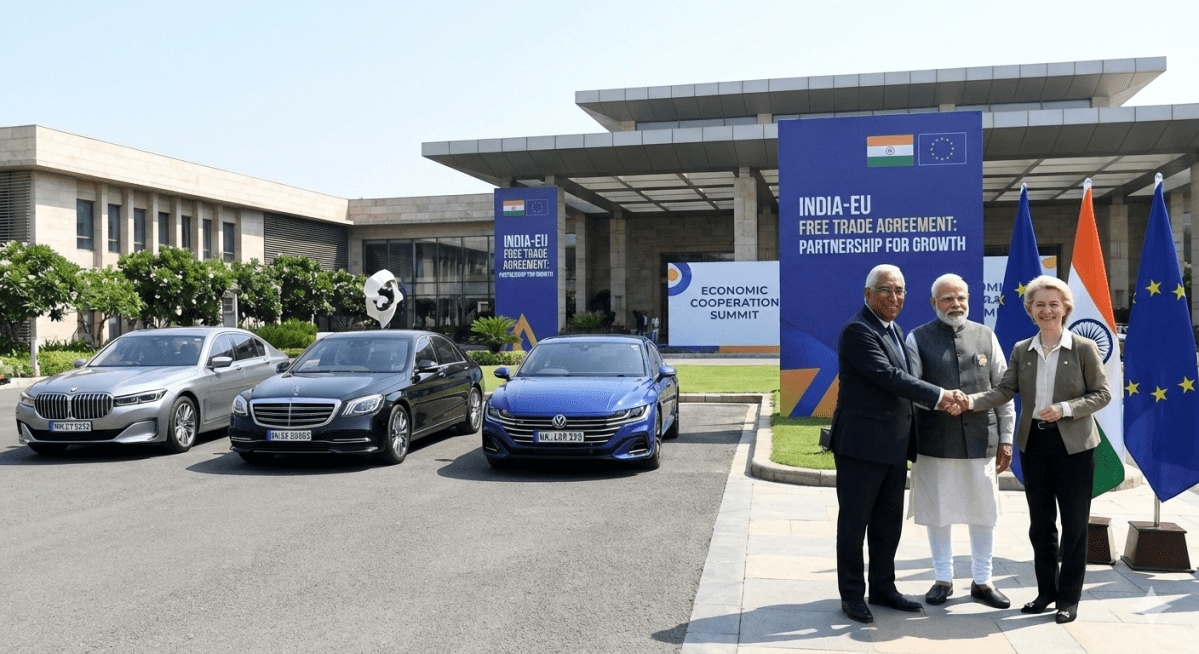
European automakers are set to gain improved access to India’s tightly guarded car market under a new trade agreement with the European Union, though analysts warn the opportunity comes with limits in a country dominated by domestic brands and budget focused rivals.
India and the EU are expected to sign the trade deal on Tuesday, cutting tariffs on imported European made cars to about forty percent from levels that previously reached as high as one hundred and ten percent. The change marks the most significant opening yet of India’s auto market for companies such as Volkswagen and Renault, according to analysts and industry data.
The tariff reduction offers relief to European carmakers facing pressure from United States import duties and aggressive pricing competition in China. Still, industry experts say the Indian market will remain difficult to crack, particularly for mass market vehicles.
Read Also: Germany India Security Talks To Curb Russia Ties
“It is a start, but when we talk about exports from Europe, it is mainly premium cars,” said Stefan Bratzel of German automotive research group CAM. “For volume segments, it is difficult. In India, buyers want affordable, reliable vehicles, and local and Asian brands understand this better.”
India’s passenger car market is led by Maruti Suzuki and Hyundai, alongside domestic manufacturers Tata and Mahindra. Together, those firms control roughly two thirds of sales, driven by demand for compact, low cost vehicles such as the Maruti Suzuki Wagon R.
Read Also: Mark Carney Trade Diversification Drive Faces U.S. Reality
Despite India being the world’s third largest auto market after China and the United States, European manufacturers currently account for less than three percent of total car sales, according to Indian automobile industry data.
Many European firms maintain modest production bases in India, with annual sales still measured in the tens of thousands. Analysts say the tariff cut improves the economics of imported vehicles but does not erase long standing challenges around pricing, local manufacturing scale, and consumer preferences.
India’s domestic car market produces about four point four million vehicles a year and has historically been one of the most protected globally, with import duties designed to encourage local production.
Volkswagen Group, which owns Audi, Porsche, and Skoda, said India remains strategically important as it evaluates the business impact of the agreement.
“India is a dynamically growing market and of considerable strategic importance to the Volkswagen Group,” a company spokesperson said, adding that the firm would review how the tariff changes affect its operations.
While the trade deal lowers barriers, analysts caution that meaningful growth for European brands will likely depend on deeper investment in local production and vehicles tailored to Indian consumers.
The agreement signals closer economic ties between Brussels and New Delhi, but for European automakers, it represents an opening rather than a breakthrough.