
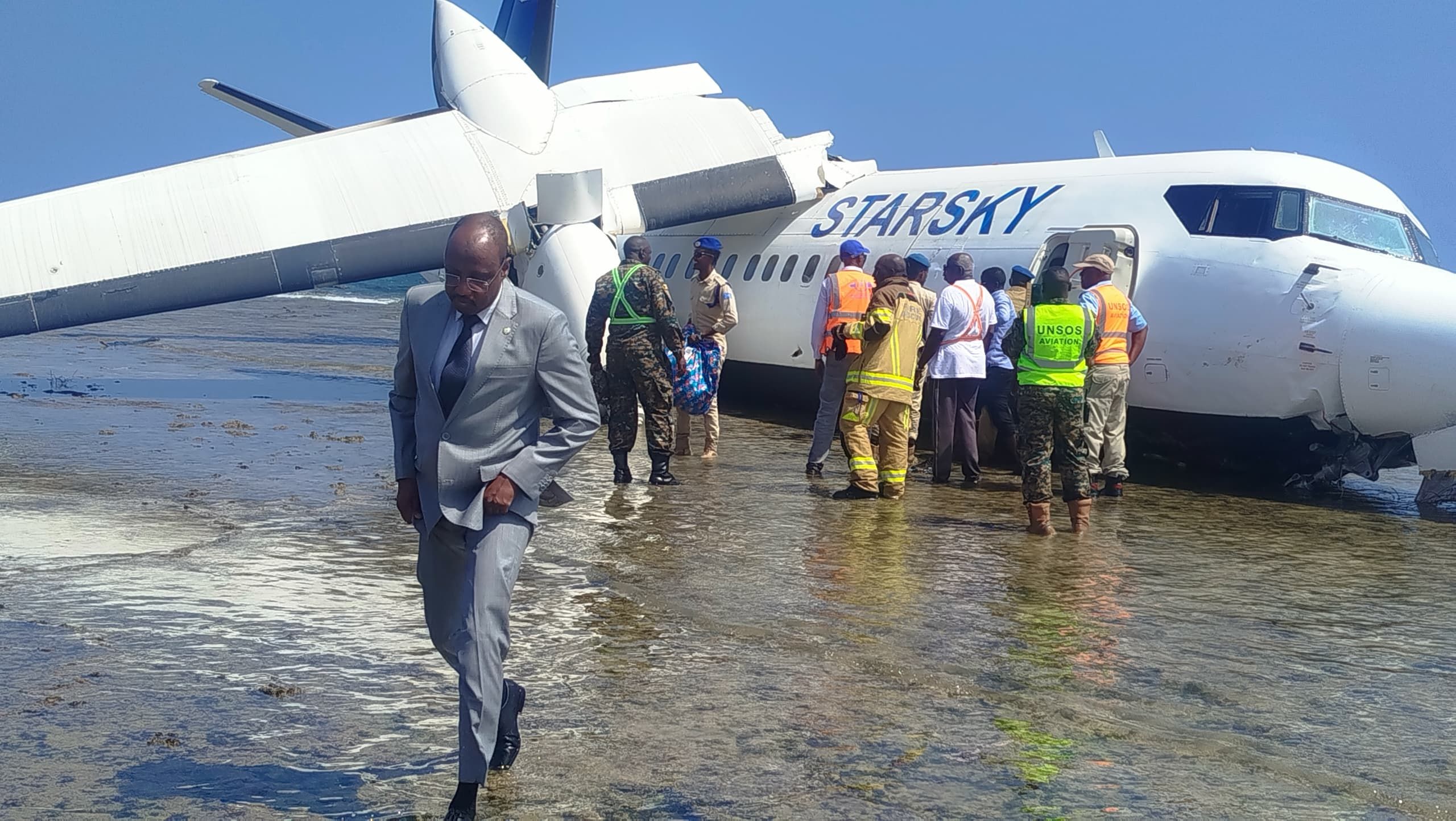
All 55 people aboard a domestic flight in Somalia survived on Tuesday after a turboprop aircraft overran the runway at Mogadishu’s international airport and came to rest in shallow coastal waters, following a reported technical malfunction shortly after take-off, aviation authorities and the airline said.
The aircraft, a Fokker 50 operated by Starsky Aviation, had departed Aden Adde International Airport in the Somali capital on a scheduled flight when the flight crew detected a fault and requested an immediate return, according to the Somali Civil Aviation Authority (CAA). The plane landed back at the airport but was unable to stop within the length of the runway, overshooting the paved surface and ending up on the shoreline adjacent to the airfield, officials said.
No fatalities or serious injuries were reported among the 50 passengers and five crew members, and all were able to evacuate the aircraft, the CAA and the airline confirmed.
Ahmed Macalin Hassan, director of the Civil u Authority, said the incident occurred shortly after the aircraft attempted to land following its aborted flight. “The plane touched down but failed to stop on the runway,” he said, adding that it continued beyond the tarmac and came to rest in shallow water near the coast. He said an investigation had been opened to determine the cause of the technical issue and the circumstances surrounding the runway overrun.
Starsky Aviation, a Somali carrier that operates domestic and regional flights, praised the flight crew for their handling of the emergency, saying the pilot’s actions were instrumental in preventing loss of life. “We are relieved to confirm that all passengers and crew are safe,” the airline’s spokesperson, Hassan Mohamed Aden, said in a statement. “Investigations are under way to establish what caused the technical issue that led to the emergency landing.”
Read Also: Somalia, Saudi Arabia Sign Military Cooperation Agreement
He added that the pilot’s response had been decisive. “The pilot’s swift and calm decision-making played a decisive role in ensuring the safety of everyone on board, and we commend him for how he handled the situation,” Aden said.
The aircraft involved was a Fokker 50, a twin-engine turboprop commonly used on short- to medium-haul routes and introduced into service in the late 1980s. While widely regarded as a robust workhorse for regional aviation, many Fokker 50s operating in Africa are decades old, making maintenance and oversight a persistent concern for regulators and operators alike.
Footage circulating on social media platform X showed the aircraft partially surrounded by water, with passengers disembarking and walking away along the shoreline of the Indian Ocean. Some were seen carrying personal belongings as they moved clear of the aircraft. Reuters was not immediately able to independently verify the footage, but authorities said it was consistent with the scene at the airport.
Emergency services were quickly dispatched after the incident. The African Union Support and Stabilisation Mission in Somalia said in a post on X that United Nations and African Union personnel stationed nearby were “swiftly deployed” to assist with rescue and evacuation efforts. The statement did not specify how many responders were involved but said coordination with Somali authorities was immediate.
Read Also: Somalia Rejects Israeli Base Plan, Warns Of Confrontation
Somalia’s transport minister was also present at the scene, according to the African Union mission, underscoring the high-level attention the incident drew in a country where aviation safety has long been under scrutiny.
Aden Adde International Airport, located close to the coastline in Mogadishu’s Wadajir district, is Somalia’s main international gateway and a critical hub for humanitarian operations, diplomatic travel and domestic flights. Its single main runway is bordered on one side by the Indian Ocean, leaving little margin for error in the event of overruns during landing or aborted take-offs.
Aviation incidents at the airport are closely watched by international partners, particularly given Somalia’s efforts in recent years to rebuild its civil aviation sector after decades of conflict and institutional collapse. In 2013, responsibility for managing Somali airspace was formally transferred back to Somali authorities from the United Nations’ International Civil Aviation Organization, a move seen as a key step in restoring national oversight.
Since then, the Civil Aviation Authority has worked with international donors to improve safety standards, upgrade infrastructure and strengthen regulatory enforcement. However, challenges remain, including aging aircraft fleets, limited technical capacity and the difficult security environment in parts of the country.
The CAA said investigators would examine flight data, maintenance records and crew reports as part of their inquiry into Tuesday’s incident. It was not immediately clear whether the technical fault originated in the aircraft’s engines, braking systems or other components, and officials cautioned that determining the precise cause could take time.
For passengers, the incident ended without serious harm, but it highlighted the risks associated with aviation operations in challenging environments. One passenger, speaking to local media after reaching safety, described the evacuation as orderly and said cabin crew instructed passengers to remain calm as they exited the plane.