
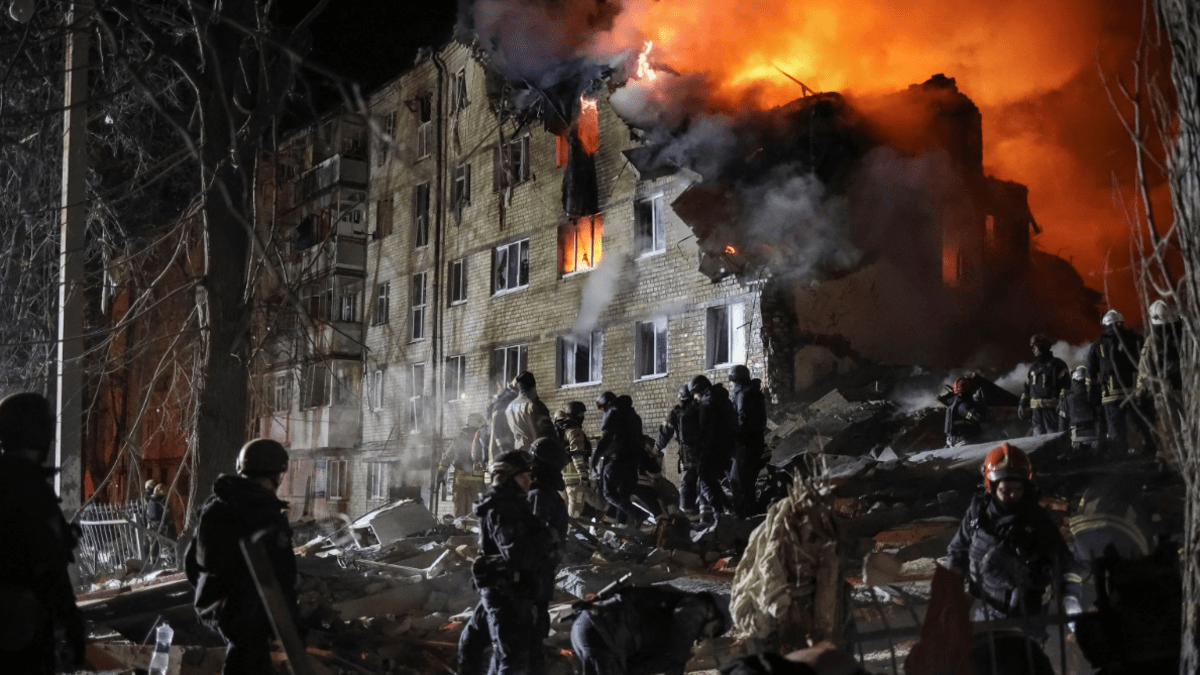
Russia launched its largest single overnight drone and missile barrage of 2026 against Ukraine on Saturday, firing 480 Shahed-type drones and 29 missiles in a combined assault that killed at least seven people, including two children, after a ballistic missile tore through a five-storey residential block in Kharkiv.
It left 2,806 apartment buildings in Kyiv without heating, and damaged four railway stations, port infrastructure in Odesa, and energy facilities across seven regions in what Ukrainian President Volodymyr Zelenskyy called a deliberate campaign to destroy civilian infrastructure while Western partners remain distracted by the Middle East conflict.
A Russian ballistic missile struck the Kyivskyi district of Kharkiv in the early hours of Saturday, destroying the entrance section of a five-storey residential building. Rescue workers recovered the bodies of five people from the rubble while 10 others were injured, including two boys aged six and eleven and a 17-year-old girl.
One additional person was killed in the Nikopol district of Dnipropetrovsk, bringing the overnight national death toll to six, rising to seven as rescue operations continued through the morning. Kharkiv Mayor Igor Terekhov confirmed the residential building fatalities. Nearby structures were also damaged. Nineteen residential buildings were damaged across the city alongside commercial buildings, electricity distribution infrastructure, and parked vehicles.
The attack on Kharkiv came as ballistic missiles were simultaneously launched toward Kyiv, where Mayor Vitalii Klitschko reported debris falls in three districts of the capital, Holosiivskyi, Desnianskyi, and Dniprovskyi, causing fires and structural damage. Emergency power cuts were introduced in seven regions across Ukraine following the attack.
Prime Minister Yulia Svyrydenko confirmed that Russian strikes on an energy infrastructure facility in Kyiv knocked out heating to 2,806 residential apartment buildings across four districts of the capital. The national grid operator Ukrenergo said the scale of the energy infrastructure damage was among the most significant of the year to date.
Ukraine’s Air Force said it shot down 453 drones and 19 of the 29 missiles, deploying a combination of fighter aircraft, anti-aircraft missile systems, electronic warfare, and mobile fire groups in intercepting 88 per cent of the aerial salvo. Nine missiles and 26 attack drones evaded defences and struck 22 sites across the country.
The scale of the barrage, 509 aerial objects launched in a single night, tested the limits of Ukraine’s air defence coverage, which has been progressively strained by attrition and supply delays from Western partners consumed by the Iran conflict’s impact on defence procurement and political attention.
Ukrainian officials confirmed Russian strikes damaged railway infrastructure in several regions and port infrastructure in southern Odesa, setting fire to containers of vegetable oil and damaging a grain warehouse.
The targeting of Odesa port infrastructure has recurring consequences for Ukraine’s agricultural export capacity, as well as for the Black Sea Grain Initiative’s successor arrangements that allow Ukrainian grain to reach global markets. The targeting of railway infrastructure across central Ukraine disrupted logistical operations that serve both civilian supply chains and military resupply corridors.
Read Also: Russia Threatens Response As Finland Lifts Nuclear Weapons Ban
Zelenskyy posted to Telegram after the attack: “Russia has not abandoned its attempts to destroy Ukraine’s residential and critical infrastructure, and therefore support should continue.” He called for a response from partners to what he described as “savage strikes against life.”
Speaking separately to Ukrainian national television, Zelenskyy said the timing of the attack was deliberate — designed to maximise civilian disruption while the global community was focused on the Iran war and Ukraine’s diplomatic activity was concentrated on securing a new round of US-brokered peace talks. He said Kyiv was still waiting for Washington to set a new date following the postponement of a fourth negotiating round that had been scheduled for early March before Operation Epic Fury redirected American diplomatic capacity toward Tehran.
A resident named Hanna, who escaped the Kharkiv attack because she was not in the building at the time, spoke to Reuters at the rubble of her home.
“When we arrived here 20 minutes after the explosion, I thought I was going to have a stroke. I couldn’t string two words together and my legs were buckling. It’s good that I wasn’t there with my child and that my father was with me. It was ordinary people who lived there. What were they targeting?” White smoke rose from the ruins as emergency workers carried bodies in black sacks. The Kharkiv attack is the city’s most destructive single residential strike since a January 2026 ballistic missile hit a residential neighbourhood in the same city, killing six people including a three-year-old child.
Read Also: Ukraine And Russia Complete 500-Each Geneva POW Swap
Russian forces attacked the Kyiv region with strike drones on the evening of March 6, causing damage in the Bucha and Vyshhorod districts, with Saturday’s overnight barrage representing the second consecutive night of attacks on the capital region. Poland scrambled fighter jets and temporarily closed airports in Lublin and Rzeszow near the Ukrainian border during the Russian attacks before confirming no violation of Polish airspace had occurred and resuming operations.
Ukraine’s Defence Forces separately struck a number of Russian military facilities overnight, including targets in temporarily occupied territories, and conducted strikes on a Ka-27 helicopter and Iskander missile system launcher concentrations in the Kharkiv and Zaporizhzhia directions.
The attack was Russia’s largest since the peace talks process began in Abu Dhabi in February, and came against the backdrop of Zelenskyy’s diplomatic push to keep Ukraine’s security needs in international focus during a period when the United States, the United Kingdom, France, and other NATO partners have been absorbed by the Iran crisis. Ukraine’s UN ambassador Sergiy Kyslytsya called the attack a demonstration of Russia’s intentions: “This is what Russia does when it talks about peace.”