
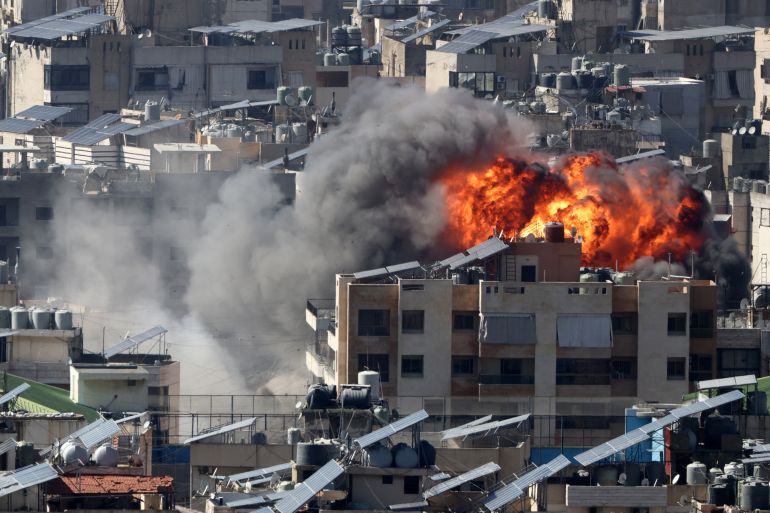
Israeli warplanes struck multiple branches of Al-Qard al-Hasan, Hezbollah’s quasi-banking network, across Beirut on Monday, hitting locations in the southern suburbs, near the international airport, and in the densely populated central neighborhood of Nouairi — the latest phase of a financial warfare strategy that had already targeted the institution’s branches in the opening days of Hezbollah’s entry into the Iran war.
The Israeli military issued advance warnings before the strikes, saying the institution was being used to store cash reserves, manage salaries for Hezbollah operatives, transfer funds from Iran’s Islamic Revolutionary Guard Corps, and purchase weapons.
“Hezbollah’s attempts at economic rehabilitation and the activity at the branches of the Al-Qard al-Hasan association constitute a threat to the citizens of the State of Israel,” the IDF said. Lebanon’s state-run National News Agency confirmed strikes on the Al-Qard al-Hasan building in the Bir al-Abed area in Haret Hreik, and on a second branch along the road leading to Beirut’s Rafic Hariri International Airport. Lebanese authorities blocked roads and redirected traffic around the Nouairi branch in central Beirut ahead of expected strikes there.
Al-Qard al-Hasan, whose name in Arabic means “the benevolent loan,” operates as one of Hezbollah’s main financial institutions in Lebanon, functioning as an unregulated quasi-bank that provides interest-free loans and other financial services to Lebanon’s Shia community. It is not a registered financial institution under Lebanese banking law, and operates entirely outside the country’s formal financial system. Estimates suggest it handles approximately $3 billion in financial activity, potentially amounting to 10 percent of Lebanon’s GDP. The institution has been under US Treasury sanctions since 2007, with additional sanctions imposed in 2021, 2025, and February 2026 — the last targeting an Al-Qard al-Hasan-directed gold smuggling network that US Treasury identified as converting Hezbollah’s gold reserves into usable funds.
Monday’s strikes were not the first time Israel had targeted the institution’s branches. Israeli jets struck nearly 30 Al-Qard al-Hasan branches in June 2024, and the IDF attacked 18 branches on March 2, the same day Hezbollah officially entered the Iran war by firing rockets and drones into northern Israel.
The pattern of repeated strikes on the same institution underscored Israel’s assessment that Al-Qard al-Hasan served as a critical financial lifeline enabling Hezbollah’s military regeneration after the damage it sustained during the 2024 Lebanon war — damage the IDF estimated would require billions of dollars to repair. The military estimated that Hezbollah would need billions of dollars in coming years to fund its recovery from Israeli strikes since October 2023, with the IRGC’s Quds Force taking responsibility for transferring funds via Syria.
Read Also: Pope Leo Warns Iran Conflict Could Engulf Lebanon
The Nouairi neighborhood in central Beirut presented a particular challenge to rescue services and evacuation planners. Unlike the southern suburbs of Dahiyeh, which Israel had designated as evacuation zones and which had been largely emptied of residents, Nouairi was densely populated with civilians, including large numbers of internally displaced people who had fled earlier strikes in the south.
Al Jazeera’s Zeina Khodr, reporting from Beirut, said local authorities issued evacuation orders to residents of the area but that compliance was incomplete.
“But there is a school housing displaced people nearby, and many of them are choosing not to leave the area,” she said. Residents across Beirut described living on a knife’s edge. “While Israel has issued a warning, more often than not, strikes come without any prior notice,” Khodr added.
Lebanon’s Social Affairs Minister confirmed that 517,000 people had been registered as displaced since the conflict resumed on March 2, equivalent to approximately eight percent of Lebanon’s total population.
Israel’s strikes on Lebanon since Hezbollah’s re-entry into the war had killed more than 400 people and displaced hundreds of thousands across the south and Beirut’s suburbs. The heaviest displacement was concentrated in the south of the country, where the IDF had issued blanket evacuation orders south of the Litani River, and in Beirut’s Dahiyeh district, whose residents were told to evacuate to points north and east of the capital.
Read Also: Hezbollah Ramps Up Assaults On Israel As Tension Escalates
Lebanese President Joseph Aoun used the escalation on Monday to publicly renew Lebanon’s push for international mediation. He said he had informed the United Nations and the international community of Lebanon’s readiness to resume negotiations to halt the Israeli military campaign, a statement that carried diplomatic weight as Lebanon’s first new president in more than two years attempted to assert state authority in the face of a Hezbollah military action his government had explicitly declared illegal.
Lebanon’s cabinet had passed a resolution on March 2 demanding Hezbollah hand over its weapons to the Lebanese state, with Prime Minister Nawaf Salam stating that Lebanon rejected any military operations launched from its territory “outside the framework of its legitimate institutions.” Hezbollah ignored the resolution and continued firing into Israel.
Al-Qard al-Hasan issued a statement after Monday’s strikes calling Israel’s targeting of its branches a sign of “bankruptcy” and assuring customers it had taken “measures” to ensure their funds were safe — language identical to the statement it issued following the October 2024 strikes, suggesting the institution had prepared contingency protocols anticipating repeated targeting.
The IDF’s gold-and-cash seizure campaign against the institution over multiple rounds of strikes had disrupted but not destroyed its operational capacity, according to US Treasury officials who described its resilience as partly attributable to the dispersal of assets across dozens of branches and the movement of gold collateral to concealed locations including at least one bunker beneath a Beirut hospital identified by Treasury in 2024.