
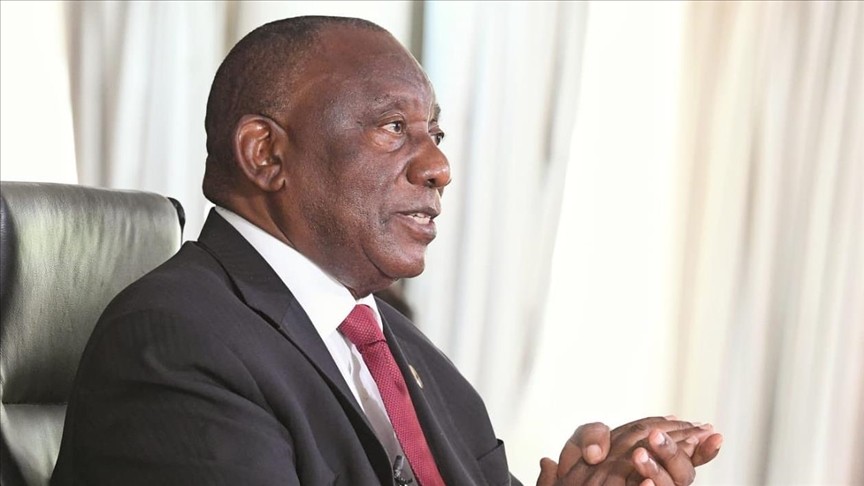
South Africa‘s most senior foreign affairs official publicly refused on Monday to distance Pretoria from Iran, drop its genocide case against Israel at the International Court of Justice, modify its Black economic empowerment legislation, or accept a Trump administration program that would classify white South Africans as refugees, rejecting in a single interview virtually every substantive demand Washington has presented to the Ramaphosa government since the start of Donald Trump’s second term.
Zane Dangor, director-general of the Department of International Relations and Cooperation, told Reuters that South Africa saw no justification for cutting diplomatic ties with Tehran. “We have not any reason to cut ties with Iran,” he said. He acknowledged that Pretoria was not uncritical of the Islamic Republic, pointing to public condemnations by President Cyril Ramaphosa of Iran’s crackdown on protesters in January and its attacks on neighboring Gulf states during the current war. But he drew a firm line against any fundamental reorientation of policy driven by American pressure. “We cannot be pulled into the sort of sphere of influence politics that great powers want to pull us into, and that in this instance includes the U.S.,” Dangor said.
The remarks came five days after Pretoria formally summoned Ambassador Leo Brent Bozell III to the foreign ministry to explain comments he made at a gathering of Johannesburg business leaders on March 11. Bozell told the business community that South Africa should change parts of its affirmative action laws, modify its land expropriation framework, and distance itself from Iran, repeating in public the five-point demand list the US had presented to the South African government roughly a year earlier and had not received a response to. Foreign Minister Ronald Lamola said South Africa welcomed active public diplomacy but that the ambassador’s remarks had not remained “consistent with established diplomatic etiquette and international protocols.” He said Bozell had been called in to explain his “undiplomatic remarks.” Dangor confirmed that Bozell subsequently met with South African officials and “apologized and expressed regret.”
Bozell partially walked back one remark. He had criticized a South African court ruling that found an apartheid-era chant repeated by a far-left opposition party was not hate speech, saying: “I am sorry, I don’t care what your courts say, it’s hate speech.” He later posted on X that the comment reflected his personal view and that the US government “respects the independence and findings of South Africa’s judiciary.”
The episode added another layer to what both governments now acknowledge is the lowest point in bilateral relations since the end of apartheid in 1994. The trajectory has moved sharply downward across the past year. The Trump administration expelled South Africa’s ambassador to Washington and barred the country from participating in Group of 20 meetings held in the United States this year. South Africa is the host of the current G20 cycle, which is scheduled to culminate in a leaders’ summit in Johannesburg in November — a summit that Washington’s boycott of preparatory meetings has thrown into diplomatic uncertainty. South African authorities also raided a US refugee processing center operating in the country, a response to the administration’s attempt to process applications from white South Africans under a refugee designation that Pretoria describes as politically motivated and legally improper.
Read Also: Israel Opens Ground Push in Southern Lebanon
On the refugee program, Dangor was direct. “It’s a preferential immigration programme,” he said. “But they should do it through the normal channels. They cannot use the moniker of ‘refugee.'” He noted that Pretoria’s objection to the refugee classification was the reason a Kenya-based organization that facilitates US refugee processing was denied entry into South Africa.
The genocide case against Israel at the International Court of Justice was equally non-negotiable. “It’s not even on the table,” Dangor said. He added that in his most recent engagement with State Department officials, South Africa had made its position unambiguous: “If you disagree with us on this, it’s a court process.” South Africa filed the ICJ application against Israel in December 2023, making it the first country to bring a formal genocide case against Israel before the UN’s principal judicial body. The proceedings remain active, with hearings continuing in 2026. The Trump administration has described the case as antisemitic and as incompatible with US values, and the demand to drop it has been a consistent element of the pressure Washington has applied to Pretoria.
On Black economic empowerment legislation, Dangor declined to engage the substance. “We’re not going to let the domestic issues that they’ve put on the table become part of that equation,” he said. Trump has described South Africa’s Broad-Based Black Economic Empowerment laws — designed to redress employment and ownership disparities created during decades of apartheid — as discriminatory against white South Africans, a framing the Ramaphosa government rejects entirely. In August 2025, the Trump administration imposed a 30% tariff on South African imports, a measure whose consequences are particularly severe given that approximately a third of South Africa’s working-age population is unemployed and the country’s manufacturing sector is heavily dependent on the export market.
Read Also: Israel-Lebanon Direct Talks Set, Kushner To Lead US Role
Bozell said the US was frustrated that it had received no reply from South Africa to the five-point demand list. Dangor acknowledged that Pretoria wanted to improve ties with Washington but set explicit terms. “Let’s engage about areas we agree on,” he said, proposing cooperation on trade and investment rather than capitulation on domestic policy or foreign alignment.
South Africa’s foreign policy has been consistently positioned as non-aligned since the end of apartheid, a posture that reflects both the African National Congress’s historical relationships with the Soviet Union and Cuba during the liberation struggle, and the post-apartheid government’s calculated interest in maintaining relationships with all major powers rather than being formally aligned with any bloc. That orientation has produced friction with Western governments repeatedly, including over South Africa’s abstention on UN resolutions condemning Russia’s invasion of Ukraine and its refusal to arrest Vladimir Putin during the G20 summit in Johannesburg in 2023. The current Iran-related pressure follows the same structural logic.
No response to Dangor’s interview was issued by the US Embassy in Pretoria or the State Department as of Monday afternoon.