
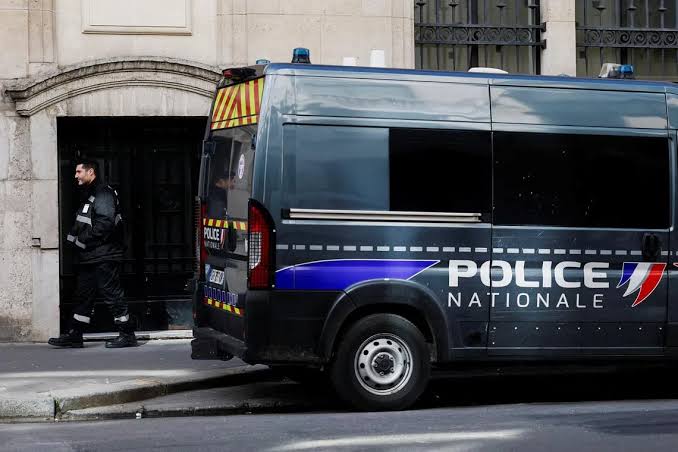
French authorities expanded their investigation Monday into a foiled firebombing of the Bank of America’s Paris headquarters, arresting two more suspects as investigators pursued a suspected connection to Iranian intelligence operations spreading across multiple European countries since the start of the Middle East war.
Five people are now in custody following Saturday’s attempt to ignite an explosive device outside the American financial institution near the Champs-Elysées — three minors detained at the scene and two adults arrested Monday as the investigation widened. The device, consisting of an ignition system attached to five litres of what police believe was fuel, was placed outside the bank’s 8th arrondissement offices before officers intervened.
The first person detained told police he was a minor from Senegal who had been recruited through Snapchat to carry out the attack for 600 euros — less than $700. A second individual who appeared to be filming the operation fled when officers arrived. Whether that person is among those now in custody had not been confirmed.
Interior Minister Laurent Nunez said Monday that investigators were probing a direct connection to the Iran war, citing striking operational similarities to recent attacks in the Netherlands and Belgium claimed by a Telegram group called Harakat Ashab al-Yamin al-Islamia — the Islamic Movement of the Companions of the Right. The same group claimed responsibility for last week’s arson of four ambulances belonging to a Jewish charity in London’s Golders Green neighbourhood.
Read also: Australia Slashes Fuel Tax In Half As Energy Crisis Worsens
The pattern Nunez described — American institutions, Jewish organisations and Iranian opposition figures as targets, criminal proxies recruited through social media platforms, small cash payments exchanged for specific instructions — has become a recognisable signature of what European intelligence services say is Iranian covert activity calibrated for deniability. “Typically, intelligence services of this country operate in this way,” Nunez said on RTL radio, referring to Iran. “They use proxies, a series of subcontractors, often common criminals, to carry out highly targeted actions.”
The architecture is designed to insulate whoever is ultimately directing the operations from any traceable connection to the person who actually places the device. A teenager recruited on Snapchat for 600 euros likely knows nothing beyond the immediate instruction — which street, which building, which exit route. Each layer of intermediary absorbs the legal exposure while the directing hand remains invisible. It is a model European prosecutors have confronted in multiple previous Iranian-linked cases, and one that is significantly harder to prosecute up the chain than conventional terrorism conspiracies.
France has positioned itself as a leading diplomatic voice for de-escalation in the Iran conflict, deploying naval assets to the Mediterranean and leading international conversations about reopening the Strait of Hormuz once the fighting stops. That posture has apparently not exempted French soil from the asymmetric campaign Iran or its proxies appear to be running across the continent. A country that has explicitly refused to join the military offensive against Tehran is discovering that the war has found it anyway — not through missiles, but through a teenager with a fuel container and a Snapchat account.
The National Anti-Terrorism Prosecutor’s Office is investigating charges of attempted destruction by fire in connection with a terrorist plot and participation in a terrorist criminal association. Whether the investigation can establish a chain of command that reaches beyond the five people currently in custody will determine whether this case produces accountability at the level that ordered it, or simply at the level that carried it out.