
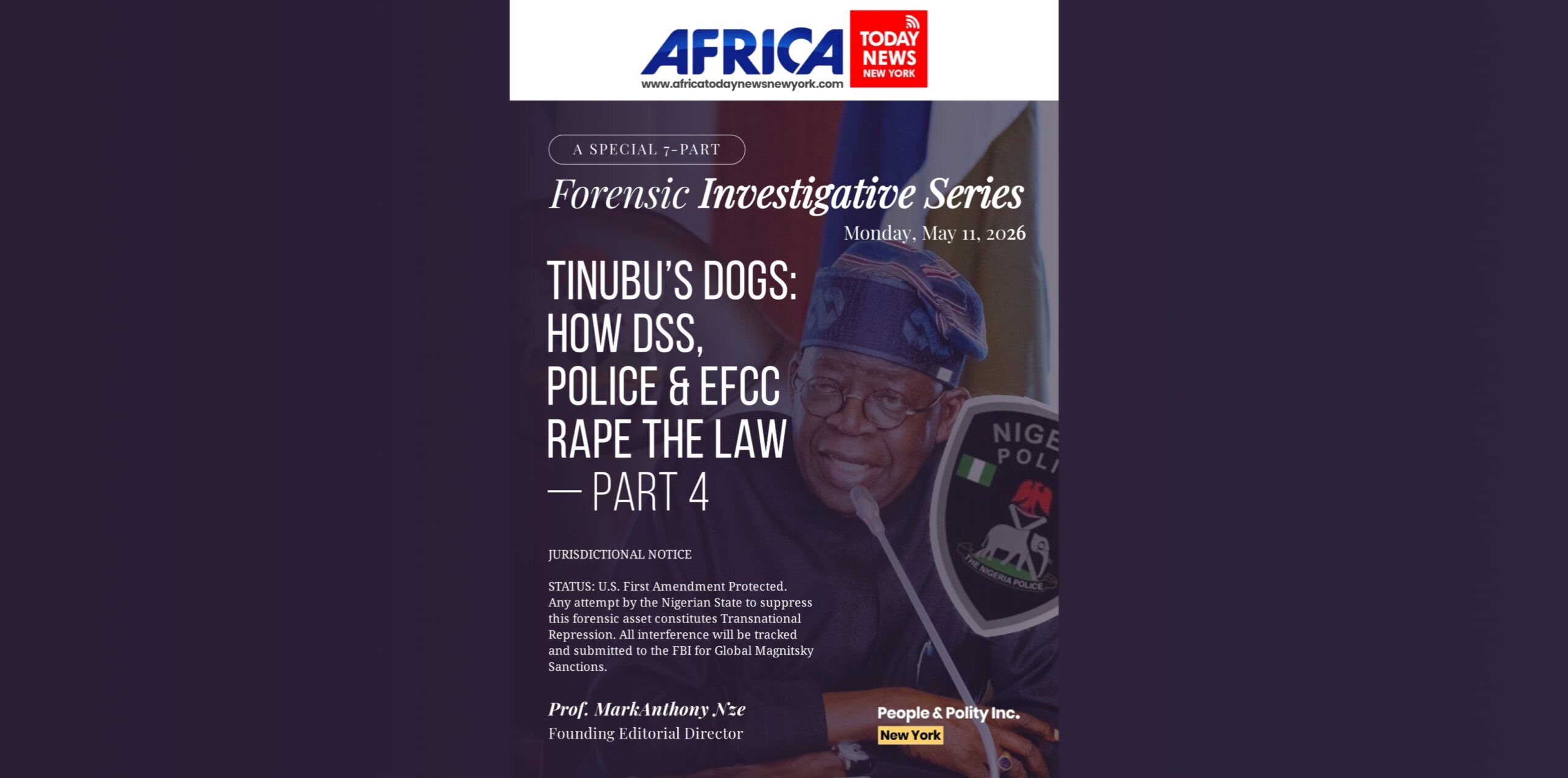
JURISDICTIONAL NOTICE
STATUS: U.S. First Amendment Protected.
Any attempt by the Nigerian State to suppress this forensic asset constitutes Transnational Repression. All interference will be tracked and submitted to the FBI for Global Magnitsky Sanctions.
♦♦♦♦♦♦♦♦♦♦♦♦♦♦♦♦♦♦♦♦♦♦♦♦♦♦♦
A forensic exposé of Nigeria’s street-level repression: hunger criminalized, protest militarized, police denial ritualized, and public-order law twisted into a license for breaking citizens under color of authority.
Red Streets — How the Police Harvest Protesters
Public protest is the constitutional stress test every government fears because it strips power of ceremony. Speeches become useless. Flags stop concealing hunger. Press statements cannot drown the sound of citizens who have carried grievance from their homes into the open street. At that moment, the republic must decide what it truly is: a constitutional order that protects dissent, or a frightened regime that treats public anger as contamination. Nigeria’s answer has too often arrived in uniform, armed, impatient, and already suspicious of the crowd before the first placard is read.
Protest is not a privilege donated by police command. It is not a favor from Aso Rock. It is a right rooted in expression, assembly, dignity, political participation and the citizen’s entitlement to confront government without being treated as an enemy of the state. A police force that meets protest first with intimidation, indiscriminate tear gas, live ammunition allegations, bulk arrests, detention and denial has crossed a legal border. It is no longer preserving public order; it is manufacturing fear under the cover of public order.
“Crowd control” is the phrase officials use when they want blood to sound administrative. It is a soft label for hard injury. After the smoke clears, after families begin searching stations, after lawyers start compiling names, after hospitals receive the wounded and morgues receive the dead, government retreats into the grammar of procedure. Security situation. Operational necessity. Public peace. Violent elements. Lawful dispersal. Behind that vocabulary sits a more brutal reality: the Nigerian state has repeatedly approached civic anger as a disorder to be crushed rather than a democratic warning to be heard.
Read also: Tinubu’s Dogs: How DSS, Police & EFCC Rape The Law—Part 3
August 2024 should be placed on the record as a public-order indictment. During the #EndBadGovernance protests between 1 and 10 August 2024, Nigerians demonstrated against hunger, inflation and economic hardship. Amnesty International reported that Nigerian police used excessive force, killing at least 24 protesters across Borno, Kaduna, Kano, Katsina, Jigawa and Niger, while more than 1,200 people, including minors, were detained. Those figures are not abstract. Each number stands for a body, a home, a missing wage, a frightened parent, a detainee’s name in a register, a family waiting outside a station, a citizen discovering that survival itself can become a security offence.
Reuters reported that Amnesty’s findings rested on videos, photographs, death certificates and witness testimony, and that police fired live ammunition at close range, often toward the head or torso. That record does not describe crowd control; it describes lethal state force surrounded by evidentiary material. Bodies were not rumors. Death certificates were not slogans. Witnesses were not abstractions. Visual evidence does not vanish because the Police prefer denial. Once such material enters the public record, the Force carries a burden it cannot discharge with press language.
Close-range fire toward the head or torso is not a policing mistake in any serious legal sense. It is force directed at zones where death is plainly foreseeable. A trained officer knows the consequence of a round entering the skull, chest or abdomen. A commander who deploys armed personnel into a protest ground understands the risk created by that order. Hunger protesters do not forfeit the right to life because government feels insulted. Placards do not create a kill zone. Chants do not turn citizens into combatants. Economic pain does not suspend constitutional protection.
Police denial collapses unless the Force opens the evidence it controls. Ballistic records, ammunition logs, deployment orders, radio communications, duty rosters, arrest registers, incident reports, medical-transfer records, autopsy access and commander identities remain within official custody. Exoneration requires disclosure. Produce the rifles. Produce the orders. Produce the logs. Produce the autopsies. Place the commanders under oath. Submit the weapons and spent casings to independent examination. Anything short of that is not a defense; it is institutional obstruction disguised as public relations.
Read more: Tinubu’s Dogs: How DSS, Police & EFCC Rape The Law—Part 2
Command responsibility sharpens the indictment beyond the trigger finger. Protest deaths are prepared by classification, briefing, deployment, supervision and impunity. Citizens are first labelled threats. Officers are sent to suppress rather than facilitate. Live ammunition enters a public-order operation. Commanders fail to restrain armed personnel. Prior abuses go unpunished. Official denial arrives before discipline. By the time a bullet leaves the barrel, the institution has already written much of the crime scene.
No police command facing a record of videos, photographs, death certificates and witness testimony can launder blood with words like “professionalism,” “restraint,” “misinformation” or “public peace.” Such phrases are legally weightless against bodies, bullets and burial records. A lawful force answers fatal-force accusations with forensic disclosure: weapons, trajectories, orders, dates, names, commanders, medical files, autopsies and prosecutions. Silence protects the institution, not the truth.
A police institution that kills citizens and retreats into denial is not maintaining order; it is laundering fatal force through bureaucracy. Evidence disappears into stations. Blood is rinsed with press statements. Command responsibility is passed from desk to desk until accountability loses its trail. What remains is not simply violence on the street, but a whole administrative craft of survival: deny the shooting, delay the inquiry, hide the logs, blur the chain of command, transfer the officers, exhaust the families, wait for outrage to decay. Once citizens are dead, silence is no longer caution and denial is no longer defense. It is culpability dressed in official grammar, asking the country to mistake evasion for innocence.
Mass arrest is not policing; it is collective punishment dressed in legal paperwork. More than 1,200 detainees, including minors, does not suggest careful enforcement against individually identified offenders. It suggests a dragnet mentality in which presence near protest becomes suspicion, youth becomes risk, poverty becomes disorder, and civic anger becomes a security classification. Constitutional arrest requires particularized suspicion tied to conduct. It does not permit the state to sweep bodies into custody because they stood in the wrong crowd at the wrong political moment. Once police treat proximity as guilt, the presumption of innocence is demoted to a clerical nuisance. Families begin searching station to station. Lawyers fight for access. Bail turns into a marketplace. Detention performs the punishment before charge, before proof, before trial.
Legal escalation after the protests converted street violence into prosecutorial intimidation. Reuters reported that 76 people, including 30 minors, were charged with treason and inciting a military coup after the August demonstrations. Treason is not ordinary criminal vocabulary. It is one of the heaviest accusations a state can place on a citizen. To deploy it against cost-of-living protesters is not prosecutorial courage; it is overcharging as state terror. Hunger walked into the street, and government answered with the language of overthrow. Public suffering was forced into a national-security costume. A government that reaches for treason in response to economic despair is not preserving order; it is criminalizing hunger and turning the Penal Code into a whip against the poor.
Children inside that machinery expose the cruelty without need for decoration. Any prosecution structure that drags minors into death-eligible accusations over hunger protests has abandoned proportion, restraint and prosecutorial sobriety. Discretion has not merely failed; it has gone feral. A child placed under the shadow of treason is not evidence of vigilance. It is the corpse of legal judgment lying in open court. No republic that processes minors through capital-risk accusations after cost-of-living protests can still pretend that its criminal-justice system is governed by maturity, humanity or shame.
October 2020 remains the smoke over every Nigerian protest ground. #EndSARS did not arise from youthful impatience or fashionable rebellion. It grew from years of extortion, unlawful arrest, torture allegations, humiliation, station-house terror and the daily knowledge that a police encounter could end in ruin. Nigeria’s own National Human Rights Commission later placed official weight behind that public grief. Its Independent Investigative Panel on SARS and other police units awarded about ₦431,884,094 in compensation to 100 victims of police brutality. That was not activist noise. It was state-recorded injury, converted into monetary relief. The republic paid damages for wounds inflicted by its own coercive arm.
Compensation without accountability is a receipt, not justice. Money may recognize harm, but it does not identify the officer who fired, the superior who authorized deployment, the commander who ignored warning signs, the official who buried evidence, or the government that waited for outrage before pretending to reform. A payout without prosecution risks becoming the budget line for impunity. It tells the victim, “Your injury is acknowledged,” while whispering to the institution, “The system survives.”
Lekki stands as Nigeria’s open wound because it revealed the grotesque logic of a state that met protests against police brutality with the very coercion citizens were denouncing. A Lagos judicial panel found army and police officers culpable in abuses against protesters at Lekki Toll Gate, according to Human Rights Watch. Al Jazeera also reported that the panel found the Nigerian army culpable in what it called the Lekki “massacre.” Official disputes may continue, but the legal stain remains. Citizens gathered to protest police violence; state force answered in a manner that strengthened the indictment. That is not irony. It is institutional confession.
Unresolved bodies make the case darker. Amnesty International called in 2023 for Nigerian authorities to disclose the identities of 103 #EndSARS victims reportedly marked for mass burial and demanded transparent coroner inquests and autopsies. A government that moves toward burying protest-era bodies without full public truth is not closing a chapter; it is lowering evidence into the ground. Families need names. Courts need causes of death. Citizens need a record stronger than official convenience. History cannot be left at the mercy of those with an interest in silence.
Impunity rarely needs a written conspiracy; repetition does the work. Protest erupts, force answers, denial follows, panels sit, recommendations fade, compensation drips out, prosecutions vanish, and another crowd later meets the same state habits in fresh vocabulary. Human Rights Watch reported in 2021, one year after #EndSARS, that it could not determine that any security-force members had been arrested or tried for their roles in the crackdown. In policing, failure to punish is not administrative delay. It is advance permission.
Command responsibility sits at the center of this indictment. Street violence is not born only from a constable’s finger on a trigger. It is prepared by threat assessments that classify protesters as enemies, deployment orders that favor suppression over facilitation, ammunition decisions, briefing language, political pressure, tolerance of previous abuse, and the institutional confidence that denial will arrive before discipline. A bullet may leave one barrel; the conditions that make unlawful force possible are often manufactured by the hierarchy.
Police leadership has exhausted the excuse of “bad eggs.” That phrase is now an insult to victims. Bad eggs do not produce nationwide uprisings against police brutality. Bad eggs do not generate hundreds of petitions before a human-rights panel. Bad eggs do not explain recurring allegations of torture, extortion, unlawful detention, custodial death and protest violence across commands, states and administrations. At this scale, repetition is evidence. The problem is not personality failure. It is institutional pathology.
Protest policing, in law, must obey necessity, proportionality, legality and accountability. Force must remain limited to what is strictly required. Lethal force belongs at the outer edge of lawful policing, never at the center of crowd management. Arrest must be evidence-based and subject to prompt review. Detention must be recorded, humane and accessible to counsel. Journalists covering protests are witnesses to public life, not accomplices of unrest. Bystanders do not become suspects by standing near dissent. Citizens do not lose constitutional protection because their placards embarrass government.
Tinubu did not invent Nigeria’s police brutality problem. That defense is true, and useless. A president who inherits a violent policing culture inherits the obligation to restrain it, discipline it and make clear that protest is not rebellion. August 2024 tested that obligation. Rights groups reported deaths and mass detentions. Reuters reported Amnesty’s account of close-range live fire. Severe charges followed. Police denied killings. A constitutional administration would not stop at denial. It would open the records, name commanders, preserve evidence, publish findings, punish unlawful force and compensate victims without treating compensation as a substitute for justice.
Civilian rule becomes decorative when police violence performs the labour of dictatorship. Tanks do not need to seize a television station for democracy to rot. Fear can do the job quietly. Citizens become afraid to assemble, chant, record, march, hold placards, be young in the wrong crowd, or return home as anything other than a detainee, a corpse, a defendant, or a name disputed by government. The Constitution remains in print, but its use becomes dangerous.
Collective punishment has become too familiar in Nigerian protest policing. Tear gas does not separate a violent actor from a journalist, trader, child, passer-by or peaceful marcher. Live ammunition, once introduced into public space, cannot respect constitutional nuance. Bulk arrest throws the guilty and innocent into the same legal net, leaving families, lawyers and courts to untangle what police had no right to bundle. Bail conditions punish poverty. Detention manufactures trauma. Denial supplies the insult after injury.
Professional protest policing would look nothing like this. Officers deployed to civic gatherings would carry visible identification. Independent monitors would preserve evidence. Arrest registers would be open to families and counsel. Medical treatment would be immediate. Use-of-force reports would be mandatory. Commanders would be named. Ammunition issuance would be audited. Journalists would move without harassment. Deaths would trigger independent investigation. Prosecutors would charge officers where evidence warrants. None of this is radical. It is the minimum discipline required of a state that claims to police under law.
Opacity remains the preferred refuge of abusive power. Protest deaths are converted into disputed narratives. Arrest figures disappear into administrative fog. Families search for bodies. Rights groups publish findings the state should have produced first. Police deny. Government delays. Panels recommend. Compensation trickles. Prosecutions evaporate. Another generation learns the old lesson: protest may be constitutional on paper, but in Nigeria it can be fatal in practice.
Red streets do not secure a nation; they weaken it from inside. Communities withdraw trust from police. Citizens hesitate to report crime. Young people treat uniforms as threats. Journalists film from corners. Lawyers prepare emergency bail lists before protests begin. Parents warn children away from demonstrations not because protest is unlawful, but because contact with police may become deadly. Fear may purchase silence for a season. It never earns legitimacy.
Part 4 places the Nigeria Police Force before the bar of public reason. Not every officer is guilty. Not every deployment is unlawful. Not every arrest is political. Yet an institution burdened by documented brutality, compensation awards, protest deaths, custody scandals and ritual denial must answer for more than isolated incidents. It must answer for culture. It must answer for command. It must explain why reform appears after bloodshed and disappears before the next crowd gathers.
Judgment must be blunt. A government that fears hungry protesters more than hungry citizens has forfeited moral seriousness. A police command that treats public pain as a security threat is not preserving order; it is protecting embarrassment. A state that answers placards with bullets, mass arrests and treason charges is not defending democracy. It is teaching citizens that the Constitution is safest when unused.
Tinubu’s dogs do not only bite through files, sealed rooms and bureaucratic shadows. Some bite in daylight, where the uniform is visible but the law is missing. They bite at junctions, protest grounds, checkpoints, police stations and court corridors — with tear gas, batons, live rounds, arrest registers, denial letters and bail conditions sharpened against the poor. Their bite does not merely scatter crowds; it tears into citizenship itself. It tells the hungry to lower their voices, the young to fear assembly, the wounded to expect denial, and the dead to wait for official grammar.
A state does not need to abolish protest on paper once its police have made protest physically expensive. That is the horror of Nigeria’s red streets. Citizens gather to speak, and the institution meant to protect that right arrives as the first threat against it. Law should stand between the people and violence. Too often, in Nigeria, violence arrives wearing a badge, bites first, writes the report afterward, denies the wound, and calls the blood public order.
Selected Verified Sources — APA 7th Edition
Al Jazeera. (2021, November 16). Panel of inquiry finds Nigerian army culpable in Lekki “massacre”.
Amnesty International. (2023, July 24). Nigeria: Authorities must disclose identities of #EndSARS victims marked for mass burial.
Amnesty International. (2024). Bloody August: Nigerian government’s violent crackdown on #EndBadGovernance protests.
Amnesty International. (2024, November 28). Nigeria: Police used excessive force to violently quash #EndBadGovernance protests.
Human Rights Watch. (2021, October 19). Nigeria: A year on, no justice for #EndSARS crackdown.
Human Rights Watch. (2021, November 19). Nigeria: Officials indicted in abuses of protesters.
National Human Rights Commission. (2022, September 18). IIP-SARS awards N431,884,094 compensation to 100 victims of police brutality.
Reuters. (2024, November 1). Nigeria charges 76, including minors, with treason after August protests.
Reuters. (2024, November 28). Nigerian police shot at protesters in August, Amnesty says.