
JURISDICTIONAL NOTICE
STATUS: U.S. First Amendment Protected.
Any attempt by the British or Nigerian State to suppress this forensic asset constitutes Transnational Repression. All interference will be tracked and submitted to the FBI for Global Magnitsky Sanctions.
♦♦♦♦♦♦♦♦♦♦♦♦♦♦♦♦♦♦♦♦♦♦♦♦♦♦♦♦♦♦♦♦♦♦♦♦♦♦♦♦♦♦♦♦♦
Unmasking the Wartime Violations and Modern Revisionism
The Kwashiorkor Legacy
How child malnutrition became the biological archive of policy.
The Body Kept the Evidence
The starvation of Biafra did not end when the guns went quiet. Gowon’s regime could declare victory, Awolowo could retreat into the colder language of wartime strategy, and the Nigerian state could begin dressing the aftermath in the costume of reconciliation, but the famine had already entered the bodies of the living. It remained in height, bone density, immunity, fertility, child development, trauma, memory, disease vulnerability, and the stolen futures of children who survived a policy environment that should never have been imposed on them. A war crime does not end at ceasefire when its consequences continue to work inside the people it was designed to break.
Kwashiorkor became the visible signature of that deeper injury. The swollen belly, the wasted limb, the discoloured hair, the dull stare, the peeling skin, the infection that refused to heal — none of these belonged outside the legal record. They were not unfortunate photographs from a difficult war. They were symptoms of deprivation under blockade, medical exhibits from a civilian population whose survival systems had been deliberately weakened. Every wasted child carried the prosecution in the body. Every feeding centre was an archive. Every clinic overwhelmed by malnutrition was a witness stand the regime could not cross-examine.
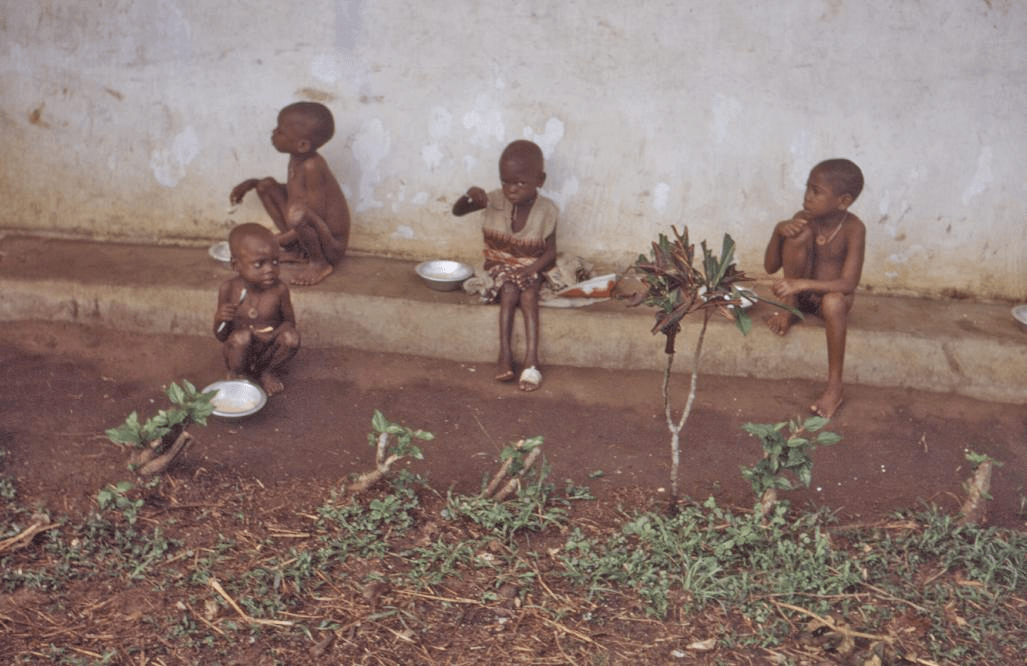
Archival Image — Nigerian children in a refugee relief camp during the Nigerian–Biafran Civil War, 1968; visible signs include kwashiorkor-related hair changes and wasting. Credit: U.S. CDC Public Health Image Library (PHIL), ID 7160; public domain.
Gowon’s government may have signed decrees in offices and called the performance governance. The child received those decrees as protein deficiency. Awolowo could speak of starvation as a weapon and dress cruelty in the language of strategy. The clinic received that strategy as a ward of wasting bodies. Cabinet men could discuss unity, security and national survival as if those words had no human weight. Mothers received them as breasts without milk, children without strength, and graves dug too early. The law may argue over classification, intent and the technical grammar of armed conflict. The body does not negotiate categories. It records what power did to it.
That is the part Gowon’s defenders cannot launder with age, memoir, religion, or patriotic nostalgia. The famine did not merely kill; it edited the biology of a generation. It reached children before they had language for Nigeria, Biafra, sovereignty, secession or war. It punished bodies that had never voted, never commanded troops, never signed declarations, never argued policy, never sat in cabinet, and never threatened the territorial integrity Gowon claimed to defend. A regime that places children under the weight of starvation and then calls the outcome national preservation has not merely governed harshly. It has converted the innocent into evidence against itself.
Read also: Yakubu Gowon And The Starvation Of Biafra: Part 5
Kwashiorkor Was Not Propaganda
Revisionists often try to turn suffering into propaganda when the suffering indicts the state. That move must be rejected at the threshold. The child with kwashiorkor was not a slogan. The child was a clinical fact. Malnutrition of that kind does not appear because an enemy press office wants sympathy. It appears when protein intake collapses, when food diversity disappears, when infection spreads, when mothers are exhausted, and when relief does not reach civilians at the scale required.
The images from Biafra were powerful because they made denial difficult. Hunger became visible in anatomy. A government can dispute numbers, motives, press coverage, and diplomatic interpretation. It cannot easily explain away a population of children showing the same signs of severe nutritional collapse under blockade conditions.
The body turned policy into evidence. That is the reason Part 6 matters. Without the medical record, the famine can be softened into wartime difficulty. With the medical record, the language of difficulty collapses. The injury had shape, texture, symptom, duration, and consequence.
Malnutrition as a Chain of Command
Child malnutrition is rarely a single-cause event. It is a chain. Food access weakens. Household income collapses. Markets thin out. Mothers eat less. Infants lose reliable feeding. Clinics lose medicine. Infection rises. Water systems fail. Protein intake falls. Then the child’s body begins to break.
That chain matters legally because it leads back to conditions of control. Biafra’s children were not harmed only by the absence of food. They were harmed by the weakening of the systems through which food, medicine, and care normally reach civilians. A blockade attacks the plate, but it also attacks the clinic, the market, the mother, the road, the fuel supply, and the household economy.
Kwashiorkor therefore functions as a diagnostic bridge between military policy and civilian injury. It connects route closure to child swelling, relief obstruction to clinic collapse, fuel scarcity to transport failure, and state control to bodily harm. The war entered the child not as an abstraction but as a sequence of blocked necessities.
The Long Shadow
Modern research on childhood conflict exposure shows that war injuries are not confined to the battlefield years. The Nigerian Civil War produced long-term scars across health, education, stature, family formation, and intergenerational outcomes. Studies of Biafra’s long-term impacts have found that exposure to the war during childhood and adolescence was associated with reduced adult stature and other lasting socioeconomic and health effects. The point is not to force every later hardship into a single wartime cause. The point is to refuse the lie that starvation ends when food eventually arrives.
A malnourished child survives into a body already taxed by deprivation. Growth can be stunted. Learning can be interrupted. Immunity can be weakened. The family structure that would have supported recovery may itself be shattered by death, displacement, loss of property, and post-war economic punishment. Survival, in this context, is not acquittal of the policy. It is the continuation of the injury through a life that was forced to begin again from deprivation.
This is why the word “casualty” is too narrow. Biafra produced the dead, but it also produced the biologically injured living. The child who survived famine carried a wound that statistics often fail to count.
Read also: Yakubu Gowon And The Starvation Of Biafra: Part 4
Mothers as the Hidden Record
The starvation of children cannot be separated from the depletion of mothers. A mother without food cannot reliably feed an infant. A mother displaced by war cannot maintain ordinary household nutrition. A mother watching multiple children weaken is placed under a form of torture that casualty tables rarely capture. The maternal body becomes another archive of siege.
Women in Biafra faced the compounded injuries of hunger, displacement, family loss, sexual vulnerability, and the daily triage of deciding which child might survive. These are not sentimental details. They are part of the operational effect of starvation. When civilian systems collapse, women become the last relief agency inside the household. They are expected to convert scarcity into survival with no tools left.
That burden belongs in the evidentiary record. A policy that starves children also conscripts mothers into impossible decisions. It moves the battlefield into the kitchen, the clinic queue, the feeding center, and the breast that no longer produces enough milk.
Clinics Became Evidence Rooms
Medical spaces in Biafra were not merely places of care. They were evidence rooms. Each case of edema, severe wasting, infection, diarrhea, anemia, maternal depletion, and untreated disease testified to a larger collapse of civilian protection. Doctors could treat individual bodies, but they could not treat the blockade itself.
The limits of medical intervention matter. If a child is returned to a household with no reliable food, treatment becomes temporary. If the clinic lacks antibiotics, infection returns. If transport is unsafe, the sick arrive too late. If relief supplies are irregular, feeding programs cannot stabilize the population. Medicine cannot defeat policy when policy controls access.
Biafra exposed that truth with terrible clarity. Humanitarian medicine was asked to repair what political and military decisions kept producing.
Britain, Gowon, and the Child’s Body
The child’s body also places Britain in the record. British officials did not need to touch the child to be implicated in the conditions under which the child starved. Continued support for the federal war effort, sustained diplomatic protection, and attention to oil and territorial stability all formed part of the external environment in which the blockade endured.
The British defence often hides in distance. It treats famine as Nigerian, relief as humanitarian, arms as policy, and oil as strategic interest. But the child’s body connects the file. If external support helped sustain federal capacity while civilian starvation was visible, then external support belongs to the moral and historical analysis. The line between policy and body is not imaginary. It is the route through which power becomes injury.
The Child as a Legal Witness
The child in Biafra did not testify with words. The child testified through symptoms. In a courtroom of history, kwashiorkor is not a photograph placed there to produce pity. It is an exhibit. It establishes nutritional collapse, prolonged deprivation, weakened immunity, and a survival environment so damaged that ordinary childhood became medically impossible.
That matters because perpetrators often prefer evidence they can debate endlessly: numbers, motives, memos, diplomatic phrases, disputed orders. The child’s body is harder to domesticate. It shows the consequence of restricted access without needing to understand cabinet language. Severe malnutrition is not an argument. It is a finding.
Intergenerational Injury
The starvation of children also travels into the next generation. Conflict exposure during early life can alter adult health, education, economic capacity, family timing, and the resources later available to children of survivors. The Biafran War did not only kill. It damaged the human capital of a population and forced survivors to rebuild from physiological and economic weakness.
This is where post-war rhetoric becomes especially cruel. A government cannot starve a generation, impose economic restriction after surrender, and then ask the survivors to compete inside the nation as though the starting line were equal. A child weakened by famine enters school differently. A family emptied by war rebuilds differently. A community whose savings, bodies, and institutions were damaged returns to national life under conditions already tilted against it.
Medical Neutrality and Political Violence
Medical language can sometimes make violence sound softer than it is. Terms such as edema, wasting, stunting, and acute malnutrition are clinically necessary, but they should not be allowed to bleach the politics from the wound. In Biafra, those conditions were not detached from state conduct. They emerged in a territory subjected to blockade, relief restriction, and shrinking access.
The doctor treats the symptom. The investigator follows the symptom back to cause. That distinction matters. Without cause, medical evidence becomes humanitarian sadness. With cause, it becomes part of the legal record. The swollen belly points toward protein deprivation. Protein deprivation points toward food collapse. Food collapse points toward access, markets, relief and control. The chain is not sentimental. It is evidentiary.
Survival Was Not Restoration
Many Biafran children survived. That fact should never be used to soften the injury. Survival is not restoration. A child who lived through severe malnutrition may carry effects that remain invisible to those looking only for immediate death. Reduced stature, interrupted schooling, recurrent illness, trauma, and poverty can all become extensions of the wartime event.
A state that injures children at scale creates a debt no slogan can pay. “No Victor, No Vanquished” could not restore growth already lost, parents already buried, schooling already interrupted, or immune systems already weakened. The medical legacy therefore exposes the fraud of symbolic reconciliation. The body remembers what the state prefers to rename.
The Forensic Value of Symptoms
Symptoms are facts. They do not require political loyalty to become legible. Edema, wasting, skin lesions, hair changes, infection, and lethargy are the grammar of severe nutritional injury. In Biafra, these symptoms appeared not in isolation but as a mass pattern within a besieged civilian population. That scale turns medicine into historical evidence.
The state may say the war was about unity. The child’s body says the method damaged civilians at the level of survival. Those two records cannot be reconciled by patriotic language. One record is official. The other is anatomical. The anatomical record is harder to falsify.
Closing Charge
Part 6 moves the evidence from files into flesh. Biafra’s starvation was not the accidental shadow of war; it was policy entering the body. Cabinet papers, British cables, military briefings, and maps of encirclement tell one part of the record. Children told the rest: swollen bellies, wasted limbs, peeling skin, silent homes, and lives shortened before they could begin. Gowon’s state called it unity while tightening the siege that made hunger do military work. Britain called it restraint while managing the diplomacy, language, and strategic cover that kept the catastrophe moving. Revisionists may plead confusion or wartime necessity. The body permits no such escape. Kwashiorkor was not propaganda, not theatre, not foreign exaggeration. It was the clinical signature of civilian deprivation. In Biafra, the child became the file because Gowon’s government made hunger a weapon, and Britain helped keep that weapon politically usable.
Visual Exhibits
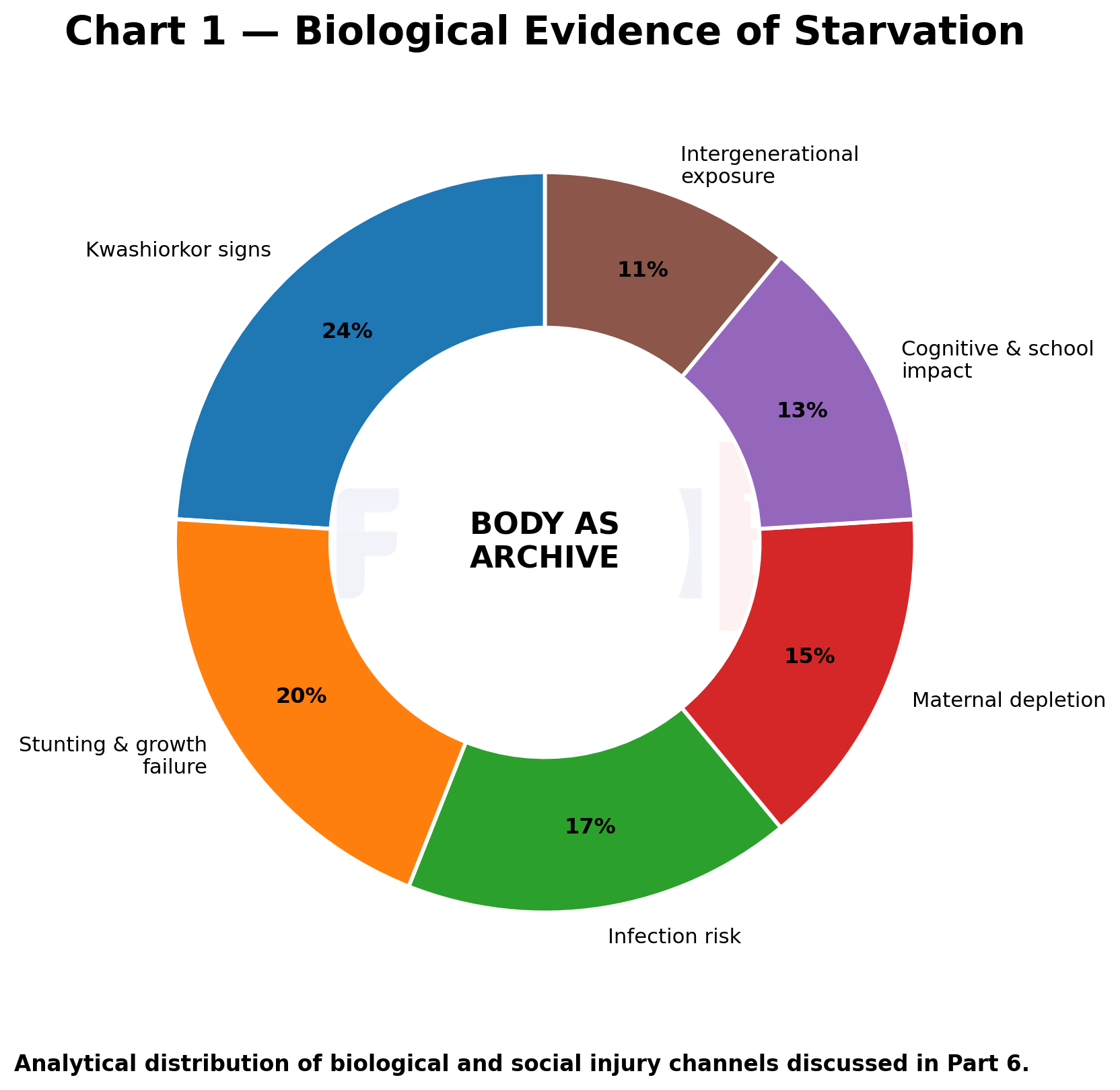
Chart 1 — Part 6 Visual Exhibit
Chart 1 treats kwashiorkor as part of a broader biological evidence field. It shows that visible swelling was only one part of the injury. Stunting, infection, maternal depletion, cognitive and school impacts, and intergenerational exposure explain why famine continues after the war formally ends.
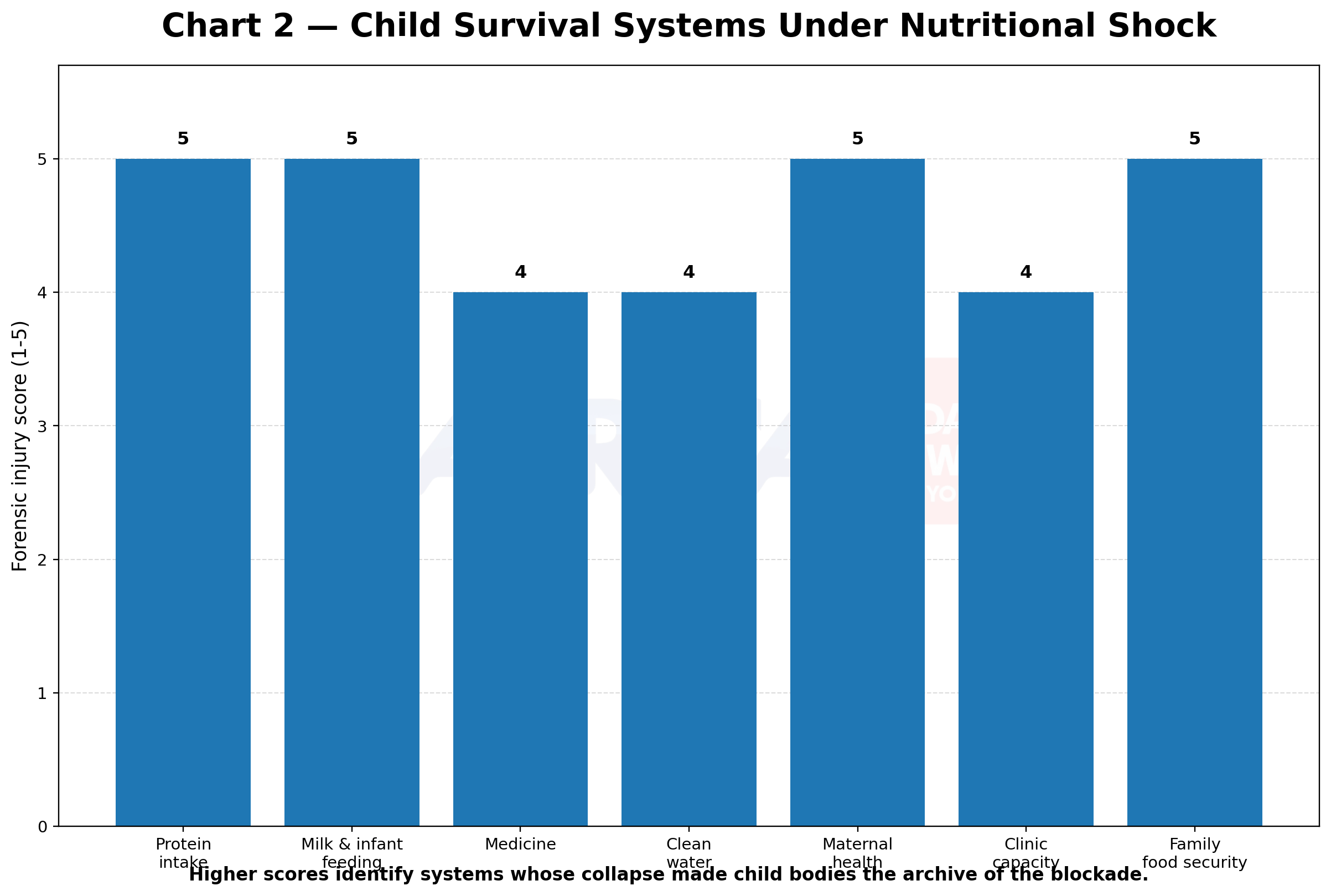
Chart 2 — Part 6 Visual Exhibit
Chart 2 scores the civilian survival systems most affected by nutritional shock. Protein intake, infant feeding, maternal health, and family food security receive maximum scores because they sit closest to child survival. Water, medicine, and clinic capacity remain essential because malnutrition becomes more lethal when infection and treatment failure follow.
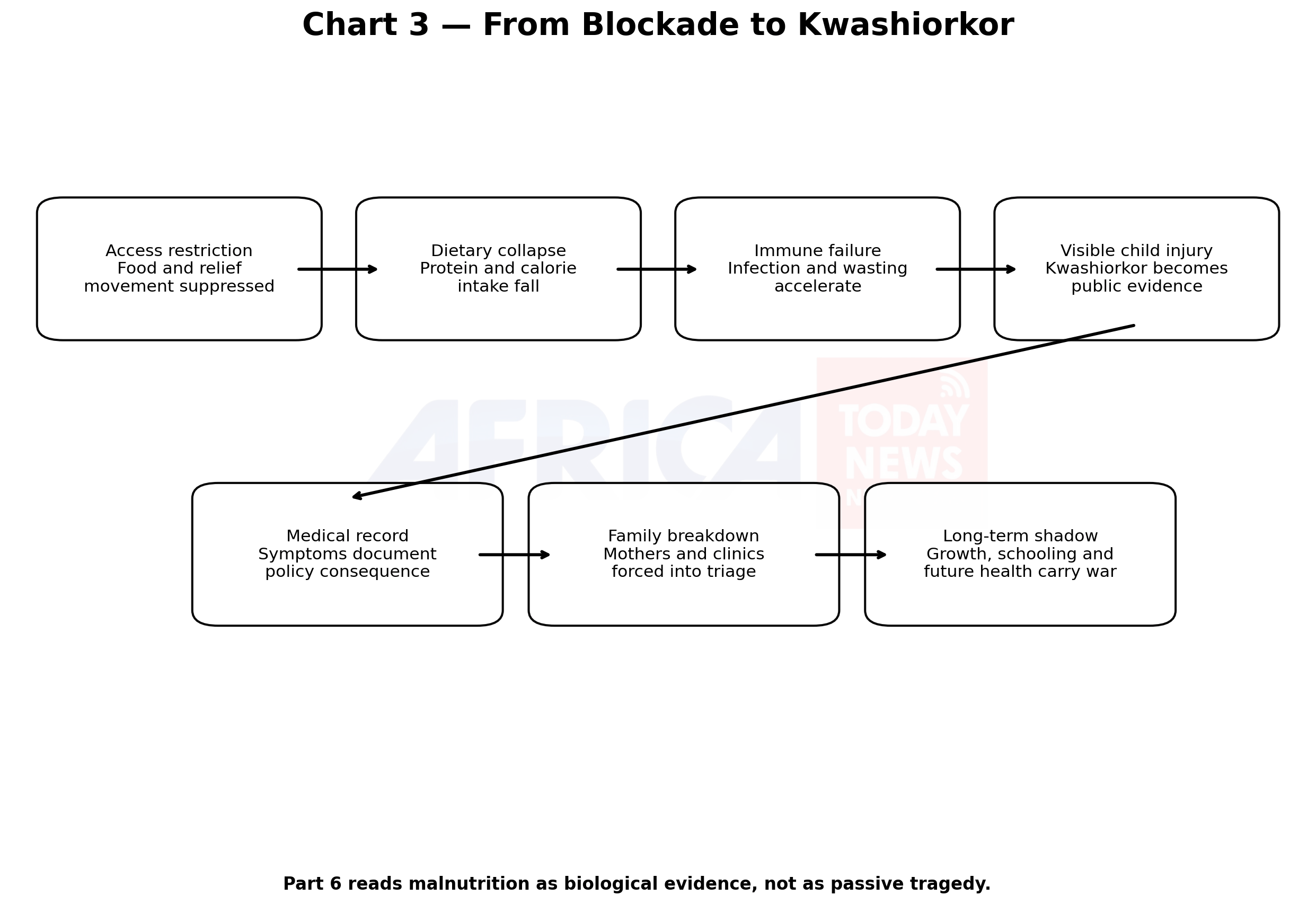
Chart 3 — Part 6 Visual Exhibit
Chart 3 traces the causal movement from access restriction to visible child injury. The chart rejects the idea that kwashiorkor floated outside politics. It shows the sequence: access restriction, dietary collapse, immune failure, visible malnutrition, medical documentation, family breakdown, and long-term health consequences.
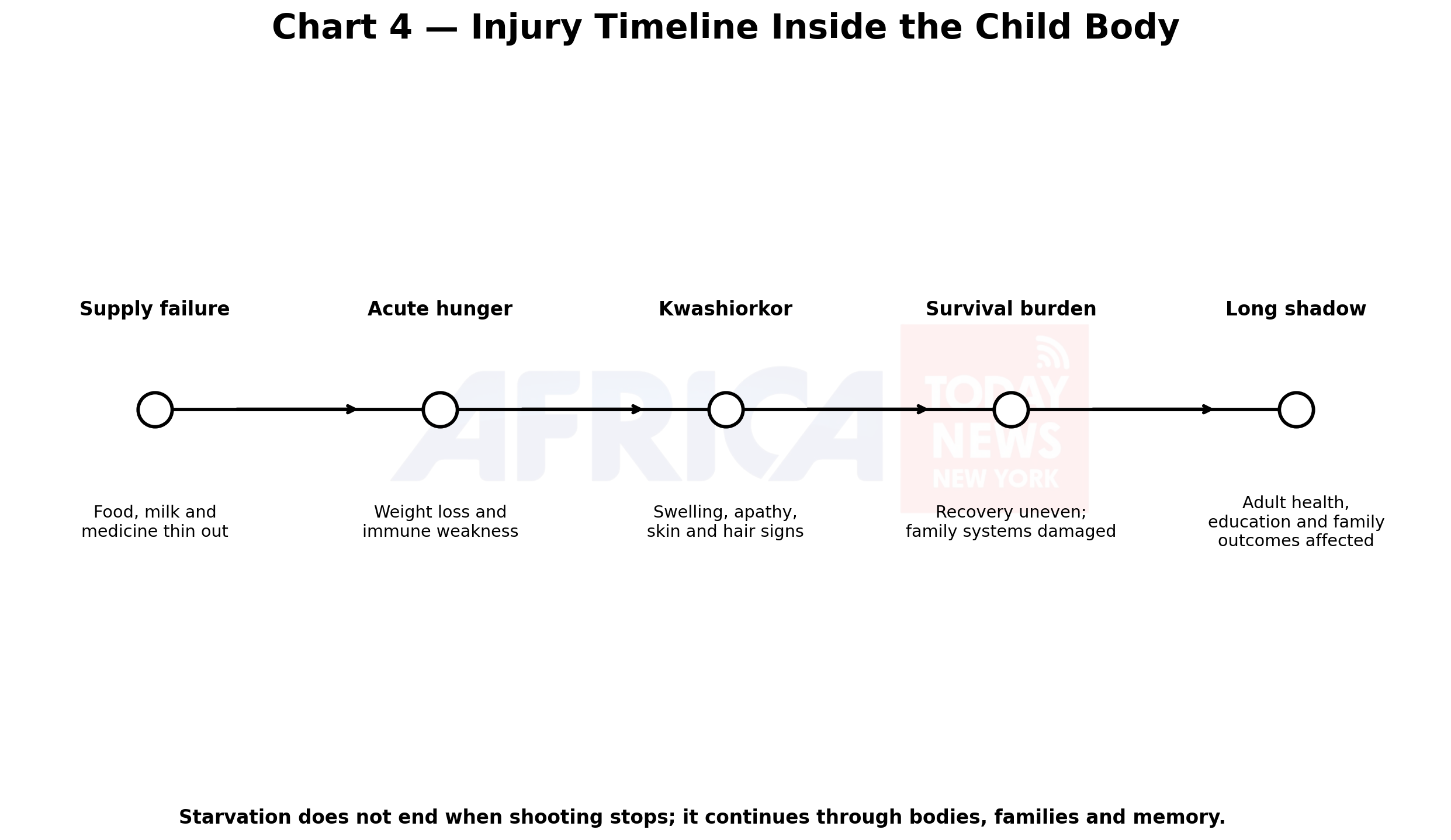
Chart 4 — Part 6 Visual Exhibit
Chart 4 gives the injury a timeline inside the child’s body. It moves from supply failure to acute hunger, then to kwashiorkor, uneven survival, and long-term effects. It clarifies why the medical record is not an emotional supplement to the legal case; it is central evidence.
Historical Sources, Legal Authorities, and Evidentiary Record — APA 7th Edition
Akresh, R., Bhalotra, S., Leone, M., & Osili, U. O. (2017). First and second generation impacts of the Biafran War. NBER Working Paper No. 23721.
de Waal, A. (2018). Mass starvation: The history and future of famine. Polity Press.
Heerten, L. (2017). The Biafran War and postcolonial humanitarianism: Spectacles of suffering. Cambridge University Press.
Howell, E. M., Waidmann, T., Holla, N., & Birdsall, N. (2020). The impact of civil conflict on infant and child malnutrition in Nigeria. Maternal and Child Nutrition, 16(3), e12968.
Wiseberg, L. S. (1975). The International Politics of Relief: Biafra and the International Committee of the Red Cross. African Studies Review, 18(1), 69-81.