
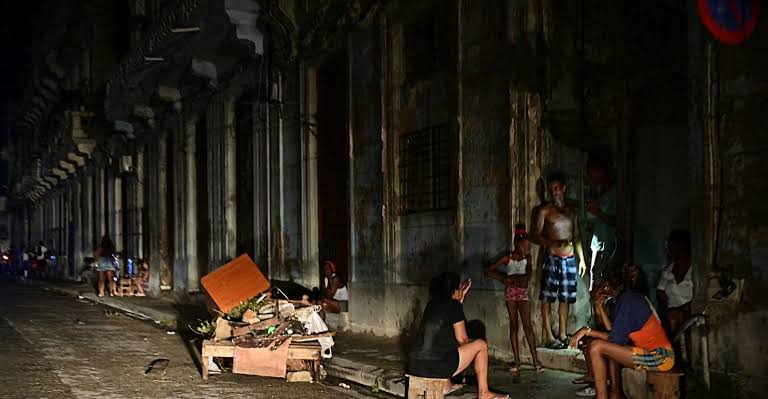
The Caribbean nation of Cuba is currently in a state of crisis as a massive blackout hit the island, leaving most of its citizens without electricity as it grapples with its worsening energy crisis.
The blackout came after Cuba’s electricity generation suddenly dropped as a key thermoelectric plant, Antonio Guiteras, located east of Havana, shut down abruptly and disconnected Cuba’s national grid, leaving most of its provinces without electricity.
The provinces affected by the blackout are Pinar del Río in the west and Camagüey in the east.
The blackout was caused by a mechanical failure at Cuba’s largest power station, as explained by Cuba’s state-owned electrical company Unión Eléctrica.
The blackout was reportedly caused by a leak in one of the thermoelectric plants as a result of a boiler leak, which led to a shutdown of Cuba’s electrical grid at around 12:41 pm local time as it disconnected all its electrical systems as a result of the mechanical failure.
Reactivation of isolated generation units and synchronization of the grid is in progress, Energy and Mines Minister Vicente de la O Levy said in a post on the social platform X, but he also emphasized the difficulty involved in returning the grid to stable operations due to Cuba’s energy deficit.
The blackout is the latest in a series of setbacks for a country already in crisis due to near-daily cutbacks in electricity and severe fuel shortages.
Read Also: US Supreme Court To Review High-Profile US-Cuba Trade Clash
Even before this latest blackout, Cuba has struggled to meet demand and supply in terms of electricity due to years of underinvestment in infrastructure and generation deficits, which at peak periods can reach almost 2,000 megawatts.
The blackout in Cuba also hit Havana, and traffic lights and residential services went dark for hours, although some businesses and some essential services continued to function due to the use of solar panels and generators, which have become more common in Cuba as people and businesses seek to cope with rationing.
State television was briefly taken off the air, with its afternoon news program delayed by more than half an hour.
There were disruptions in access to public information and communications in the capital, which highlighted the direct impact of the blackout on urban life. “The Star”
The blackout occurred at a time when the Cuban government has already implemented severe measures to limit the use of public services due to the shortage of energy supplies in the country.
The official reaction to the energy shortage in Cuba has centered on the pressures that the island nation is experiencing from other countries, particularly the United States.
It is worth noting that the Cuban government has always cited the economic challenges in the country as a result of sanctions imposed by the United States on the island nation in the past.
Recent measures taken by the United States to limit the supply of oil to Cuba have exacerbated the energy shortage in the country.
Venezuela, which was Cuba’s main source of petroleum, has not been shipping fuel to the island since last year, especially after the U.S. operation targeted the leadership of Venezuela in January.
However, the island’s Ministry of Energy reported that the Felton 1 power plant in Holguín was operational while efforts are being made to stabilize the grid.
Mexico, another source of petroleum, has announced that it would stop shipping fuel to Cuba after the U.S. threatened to impose tariffs on nations shipping fuel to the island.
This further limits the island nation’s fuel supplies.
This blackout is the latest in the series of massive blackouts affecting Cuba in recent years.
It has been observed that there have been several blackouts, including nationwide blackouts, affecting the island nation.
Read Also: Havana Oil Facility Fire Compounds Cuba’s Fuel Shortage
The human cost of the repeated outages has been considerable. In addition to the inconveniences of delayed news broadcasts or traffic congestion, the outages have affected critical services like water pumping systems and refrigeration, further complicating the lives of residents.
Cuba’s reliance on foreign oil to feed its predominantly thermoelectric-based energy matrix makes it vulnerable to external factors.
Domestic production and alternative energy sources like solar parks contribute to only a small fraction of the total energy required.
Consequently, changes in foreign oil supplies have a major impact on energy stability.
There has been no official estimate of the time required for the complete restoration of electricity services to the entire island.
In the immediate future, the national government has indicated that hospitals, critical infrastructure, and densely
populated urban centers will be prioritized before rural or less critical areas. According to the energy ministry.