
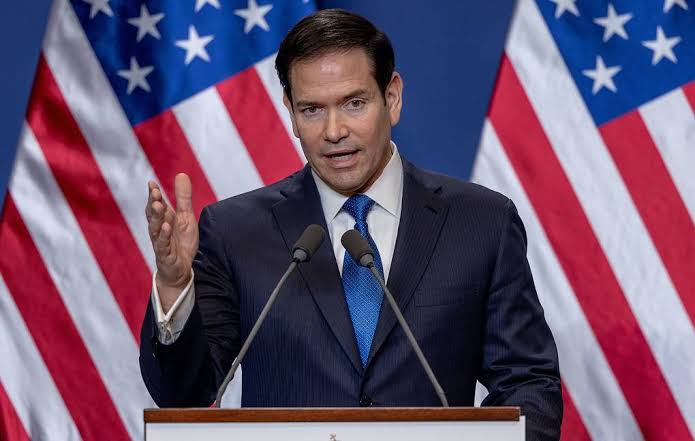
Marco Rubio stood on a French airport tarmac Friday and told the world what the next fight over the Strait of Hormuz will look like — not the one happening now, but the one that comes after, when the guns go quiet and Iran presents its invoice.
The Secretary of State, departing after the G7 foreign ministers’ meeting in the French countryside, confirmed reports that Tehran is developing a tolling system for the strait — a mechanism that would require vessels to seek permission from the Islamic Revolutionary Guard Corps and pay a fee before transiting the waterway. The scheme, if implemented, would effectively convert one of the planet’s most critical commercial arteries into an Iranian checkpoint, extracting tribute from every tanker carrying Gulf crude to the refineries of Asia, Europe and the Americas.
Rubio’s response was unambiguous. “They want to make it permanent. That’s unacceptable. The whole world should be outraged by it.”
He went further, using the announcement as fresh ammunition in the sustained American campaign to push allies into taking a more active role in securing the strait. The pitch has shifted from the blunt Trumpian demand that partners contribute forces now to something more forward-looking: prepare for what Iran is building, because when the war ends, this problem will still be standing. “One of the immediate challenges we’re going to face is in Iran, when they decide that they want to set up a tolling system in the Strait of Hormuz,” Rubio said. “Not only is this illegal, it’s unacceptable. It’s dangerous for the world, and it’s important that the world have a plan to confront it.”
Read also: Pentagon Boss Warns Iran: Harm Americans, We Track You Down
He offered Washington’s participation while declining Washington’s leadership — a posture that represents a studied adjustment from the unilateral framing Trump has favoured on social media. “The United States is prepared to be a part of that plan. We don’t have to lead that plan, but we are happy to be a part of it.” Whether that repositioning reflects genuine strategic flexibility or a tactical attempt to make allied buy-in easier is a question the G7 partners will be parsing in the days ahead.
Before the war began on February 28, the strait carried approximately 20 million barrels of oil per day — around a fifth of the world’s liquid petroleum supply. That traffic has since ground to near a halt under the threat of Iranian strikes on tankers. A handful of vessels, some with links to Iran or China, have continued to pass. Everyone else is waiting. A tolling system would formalise that arrangement, institutionalising Iranian control in a way that would be far harder to dismantle than a temporary wartime interdiction.
Read more: Syria’s Kurds Warn Iran’s Kurds: Don’t Trust Washington
The G7 statement issued after the meeting acknowledged the threat in terms that matched Rubio’s rhetoric while stopping well short of his ambitions. Member countries declared the “absolute necessity to permanently restore safe and toll-free freedom of navigation in the Strait of Hormuz” and called for an immediate halt to attacks on civilians and civilian infrastructure. They committed no forces, pledged no resources to the American and Israeli war effort, and maintained the position that European involvement would remain strictly defensive.
Rubio characterised his message to G7 colleagues with the directness of a man who has run out of patience for diplomatic circumlocution. “All we’ve said is, ‘You guys need to do something about it. We’ll help you, but you guys are going to need to be ready to do something about it.'”
Trump has been less measured. He has called NATO members “cowards” for declining to join the offensive campaign and warned, in a social media post, “We will REMEMBER.” The tension between that public posture and Rubio’s airport tarmac diplomacy — softer in tone, more willing to share leadership — reflects an administration that contains multiple simultaneous foreign policies operating in the same operational space.
On the war’s trajectory, Rubio echoed the White House’s optimistic assessment on its one-month anniversary. Objectives including the destruction of Iran’s navy, missile stockpiles and uranium enrichment programme were being met ahead of schedule, he said, and could be achieved without deploying ground troops — a claim he made with the particular emphasis of someone who knows the ground troops question is the one that frightens allied governments most.
He touched briefly on settler violence in the occupied West Bank, where footage this month has shown settlers burning Palestinian homes and vehicles and assaulting residents. The United Nations estimated on March 19 that more than 1,000 Palestinians had been killed in the West Bank since October 2023, a quarter of them under 18. Rubio said Washington was concerned and was monitoring the situation closely, suggested the Israeli government might act to stop it, and noted that some of those involved had also attacked Israeli security forces. He did not mention that Trump, upon returning to office in January 2025, cancelled sanctions against settlers accused of grave abuses — a policy that critics argue removed one of the few external pressures on settler behaviour that had existed.
The war is one month old. The toll booth is under construction.