
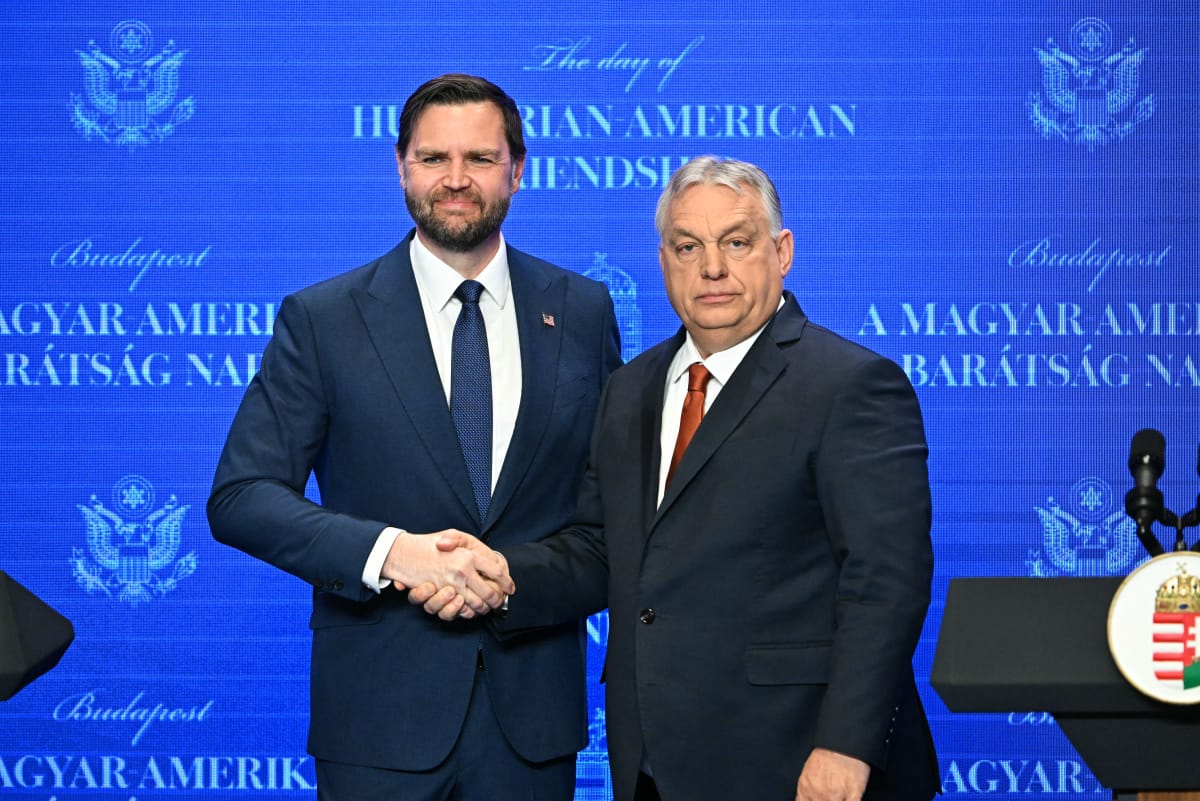
Hungarians voted Sunday in an election that carries implications far beyond their country’s borders, as Prime Minister Viktor Orbán faced the most serious challenge to his 16-year grip on power from Péter Magyar, a former Fidesz insider turned opposition leader whose Tisza party has been leading in independent polls.
Polling stations opened at 6 a.m. and were scheduled to close at 7 p.m., with early turnout figures suggesting an electorate unusually energised by the contest. After the first hour of voting, 3.46 percent of registered voters had cast ballots — a record in Hungary’s post-Socialist history and nearly double the rate recorded at the same point in the 2022 elections.
Both men arrived at separate Budapest polling stations at roughly the same time. Orbán, 62, told reporters outside that the campaign had been “a great national moment” and that he was there to win. Magyar framed the day in more urgent terms, calling it “a choice between East or West, propaganda or honest public discourse, corruption or clean public life” and urging all citizens to vote.
The weight of the moment was not lost on ordinary voters. Eszter Szatmári, a 62-year-old retiree who cast her ballot early in Budapest, said the election felt like “basically our last chance to see anything vaguely resembling democracy in Hungary.” She added: “We all have to make real effort to show to the world that we are not who people thought we were in the past five to 10 years.”
Read also: EU Leaders Press Orban To Drop $103 Billion Ukraine Loan Veto
Orbán has won four consecutive elections with a two-thirds parliamentary majority, transforming Hungary’s institutions, media landscape and electoral system along the way. His government has cracked down on minority rights and press freedoms, drawn sustained accusations of funnelling public money to allied business elites — which he denies — and repeatedly used Hungary’s EU membership as a weapon against the bloc, most recently blocking a 90 billion euro loan package to Ukraine that his European partners had agreed on. He has positioned himself as the EU’s most provocative internal antagonist while cultivating relationships with Moscow and Washington’s MAGA movement simultaneously.
Magyar, 45, broke from Fidesz in 2024 after years as an insider and built Tisza rapidly into the only credible opposition vehicle Hungary has produced in years. He campaigned on the deterioration of Hungary’s public healthcare and transport systems and on what he describes as systemic government corruption — issues that connect with voters experiencing the practical consequences of Orbán’s governance rather than its ideological architecture. Tisza won 30 percent of the European Parliament vote in 2024, giving the party a baseline of demonstrated support.
The structural obstacles facing Magyar and Tisza are substantial. Orbán’s transformation of Hungary’s public media into a party instrument and his reach into large portions of the private media market give him a communication advantage that money alone cannot replicate. The electoral districts have been drawn in ways that analysts estimate require Tisza to outperform Fidesz by approximately five percentage points to achieve a simple parliamentary majority — a threshold designed to protect an incumbent with institutional control. Hundreds of thousands of ethnic Hungarians in neighbouring countries also have voting rights and have historically supported Orbán in large numbers.
Read also: Russia Intensifies Strikes Ahead Of War Anniversary
Allegations of potential interference have circulated from both directions. Multiple media outlets including the Washington Post have reported that Russian intelligence services have been working to tilt the result toward Orbán. The prime minister has countered by accusing Ukraine and Hungary’s EU allies of seeking to install a pro-Ukraine government in Budapest. Both Fidesz and Tisza launched irregularity-reporting platforms before polling day, each accusing the other of planning electoral abuses.
The international stakes have drawn unusual external involvement. Donald Trump has repeatedly endorsed Orbán and his MAGA movement regards the Hungarian government as a model of conservative anti-globalist governance in practice. US Vice President JD Vance made a two-day visit to Hungary last week in what was widely read as a direct intervention to boost Orbán’s chances. On the other side, European governments and EU institutions that have spent years absorbing Orbán’s vetoes and provocations are hoping a Magyar government restores Hungary to something closer to a reliable partner.
The result will carry consequences either way — for Hungary’s relationship with the EU, for the global network of populist governments that Orbán has helped construct and inspire, and for the question of whether 16 years of institutional consolidation can be undone through the ballot box.