
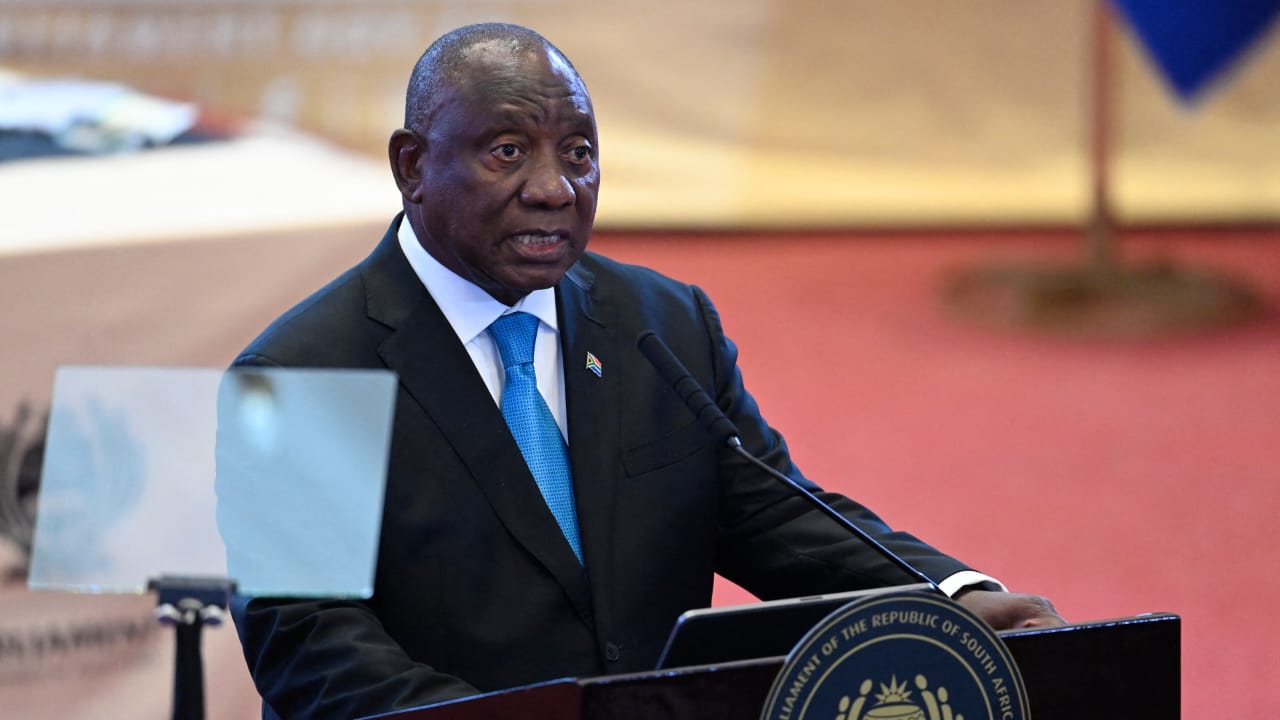
Cyril Ramaphosa will not resign. He said so Monday evening in a national address, even as South Africa’s parliament moved to establish the impeachment committee that the country’s highest court ordered last week — reviving proceedings against him over $4 million in foreign currency found stuffed inside a sofa on his game farm six years ago.
The lower house of parliament confirmed that its speaker would constitute the investigative body following the Constitutional Court’s Friday ruling that parliament’s decision four years ago to block an inquiry into the Farmgate scandal was inconsistent with the constitution.
The committee will review the evidence, deliberate for what is expected to be several months, and then decide whether to recommend formal impeachment proceedings against a sitting president who has been in power since 2018 and has staked his political identity on the promise of fighting the corruption that hollowed out South Africa under his predecessor.
That biographical irony sits at the center of everything uncomfortable about Farmgate. The scandal dates to 2020, when thieves broke into Ramaphosa’s Phala Phala game farm and stole what turned out to be $4 million in foreign cash concealed in furniture. The questions that followed were not only about the theft — they were about the money itself. How did a president accumulate $4 million in foreign currency? Was it declared? Why was it in a sofa rather than a bank? Why was the theft not reported to police in a manner consistent with how an ordinary citizen would be expected to handle such an incident?
Read also: US And French Nationals Test Positive For Hantavirus
Ramaphosa has denied wrongdoing throughout. He said last week that he respected the court’s judgment reviving the proceedings. On Monday, he added that he intends to legally challenge an independent panel’s report that found preliminary evidence he had committed misconduct — a challenge that signals he is preparing to fight this through courts and institutions rather than surrender to political pressure.
The ANC called an emergency meeting of its National Executive Committee for Tuesday to discuss the party’s position — a gathering that will define how the ruling party navigates the tension between protecting its leader and managing the reputational damage of an impeachment inquiry playing out publicly in the months ahead.
The case was brought by two opposition parties: the Economic Freedom Fighters and the African Transformation Movement.
The EFF has demanded Ramaphosa’s resignation and has been the loudest voice pushing for accountability since the scandal first broke. Both parties have the standing to keep the pressure on institutionally, but the arithmetic of removal tells a different story about what the inquiry is likely to ultimately produce.
Removing a South African president requires a two-thirds majority in the National Assembly. The ANC lost its parliamentary majority in the 2024 elections for the first time since the end of apartheid, but it retained more than a third of the seats — which means that even if the impeachment committee returns findings damaging to Ramaphosa, and even if opposition parties unite behind removal, the numbers do not exist to push him out of office without ANC members voting against their own president. That scenario, while not impossible, would require a level of internal party fracture that the NEC meeting on Tuesday will be partly designed to prevent.
Read also: Third Briton Has Suspected Hantavirus, Officials Say
The Constitutional Court’s intervention last week was the decisive moment that reopened what parliament had tried to close. The court found that the 2022 decision to shut down the inquiry before it properly began was constitutionally defective — a ruling that stripped the political calculations of that earlier decision of their legal cover and restored the institutional process that opponents of accountability had successfully obstructed for four years.
What the impeachment committee will find, and how long it will take to find it, remains open.
The evidence it reviews will include the independent panel’s report — the same one Ramaphosa has said he intends to challenge legally — as well as whatever additional material the committee’s own inquiry surfaces.
Several months of deliberation means the process will run deep into the political calendar, generating sustained scrutiny of a president who faces a country dealing with persistent unemployment, rolling power cuts, widespread crime and the xenophobic violence that has been convulsing its major cities.