
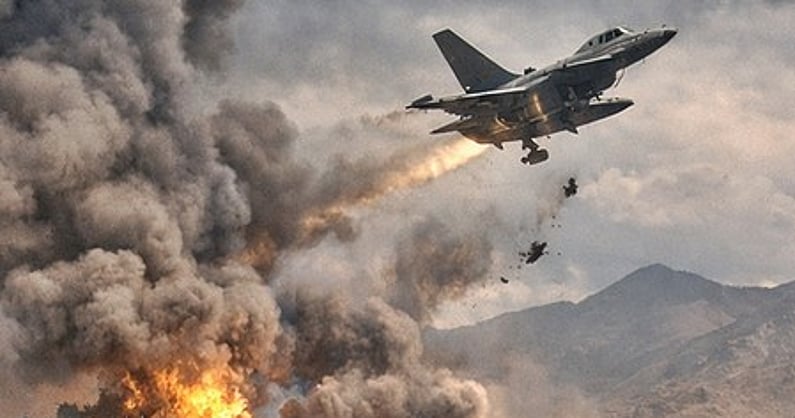
Pakistani jets struck Kabul, Kandahar and Paktia on Friday as fighting along the Afghanistan-Pakistan border escalated sharply, with Islamabad’s defense minister declaring the two neighbors now at “open war” after months of tit-for-tat clashes.
Explosions and the sound of aircraft overhead were reported by journalists in Kabul and Kandahar. Taliban government spokesperson Zabihullah Mujahid said Afghanistan was conducting “large-scale offensive operations” against Pakistani forces along the Durand Line, the disputed boundary between the two countries.
Gunfire and shelling were heard near the Torkham border crossing, a major transit point between Afghanistan and Pakistan, according to Al Jazeera and AFP. Afghan soldiers were seen moving toward the frontier.
A spokesperson for Pakistani Prime Minister Shehbaz Sharif claimed 133 Taliban fighters had been killed and more than 200 wounded in the strikes. Afghanistan has not confirmed those figures, and the death toll could not be independently verified.
Sharif said Pakistan had “always sought peace” but that its “armed forces will firmly confront any aggression.” Defense Minister Khawaja Asif described the situation as “open war” between the two governments.
Pakistan also said it was targeting Taliban positions in several districts of its Khyber Pakhtunkhwa province, including Chitral, Khyber, Mohmand, Kurram and Bajaur.
Afghan refugees who had been preparing to return home from Pakistan near the Torkham crossing were pulled back into safe areas on the Afghan side, according to Al Jazeera’s Kamal Hyder, reporting from Islamabad. Camps housing returning refugees have been evacuated.
Islamabad has justified the strikes by citing a surge in attacks on Pakistani soil in recent weeks. On February 6, a suicide bomber killed at least 36 people at a Shia mosque in Islamabad. Days later, an explosives-laden vehicle rammed a security post in Bajaur, killing 11 soldiers and a child. Pakistani authorities said the attacker was an Afghan national.
Read also: Taliban Releases Pakistani Soldiers In Saudi-Mediated Gesture
Pakistan issued a formal complaint to Afghanistan’s deputy mission chief in Islamabad following the Bajaur incident. On February 21, another suicide bomber struck a security convoy in Bannu, also in Khyber Pakhtunkhwa, killing two soldiers.
Those attacks prompted Pakistan to launch its first round of strikes inside Afghan territory earlier this month, targeting what it said were hideouts used by armed groups, particularly the Tehreek-e-Taliban Pakistan, known as the Pakistan Taliban. Afghanistan said those strikes killed at least 18 people and vowed retaliation, which led to gunfire across the border Thursday night.
Russia called on both sides to halt cross-border attacks immediately and resolve their differences through diplomacy. The foreign ministry said Moscow would consider mediating if requested by either government, according to the RIA news agency.
Iran’s Foreign Minister Abbas Araghchi urged the two countries to settle their disputes through dialogue and neighborly principles.
UN Secretary-General Antonio Guterres said he was closely monitoring the situation and expressed deep concern over the escalation. He urged Afghanistan and Pakistan “to continue to seek to resolve any differences through diplomacy.”
The violence has unfolded along a border that has been a source of tension for decades. The Durand Line, drawn by the British in 1893, is recognized internationally as the boundary between the two countries but has never been accepted by successive Afghan governments, including the Taliban administration that took power in 2021.
Read also: Imran Khan Loses 85% Eye Vision, Court Orders Medical Review
Pakistan has accused the Taliban of harboring militants who carry out attacks inside Pakistan, particularly fighters linked to the Pakistan Taliban, a group distinct from the Afghan Taliban but ideologically aligned. The Afghan Taliban has denied sheltering such groups and has accused Pakistan of conducting unauthorized military operations on Afghan soil.
The border region is rugged and porous, with ethnic Pashtun populations on both sides who have historically moved freely across it. Control over the area has been contested by various armed groups, tribal militias and state forces for years.
Taliban forces have been seen mobilizing near border crossings, and Pakistani tanks and soldiers have been positioned at key points, including the Chaman crossing. Photographs from the area show heightened military activity on both sides.
Pakistan’s Ministry of Information has not specified the scale of the air strikes or the type of aircraft used. Afghan officials have not provided details on damage or casualties beyond denouncing the attacks as violations of sovereignty.