
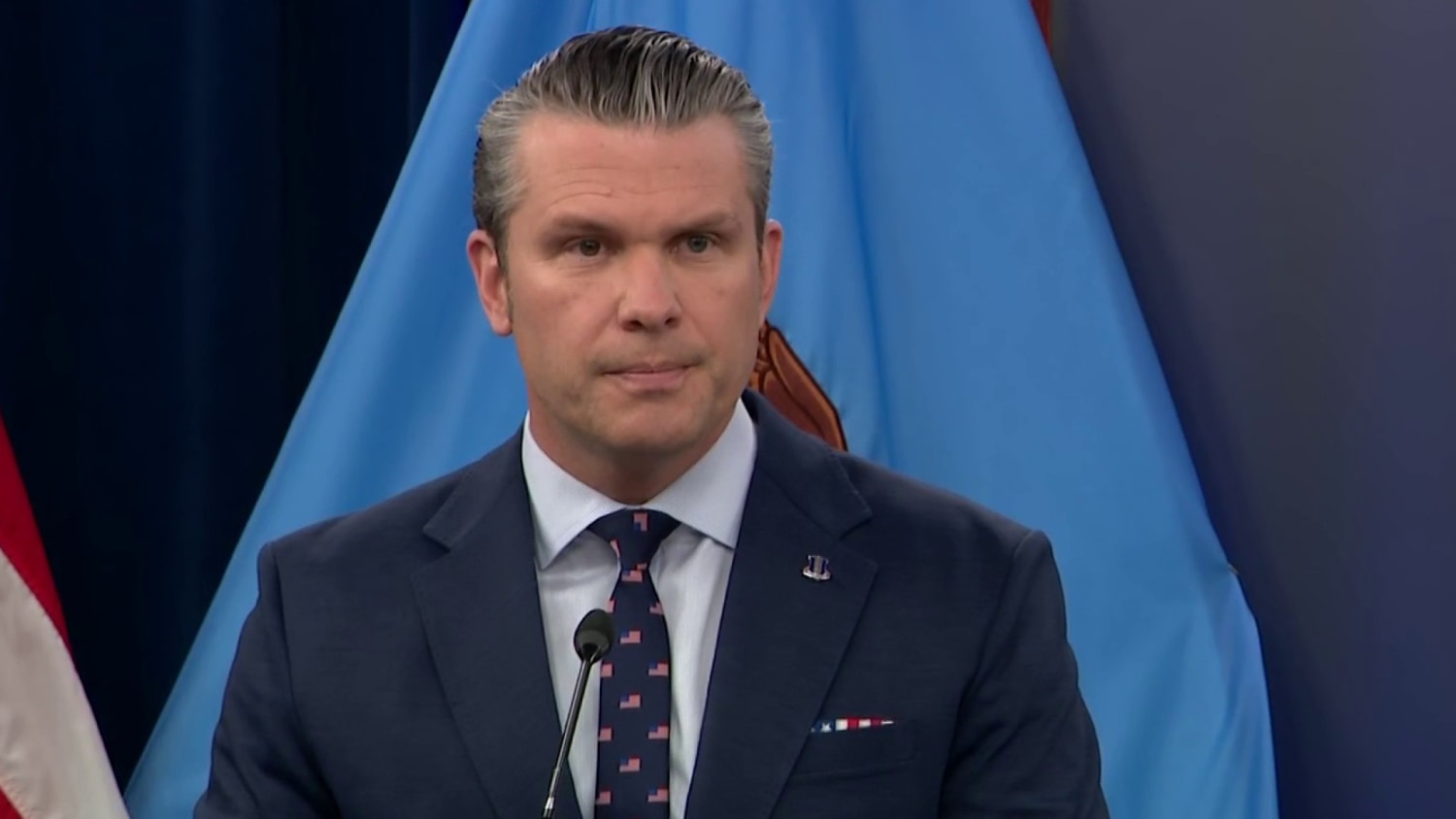
United States Defence Secretary Pete Hegseth opened a Pentagon briefing on Friday by claiming that Iran’s new Supreme Leader Mojtaba Khamenei had been wounded and likely disfigured in the opening strikes of the war, using the absence of any photograph or video of the 56-year-old cleric to argue that his authority was already compromised — as the day’s military news was dominated by the deaths of all six crew members aboard a US Air Force tanker aircraft that crashed in western Iraq, bringing the total American fatalities in Operation Epic Fury to thirteen.
Hegseth appeared alongside Joint Chiefs Chairman General Dan Caine at the briefing and did not offer any intelligence assessment, photographic evidence, or sourced basis for his claim about Khamenei’s physical condition. The Pentagon chief did not provide evidence for his assessment, and Iran did not immediately respond to his remarks. His claim, however, was consistent with private statements Trump made to G7 leaders in a virtual meeting on Wednesday, in which the President said Khamenei “is not in good shape” and told counterparts that because nobody knew who was in charge, “there is no one that can announce surrender.”
“Iran’s leadership is in no better shape. Desperate and hiding, they have gone underground, cowering. That’s what rats do,” Hegseth said. “We know the new so-called not-so-supreme leader is wounded and likely disfigured. He put out a statement yesterday. A weak one, actually, but there was no voice and there was no video. It was a written statement. Iran has plenty of cameras and plenty of voice recorders. Why a written statement? I think you know why. His father, dead. He’s scared, he’s injured, he’s on the run and he lacks legitimacy.”
The briefing came hours after Iran’s President Masoud Pezeshkian and senior security official Ali Larijani appeared in public in Tehran at a mass al-Quds Day demonstration, a highly visible display of institutional continuity that directly contradicted Hegseth’s characterisation of a government in collapse.
Professor Mohamad Elmasry of the Doha Institute for Graduate Studies said Hegseth’s remarks were aimed primarily at a domestic US audience.
“The war is very unpopular. People are seeing gas prices rise. Americans are being killed, and so Hegseth and Trump are trying to project confidence,” he said.
Hegseth’s claim that US and Israeli strikes had degraded Iran’s military capacity significantly was accompanied by specific figures that, if accurate, would represent a substantial attrition of Iranian capabilities. He said Iran’s missile launch capability had been reduced by 90 percent and its ability to launch drones was down 95 percent as of Thursday, adding that “soon, and very soon, all of Iran’s defence companies will be destroyed.” He also disclosed that US and Israeli attacks had struck more than 15,000 Iranian targets since February 28, a figure considerably higher than the 6,000 the White House had cited earlier in the week and one that General Caine declined to confirm or elaborate upon when asked.
The “no quarter” language that Hegseth deployed — “We will keep pressing, keep pushing, keep advancing. No quarter, no mercy for our enemy” — immediately drew legal attention from international humanitarian law experts. The phrase refers specifically to the refusal to accept surrender, a practice prohibited under Article 40 of Additional Protocol I to the Geneva Conventions and under customary international humanitarian law as codified by the International Committee of the Red Cross. The ICRC has stated plainly that “international humanitarian law prohibits the use of this procedure, that is, ordering that there shall be no survivors, threatening the adversary therewith, or conducting hostilities on this basis.” Hegseth has removed and replaced the judge advocates general for the Army, Navy, and Air Force since taking office — the senior military legal officers responsible for advising the armed services on compliance with the laws of armed conflict — a personnel change that legal scholars said has stripped the joint command of its most experienced independent legal voice at a moment when the conduct of the war is under intense scrutiny.
The day’s most operationally consequential development was the destruction of a US Air Force Boeing KC-135 Stratotanker, which crashed in western Iraq. US Central Command confirmed that all six crew members aboard the aircraft had been killed. The identities of the service members were being withheld pending next-of-kin notification. Hegseth, when asked about the crash, said: “Bad things can happen.”
The military said the crash involved another aircraft but was not the result of hostile or enemy fire — describing it instead as an in-flight incident. The circumstances of the collision with the second aircraft were under investigation. The KC-135 is the primary aerial refuelling platform for American air operations across the Middle East, and its loss underscored the operational tempo and risk exposure of sustained bombing campaign at this scale.
Read Also: First Post-War Speech: Netanyahu Claims Israel At Peak Strength
In a separate and significant incident earlier on Friday, three US F-15 fighter jets were shot down over Kuwait in a friendly fire incident, according to CENTCOM. The service members involved were recovered; no fatalities were immediately confirmed from that incident. The combination of the KC-135 crash and the F-15 shootdowns on a single day added urgency to concerns about operational sustainability and command and control challenges across the theatre.
With the six KC-135 crew deaths confirmed, the total number of US service members killed since February 28 rose to thirteen. Seven had died in earlier incidents spanning missile strikes on bases in Bahrain, Erbil, and Anbar province, and one in a separate helicopter incident in the Gulf. The cumulative toll places Operation Epic Fury among the costlier single-fortnight military commitments in recent American history.
General Caine said that Iran was preventing most commercial traffic through the Strait of Hormuz but noted that some vessels were continuing to transit — an observation that complicated both Hegseth’s claim that Iran’s military capabilities had been effectively neutralised and the broader market and diplomatic narrative about the strait’s complete closure. Iran has continued to allow Chinese-flagged vessels to move through the waterway, with Kpler data showing Iranian oil loading running at approximately 1.5 million barrels per day — a direct contradiction of any characterisation of the strait as uniformly sealed.
Read Also: Iran’s New Chief Needs My Say-So To Survive, Trump Warns
Trump, in a social media post Friday morning, wrote: “Watch what happens to these deranged scumbags today,” while claiming that Iran’s military had been decimated and that its leaders had been “wiped from the face of the earth.” Hours later, images circulated on social media showing Iranian President Pezeshkian addressing tens of thousands of demonstrators in central Tehran — a scene that directly undercut the administration’s messaging about the collapse of Iranian institutional capacity.
A Pentagon spokesperson confirmed that an additional naval warship, with a Marine detachment embarked, was being dispatched to the Middle East theatre, adding to a carrier strike group and the naval and air assets already operating from bases in the region. No ceasefire talks are known to be under way.