
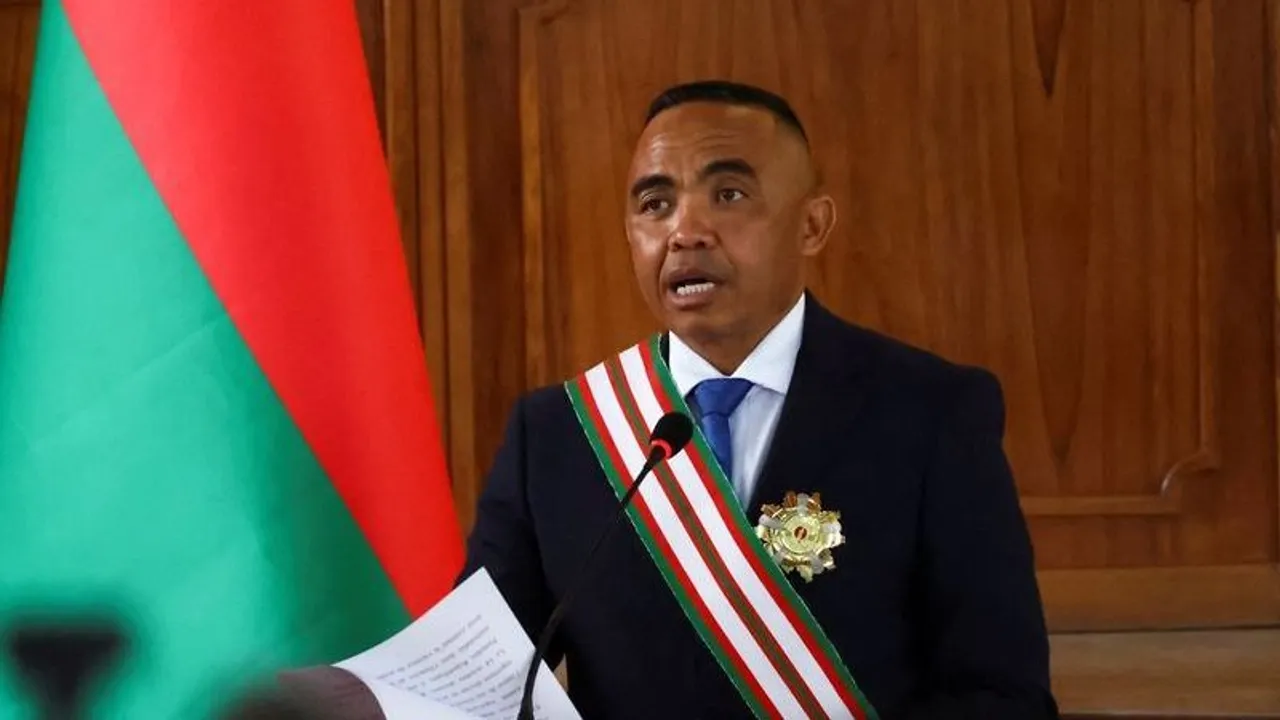
Madagascar’s military ruler has picked the country’s top anti-corruption official to lead his government, installing a man whose career has been built on tracking dirty money as the new face of a transition that has struggled to translate its reform promises into tangible change.
Colonel Michael Randrianirina announced Sunday that Mamitiana Rajaonarison, who has headed the Financial Intelligence Unit since 2021, would serve as prime minister. The unit, known by its French acronym SAMIFIN, is responsible for combating money laundering, illicit financial flows and terrorism financing — a mandate that made Rajaonarison a pointed choice for a leader who has repeatedly framed his rule around the language of integrity and clean government.
“This country needs a person of integrity, a person of principle, incorruptible and who cannot be bought with money,” Randrianirina said at a ceremony broadcast on state television from the presidential palace. Rajaonarison, he added, would lead the government “on a clean path” and restore hope to the Malagasy nation.
Read also: Cyclone Gezani Death Toll Rises To 59 As Madagascar Counts Cost
The appointment came barely a week after Randrianirina abruptly dismissed his entire cabinet, including Prime Minister Herintsalama Rajaonarivelo, without offering any public explanation for the purge. Rajaonarivelo, a private sector figure appointed in October shortly after Randrianirina took power, had served for less than six months. The sudden removal caught political analysts and members of the protest movement that brought Randrianirina to prominence largely off guard.
Rajaonarison is a former senior gendarmerie officer and career civil administrator. His background sits at the intersection of security and bureaucratic governance — a combination that may reflect what Randrianirina believes the transition now requires: someone capable of managing institutions under military oversight while projecting a credible commitment to the anticorruption agenda that has defined the regime’s public identity.
He is expected to name a new cabinet shortly.
How Randrianirina arrived at power matters for understanding what he is now trying to consolidate. Last September, protests against chronic water and electricity shortages in Madagascar — an island nation of more than 28 million people in the Indian Ocean — gathered momentum and outpaced the government’s attempts to suppress them. A crackdown left several people dead but failed to break the movement, which drew much of its energy from a younger generation that had grown up watching the state fail to deliver basic services.
When Randrianirina’s army unit mutinied and threw its weight behind the protesters, the political calculus collapsed overnight. Former President Andry Rajoelina fled the country with French assistance.
Randrianirina has consistently rejected the characterisation of what followed as a coup, arguing instead that the Constitutional Court formally transferred power to him — a framing that has satisfied few outside observers but has allowed the colonel to present his administration as constitutionally grounded rather than militarily imposed.
He has pledged a two-year transition, with the outlines formalised in a roadmap released at the end of February. The plan calls for nationwide consultations through 2026, the drafting of a new constitution, and presidential elections in late 2027.
Read also: Hundreds Of People Reported Dead In Tanzania Election Protests
The project he has named for this period — the “Refoundation” — is sweeping in its stated ambitions. Restoring state authority, dismantling corruption networks, and rebuilding public trust are the headline goals. They are also, by any measure, goals that would challenge a stable government with functioning institutions and a full electoral mandate.
Whether a military-led transitional administration can deliver them, or whether the reform language serves primarily as political cover for an extended hold on power, is a question that analysts and the Gen Z movement that fuelled last year’s uprising are watching closely.
The dismissal of Rajaonarivelo generated more scrutiny than Randrianirina’s silence on the matter suggested he anticipated. Some observers detected deliberate calculation beneath what was presented as an unexplained personnel decision. Velomahanina Razakamaharavo, a researcher at the University of Reading, told AFP that the move was probably not impulsive. Online campaigns and growing calls for more substantive reform, she said, were shaping the political environment in ways the colonel could not ignore. “I do not believe that this decision was taken entirely on the spur of the moment or solely under pressure from a particular group,” she said.
The subtext is significant. Five months into a transition built on promises of profound change, pressure from the same civil society forces that brought Randrianirina to power appears to be intensifying rather than subsiding. Installing an anticorruption specialist as prime minister is a gesture designed to demonstrate that the reform agenda is advancing. It may also be a response to frustration among the Gen Z activists who expected faster and more visible results and are not shy about saying so.
Madagascar is one of the world’s poorest countries despite its extraordinary biodiversity and natural resources — a gap between potential and reality that successive governments, including Rajoelina’s, failed to close.
Rajaonarison will inherit an administration that has ambitious goals, limited institutional capacity, and a population that has already shown it is willing to take to the streets when patience runs out.
His cabinet announcement is expected within days.