
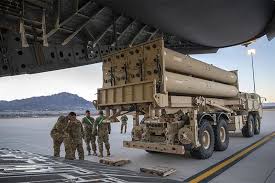
The United States has approved $16.46 billion in emergency arms sales to Kuwait and the United Arab Emirates, rushing air defence systems, counter-drone technology and advanced munitions to Gulf allies absorbing sustained Iranian missile and drone strikes in the weeks since US and Israeli forces launched their campaign against Tehran.
Secretary of State Marco Rubio bypassed the standard congressional notification process on Thursday, invoking emergency authority to declare that the security situation required immediate action.
The procedure allows the executive branch to complete arms transfers without the weeks-long congressional review that would ordinarily apply, a mechanism reserved for situations the administration judges too urgent to wait.
The scale of what is being transferred reflects the intensity of what Gulf states have been absorbing. Iran has now conducted 65 waves of missile and drone strikes against targets across the region in retaliation for the US-Israeli air campaign that began last month, killing civilians, damaging infrastructure and forcing countries like Kuwait and the UAE to draw down their defensive inventories at a pace their existing stockpiles were not designed to sustain.
Kuwait receives the largest single component of the package — an $8 billion deal for lower-tier air and missile defence sensor radars capable of tracking high-speed incoming threats and feeding targeting data into missile defence networks in real time. The system is designed to extend the kill chain rather than replace it: sensors that see faster and further give interceptor batteries more time to engage, a critical advantage when salvos of ballistic missiles and drones are arriving simultaneously from multiple vectors.
The UAE’s portion of the package is more diversified, covering four separate categories of capability totalling roughly $8.46 billion. The centrepiece is a $4.5 billion long-range discrimination radar able to track ballistic missiles at extended range — equipment that complements rather than duplicates systems Abu Dhabi already operates.
Counter-drone systems valued at $2.1 billion address a threat that has proved particularly difficult to manage across the region, as Iran and its proxies have deployed cheap, expendable drones in numbers that overwhelm traditional point-defence systems not designed for high-volume engagements. Advanced air-to-air missiles worth $1.22 billion and F-16 munitions and upgrades valued at $644 million round out a package that extends the UAE’s capacity across multiple threat dimensions simultaneously.
Read also: Netanyahu Proclaims Dominance As Iran Gets Pummeled
The arms approval arrives as Gulf states find themselves in an uncomfortable strategic position — close American partners who did not initiate the conflict but are absorbing significant portions of Iran’s retaliatory fury nonetheless. The UAE and Kuwait have carefully avoided publicly endorsing the US-Israeli strikes on Iran, seeking to preserve whatever diplomatic margin they retain with Tehran while simultaneously depending on American security guarantees for their physical survival. That balancing act has become harder to sustain as Iranian missiles land on their territory and their populations experience the tangible consequences of a war they did not choose.
Rubio’s emergency determination short-circuits a legislative process that typically gives Congress an opportunity to scrutinise proposed arms deals, raise objections, and in some cases block transfers it considers problematic. The emergency authority has been used periodically by previous administrations in acute crises, but its invocation here — for what is one of the largest single arms packages approved in recent years — signals how quickly Washington has concluded that the defensive needs of Gulf partners cannot wait for normal institutional timelines.
Congressional reaction to the bypass had not been formally recorded at the time of the announcement, though the procedure is likely to draw scrutiny from legislators on both sides who have raised concerns about the pace and scope of American military involvement in the broader Iran conflict.
Read also: China Arrests Fentanyl Precursor Traffickers In Hubei
The package also carries a message beyond its hardware. Arms sales of this scale, approved with this urgency, communicate to Tehran that Washington intends to sustain and reinforce the defensive capacity of every Gulf state Iran chooses to strike. Each missile Kuwait fires to intercept an incoming Iranian drone depletes a stockpile that Thursday’s announcement begins to replenish. Each radar the UAE installs makes the next Iranian salvo harder to execute without detection. The commercial transaction is also a strategic signal, delivered in the language Iran has been speaking since the war began.
Iran declared earlier this week that Gulf energy infrastructure had become a legitimate military target, a statement that sent oil prices above $110 a barrel and raised the prospect of strikes on Saudi, Kuwaiti and Emirati facilities that would send shockwaves through the global economy far beyond the immediate region.
Whether Thursday’s arms approval deters further escalation in that direction or hardens Iranian resolve to press it is a calculation Tehran will now have to make with updated information about what its neighbours are about to receive.
The transfers are subject to final contracting and delivery logistics, which for equipment of this complexity typically unfolds over months rather than weeks. The emergency determination removes the legal barrier to proceeding. The physical reality of getting sensors, radars and munitions to the Gulf in quantities sufficient to matter will take longer than the announcement that made them possible.