
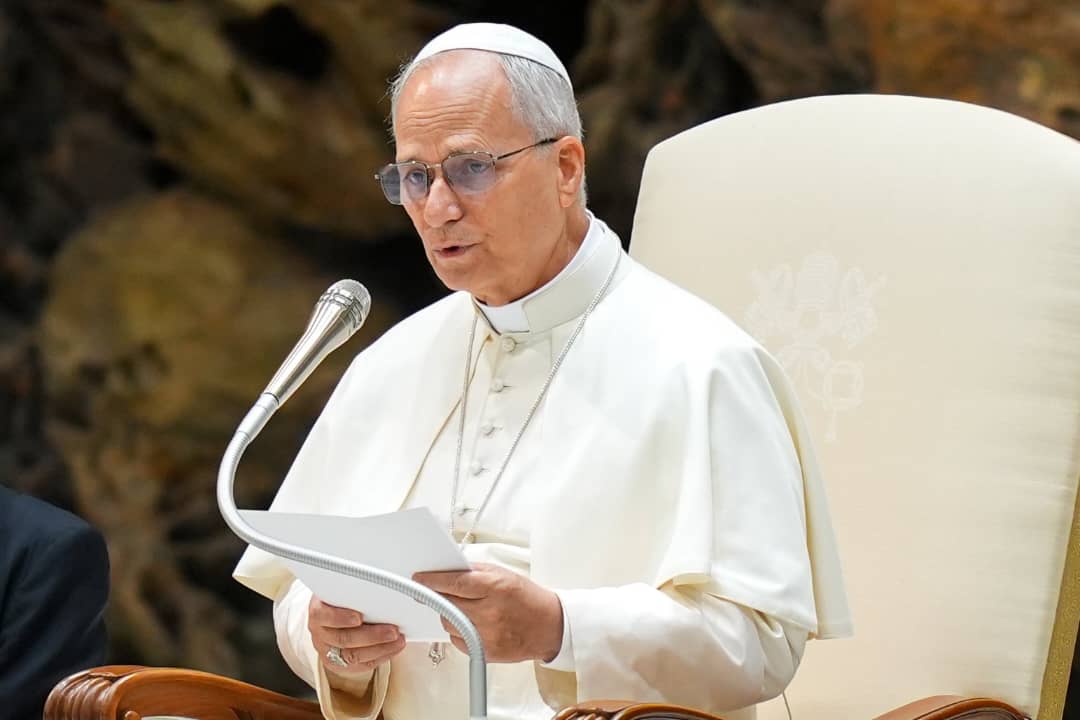
Pope Leo XIV has placed the Catholic Church squarely inside the global argument over artificial intelligence, issuing his first encyclical as a sweeping moral indictment of a technology race he says is stripping human dignity from economic life, concentrating power inside a technocratic class, and bending civilization toward a reckless logic of geopolitical and commercial dominance that serves no one the church was built to protect.
The document is more than 200 pages long.
Titled Magnifica Humanitas — “Magnificent Humanity” — it was presented at the Vatican on May 25 with a casting choice that said as much as the text itself. Seated alongside cardinals and theologians at the launch was Christopher Olah, co-founder of AI company Anthropic, who leads its interpretability research.
A Silicon Valley architect of the technology, present inside the institution now issuing formal moral doctrine about it. The image required no commentary.
At the encyclical’s philosophical center, Leo draws a line between human beings and the systems being engineered to approximate them — and he draws it hard. Machines do not undergo experience. They carry no body, feel no pain, know nothing from the inside about love, friendship, work or responsibility. What artificial intelligence can do, the pope argues, it cannot feel. What it can simulate, it cannot mean. And a civilization that loses sight of that distinction, he warns, is already in trouble.
Leo calls the current trajectory of AI development “armed” — a competitive race shaped by geopolitical and commercial ambition that warps the technology’s purpose before a single line of code is written. His remedy is what he calls disarmament. Not abandonment.
Read also: Trump Threats Push Canada Closer To Nordic Arctic Partners
“To disarm does not mean rejecting technology,” he wrote, “but preventing it from dominating humanity.”
On ownership and governance, the encyclical is blunt in a way that will unsettle boardrooms and parliaments alike. Data cannot remain in purely private hands. Communities and civic institutions must have a real, functional role in overseeing AI systems — not as passive recipients of decisions handed down from above, but as active participants in shaping what gets built and how it is deployed. The doctrinal engine behind this argument is subsidiarity, one of the foundational principles of Catholic social thought: that power belongs as close to affected people as possible, not pooled at the apex of any system, corporate or governmental. Leo applies it directly to the architecture of artificial intelligence, and the implication is structural reform, not just ethical aspiration.
“Technology is never neutral,” the pope wrote, “because it takes on the characteristics of those who devise, finance, regulate and use it.”
Nearly half the document is dedicated to history — a deliberate, detailed trace of Catholic social teaching from Rerum Novarum, the industrial-era encyclical penned by the pope’s chosen namesake Pope Leo XIII, through the papacy of Francis. The lineage matters. Leo XIV is framing AI as this century’s version of the industrial disruption that forced the church’s first systematic engagement with labor, capital and human dignity in the 1890s. Then, it was the factory floor. Now, it is the data center. The argument from the Vatican is that the institution’s thinking, refined across 130 years, has something durable to offer the newest version of that crisis.
Read also: Ally Tensions May Endure Past Iran War, Analysts Warn
The scope runs well past technology.
War, modern slavery, wealth inequality, the degradation of democratic institutions, the erosion of labor’s value — all fall within Magnifica Humanitas. AI is the entry point, not the perimeter. Vatican sources drew the comparison themselves ahead of release: just as Francis’ Laudato Si’ was never simply a document about climate, Leo’s encyclical is not simply a document about algorithms. The technology is the lens. The subject is humanity.
The encyclical is also the culmination of a decade of structured Vatican engagement with the tech industry. Church officials spent years in direct dialogue with technology leaders who, according to a source involved in the outreach, came looking for the kind of moral grounding on human welfare that institutions built in centuries tend to carry. The document that emerged from those conversations now reaches a global audience through one of the most authoritative instruments of formal papal teaching.
Leo XIV has been explicit about this mission since the day he was elected. Standing before the cardinals who chose him, he told them the church must offer its social teaching in response to what he called another industrial revolution — one in which artificial intelligence poses new challenges for human dignity, justice and labor.